
TL;DR
NASA’s TESS has found two unusually light, puffed-up planets in one star system. These ‘cotton candy’ planets are as large as Jupiter but have only a small fraction of its mass. The discovery highlights rare planetary formations and prompts further study.
NASA’s Transiting Exoplanet Survey Satellite (TESS) has identified two planets in the same star system that are remarkably light and airy, earning the nickname ‘cotton candy’ planets. These planets are as large as Jupiter but contain only a small percentage of its mass, making them some of the puffiest worlds ever observed. The discovery was made by a team led by George Dansfield of Oxford University, using data collected by TESS over seven years.
The two planets, designated TOI-791 b and TOI-791 c, are notable for their extremely low densities. TOI-791 b has a size nearly equivalent to Jupiter but only three percent of its mass, while TOI-791 c exceeds Jupiter’s size but weighs just 5.9 percent of Jupiter’s mass. These planets orbit their star with unusually long periods, which is rare for such large, low-density worlds.
Data analysis revealed that the planets tug on each other, affecting their transit timing around the host star. This gravitational interaction allowed scientists to calculate their masses despite their airy composition. The planets’ orbits and characteristics suggest they are among the rarest planetary types, with only a handful known so far.
Scientists are now aiming to learn more about their atmospheric composition and how their spin influences their shape. Understanding these ‘cotton candy’ planets could shed light on planetary formation processes, especially for such unusual worlds.
Implications of Discovering Rare ‘Cotton Candy’ Planets
This discovery is significant because it expands the known diversity of planetary types and challenges existing theories of planet formation. The existence of such low-density, Jupiter-sized planets suggests that planetary systems can produce and sustain extremely puffed-up worlds, which may influence models of planetary evolution and migration. Additionally, studying these planets can help scientists understand the mechanisms that lead to the formation of such airy, lightweight worlds, offering insights into the range of possible exoplanetary environments.

Thames & Kosmos My Discovery Telescope | Refracting Telescope with 12x Magnification | Compact & Portable for Land & Night Sky Observations | See The Moon, Planets, Wild Animals in Your Backyard!
- Magnification Power: 12x magnification for clear viewing
- Durable Build: Robust body and quality optics
- Protective Cover: Soft shell ocular lens cover included
As an affiliate, we earn on qualifying purchases.
As an affiliate, we earn on qualifying purchases.
Background on TESS and Puffiest Planet Discoveries
Launched in 2018, NASA’s TESS mission has been instrumental in discovering thousands of exoplanets by monitoring the brightness of stars for transits. It has identified nearly 8,000 planet candidates, with hundreds confirmed. Prior to this, only a few planets with similarly low densities had been observed, making these two in the same system particularly rare. The findings build on previous research into super puffy planets, which are characterized by their large sizes and low masses, often associated with specific conditions in planetary formation.
“The fact that these two extremely low-density planets are in the same system is an extraordinary find, and it challenges our understanding of planetary formation.”
— an anonymous researcher

ACADEMY ACA12402 Model Kit, Various for ages 14+
- Detailed model kit: Includes intricate parts for realism
- Glue and paints not included: Requires separate purchase
- Easy-to-follow instructions: Simplifies assembly process
As an affiliate, we earn on qualifying purchases.
As an affiliate, we earn on qualifying purchases.
Unanswered Questions About Composition and Formation
Scientists still do not fully understand the chemical makeup of these planets’ atmospheres or how their spin and orbital dynamics influence their shape and stability. It remains unclear whether these planets formed in their current state or evolved from denser worlds. Further observations are needed to clarify their origins and physical properties.

DIIOOMIEEU Rotating Star Chart Map Suitable for Astronomy Enthusiasts Schools Science Clubs Portable Stargazing & Planet Discovery
- Star Guide for Constellations: Learn constellations and bright stars
- User-Friendly Design: Aligns with date and time easily
- Versatile for Telescopes: Suitable for binoculars and telescopes
As an affiliate, we earn on qualifying purchases.
As an affiliate, we earn on qualifying purchases.
Future Observations and Research Directions
Researchers plan to use additional telescopes and spectroscopic analysis to study the atmospheres of these planets, aiming to determine their chemical compositions. Continued monitoring could reveal more about their orbital interactions and physical characteristics. These efforts will help refine models of how such ‘cotton candy’ worlds form and persist in planetary systems.
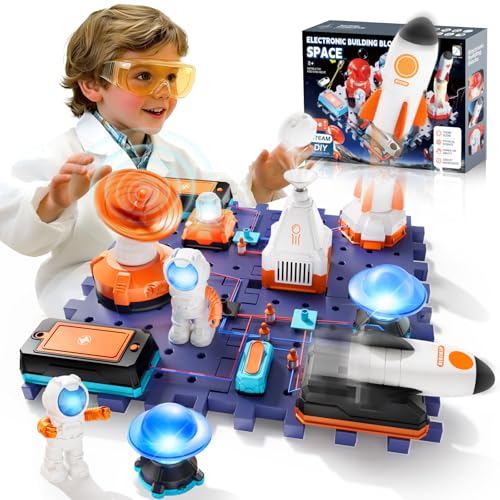
VATOS Space Science Circuit Kits for Kids – 31PCS Electronics Exploration STEM Kit with 100+ Projects, Rocket Launcher & Light Up Astronaut | Educational Learning Toy Gift for Boys Girls Ages 6+
- Number of Projects: Over 100 space-themed circuits
- Educational Focus: Hands-on electrical science learning
- Kit Contents: 31-piece complete circuit set
As an affiliate, we earn on qualifying purchases.
As an affiliate, we earn on qualifying purchases.
Key Questions
What makes these planets so unusual?
They are as large as Jupiter but have only a small fraction of its mass, making them extremely low-density and airy, similar to cotton candy.
How were their masses determined?
Scientists observed the gravitational tug between the two planets, which affected their transit timing, allowing mass calculations despite their low densities.
Why are long orbital periods significant?
Longer periods are rare for such large, low-density planets and suggest unique formation or evolutionary histories.
What is the importance of studying these planets?
Understanding these worlds can provide insights into planetary formation processes and the diversity of planetary systems.
When will more be known about these planets?
Further observations with telescopes and spectrometers are planned to analyze their atmospheres and physical properties, which may take several years.
Source: Engadget