
📊 Full opportunity report: Real-World Work Simulations For K-12 Career Exploration on IdeaNavigator AI — validation score, market gap, and execution plan.

Get business pricing on tech for your team
- Business-only prices and quantity discounts
- Tax-exempt purchasing
- Multiple users, one account, clear invoices
TL;DR
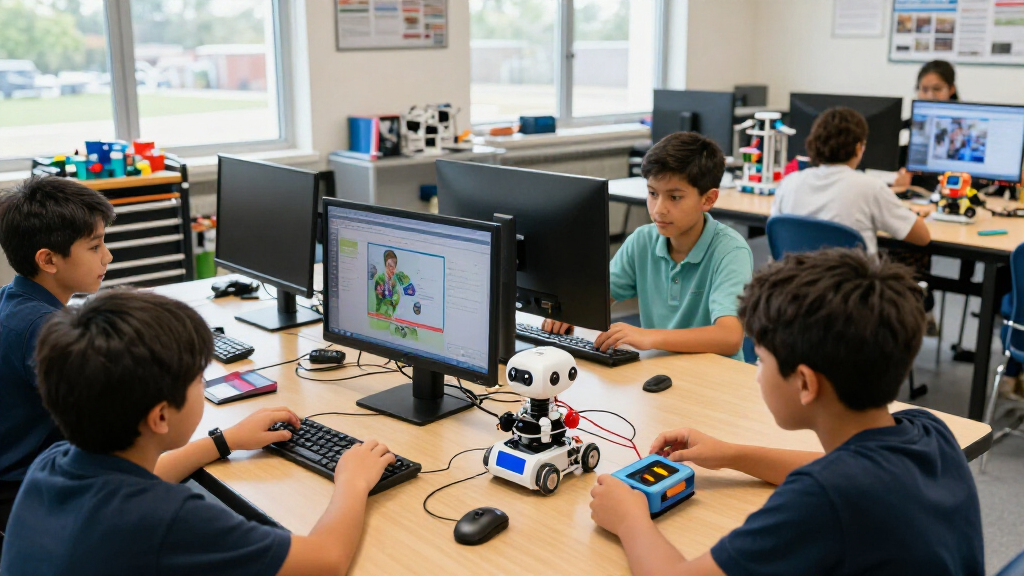
A proposal for K-12 career exploration would test 20 realistic job simulations, beginning with a five-simulation pilot in three Indiana districts. The idea is to help students gain documented work-based-learning experience where employer placements are scarce, but districts and state officials would need to confirm whether the hours qualify.
IdeaNavigator AI has proposed a pilot to test whether employer-reviewed job simulations can help Indiana high school students earn documented work-based-learning hours toward diploma seals. The plan targets district career and technical education or work-based-learning coordinators, particularly in places where there are too few employers able to host teenagers. The proposal and its pilot details are described by IdeaNavigator AI on its student job-simulations page; no participating districts or employers are named there.
According to IdeaNavigator AI’s proposal, the service would begin with a library of 20 day-in-the-job simulations for roles such as medical assistant, HVAC technician, bookkeeper, logistics coordinator and paralegal. Students would complete tasks based on work files, then receive a short live or asynchronous review from a local employer. The model is intended to offer practical exposure to jobs before students commit to a major, apprenticeship or diploma pathway.
IdeaNavigator AI says the proposed service would include hour logs, rubric scores and a training-plan export designed to match Indiana’s state template. The proposal describes employer review as a key part of the design, since Indiana’s work-based-learning framework calls for sustained interaction with industry professionals. A self-paced video or activity alone may not qualify. Whether a particular simulation earns accepted hours would need to be determined by the district and relevant state requirements.
The suggested test is a free, one-semester pilot in three Indiana districts that opted into the new diploma early. The proposal says each district would try five simulations, with a local employer reviewing each one. It calls for tracking how many hours districts accept toward diploma seals, student completion rates and whether coordinators would commit budget for the following school year. No participating districts, employers or pilot dates are identified in the proposal.
Real-World Work Simulations For K-12 Career Exploration
IdeaNavigator AI proposes employer-reviewed job simulations to help Indiana students explore careers and potentially document work-based-learning hours. Whether districts accept those hours remains unconfirmed.
How the simulations work
Students complete work-like tasks, then receive a short review from a local employer.
Explore examples such as medical assistant, HVAC technician, bookkeeper, logistics coordinator or paralegal.
Work through activities based on realistic job files.
A local employer reviews the work, while the proposed tools log hours and scores.
Why schools may consider it
The proposal aims to address limited placements and help students explore careers before choosing a pathway.
- Practice work-like tasks
- Make career options less abstract
- Offer activities where placements are scarce
- Organize hours and training-plan records
What the pilot would test
A proposed free, one-semester pilot would track completion, accepted hours and coordinators’ willingness to fund a following year.
Do hours count?
Districts and relevant state requirements determine whether particular simulations qualify.
Can employers review?
The pilot would test local employer reviews; reviewer recruitment and consistency remain open questions.
Would districts continue?
Coordinator interest and budget commitment are proposed measures; pricing and demand are not reported.
A Route to Documented Career Hours
The proposal addresses two linked challenges for schools: students may have little direct experience of a job before choosing a pathway, while coordinators may struggle to arrange placements and record participation. Employer-hosted placements can be difficult to secure, especially in rural areas and in office-based fields where a workplace may not have a suitable role for a teenager. IdeaNavigator AI presents simulations as another possible way for schools to introduce work tasks and organize career exploration.
The practical test is not simply whether students finish the activities. The proposal’s central measure is whether districts accept the completed simulations toward required hours. If they do not, the activities might still support exploration but would not solve the documentation problem that the service is designed to address. Employer participation, training-plan alignment and district approval are therefore as important as the simulation content.
For students, exposure to work-like tasks may help make career choices less abstract. For districts, a reusable set of activities could reduce some placement and paperwork demands. Those are potential benefits, not demonstrated results: IdeaNavigator AI has proposed the pilot, but has provided no completion, acceptance or cost-effectiveness data.
Products Worth Considering

Kindle Paperwhite Signature Edition 32GB E-Reader, 7-Inch Display, Seaglass Green

Logitech MX Mechanical Wireless Illuminated Keyboard, Clicky Switches

Samsung 32 Odyssey G5 (G51F) QHD 180Hz Gaming Monitor
As an affiliate, we earn on qualifying purchases.
Indiana’s Diploma Requirements
Indiana approved a new high school diploma in December 2024. It applies to the class of 2029, and districts could opt in starting in the 2025–26 school year. Under the details cited in IdeaNavigator AI’s proposal, two diploma seals require 75 or 150 hours of work-based learning; those hours may include simulated experiences. The proposal does not identify the state rule or guidance supporting that summary.
IdeaNavigator AI says Indiana launched a Digital Resource Hub with a training-plan template for qualifying work-based learning on October 6, 2026. Its proposal positions an export matching that template as a way to support coordinator record-keeping. The template and stated allowance for simulated experiences provide a policy basis for exploring the idea, but do not establish that every digital simulation, or this proposed service, will automatically count.
IdeaNavigator AI identifies the proposed customer as a district coordinator responsible for career and technical education or work-based learning. Its proposed business model is an annual district license priced per enrolled high school student, with paid options for custom simulations developed alongside local employers. The proposal reports no pricing, district demand or costs for creating and reviewing the materials.
Approval and Pilot Results
No pilot results are available, and IdeaNavigator AI’s proposal does not name districts or employers that have agreed to take part. It remains unknown whether districts would count the hours, what evidence they would require, or how state officials would interpret particular simulated activities under the work-based-learning rules.
The scope of employer involvement also needs testing. The proposal calls for short reviews of student work, but does not specify how often employers would participate, how reviewers would be recruited or paid, or how the program would maintain consistent feedback across different industries. The listed occupations are examples in the proposal, not evidence of completed simulations or confirmed regional demand.
There is also no stated license price, implementation budget or evidence that districts would renew after a free semester. Student completion and coordinator interest would offer useful early signals, but would not alone show that the model can operate at scale or provide experiences comparable to placements. Those questions remain open until a district pilot and formal hour-acceptance decisions take place.
District Pilot and Hour Review
IdeaNavigator AI proposes outreach to three Indiana districts that opted into the diploma early, followed by an offer of a one-semester pilot covering five simulations per district. The proposal says each activity would receive a review from a local employer. It would then compare completion, district-accepted hours and coordinators’ willingness to fund the service in the next school year.
For the pilot to establish whether the model meets its stated purpose, districts would need to document which activities count, how many hours they award and what training-plan records they accept. IdeaNavigator AI has announced no launch date, district commitments or state review timetable. Until those details emerge, the simulations remain a proposed approach rather than an established route to diploma credit.
Source: IdeaNavigator AI
Key Questions
What is the proposed student job-simulation program?
IdeaNavigator AI proposes a library of 20 job simulations built around work tasks, with a local employer reviewing student work and district tools for recording hours and scores.
Could simulated work count toward Indiana diploma requirements?
The proposal says qualifying work-based-learning hours may include simulated experiences. Whether a specific activity counts is not confirmed and would depend on district acceptance and applicable state requirements, including expectations for interaction with industry professionals.
Which students or schools would the pilot serve?
The proposal would first target three Indiana districts that opted into the new diploma early. It does not identify any districts as participants.
How would the pilot be evaluated?
IdeaNavigator AI’s proposal calls for measuring student completion, hours accepted toward diploma seals and whether district coordinators would fund the service for the next school year.
Has the program launched?
No launch or completed pilot is reported. IdeaNavigator AI’s current plan is to approach districts with an offer of a free, one-semester test.
Source: IdeaNavigator AI