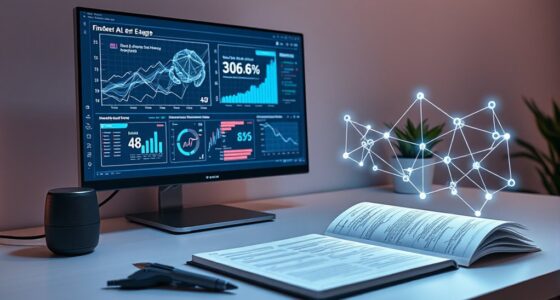
As automation transforms our economy, traditional measures like GDP no longer capture societal progress or well-being. You should consider new metrics that reflect technology adoption, digital literacy, income distribution, and social cohesion. Together, these indicators help you understand if automation benefits everyone or worsens inequality. By exploring innovative measurements, you’ll see how policymakers and businesses gauge true societal health amid rapid technological change—if you keep exploring, you’ll discover more ways to assess an automated economy’s success.

Get business pricing on tech for your team
- Business-only prices and quantity discounts
- Tax-exempt purchasing
- Multiple users, one account, clear invoices
Key Takeaways
- Traditional GDP metrics overlook social equity, sustainability, and societal well-being in an automated economy.
- New indicators incorporate digital literacy, technology access, and social cohesion to reflect broader societal progress.
- Measuring automation adoption, innovation levels, and productivity helps assess its impact on growth and inequality.
- Real-time data collection from diverse sources refines metrics, ensuring relevance amid rapid technological change.
- Holistic metrics promote inclusive, sustainable development, shifting focus from short-term growth to societal well-being.

As automation transforms industries and reshapes labor markets, establishing effective metrics becomes essential to measure progress and guide decision-making. In an era where machines and algorithms handle more tasks, traditional indicators like GDP no longer fully capture the economic realities or societal well-being. Instead, you need to focus on technological measurement—tools and data that quantify how automation impacts productivity, innovation, and resource allocation. These measurements help you understand not just how much output is generated, but how efficiently and sustainably it occurs. For example, tracking advances in robotics, AI deployment, and digital infrastructure provides concrete insights into technological progress. You’ll want to monitor metrics such as automation adoption rates, data utilization levels, and innovation indices, which serve as proxies for the technological health of an economy. These indicators help you determine whether automation is fostering growth or creating new forms of inequality.
Economic indicators in an automated economy require a shift from purely financial metrics to broader measures that reflect societal well-being. While GDP growth might suggest prosperity, it often overlooks issues like income disparity, job displacement, and environmental impact. To truly gauge progress, you need to incorporate metrics like productivity per capita, employment quality, and income distribution. Additionally, measures of digital literacy, access to technology, and social cohesion become essential economic indicators because they influence how well the benefits of automation are shared. These indicators help you assess whether automation leads to sustainable growth or exacerbates social divides. They also guide policymakers and business leaders in designing strategies that promote inclusive prosperity, ensuring technological advancements translate into tangible improvements in people’s lives. Understanding the technological measurement of progress is crucial for adapting strategies in a rapidly evolving landscape.
In practice, establishing these metrics involves collecting real-time data from diverse sources—government reports, industry surveys, and digital platforms. You must continuously refine your measurements to keep pace with rapid technological change. By combining technological measurement and expanded economic indicators, you create an all-encompassing framework that reflects the true state of your automated economy. This approach enables you to identify gaps, evaluate policies, and make informed decisions that prioritize long-term societal well-being. As automation continues to evolve, your ability to adapt your metrics will determine whether you successfully harness its potential or fall behind in addressing the complex challenges it presents. Ultimately, these new metrics will help you move beyond traditional economic success and toward a more holistic understanding of progress in an automated world.
digital literacy training courses
As an affiliate, we earn on qualifying purchases.
As an affiliate, we earn on qualifying purchases.
Frequently Asked Questions
How Do We Measure Happiness in an Automated Economy?
You can measure happiness in an automated economy by focusing on digital resilience and cultural vibrancy. Digital resilience reflects how well society adapts to technological changes, boosting overall wellbeing. Cultural vitality measures community engagement and shared values, which directly influence happiness. By tracking these indicators alongside traditional metrics, you gain a holistic view of societal wellbeing, helping you understand how automation impacts happiness beyond just economic output.
What Are Alternative Metrics to GDP for Wellbeing?
You can measure wellbeing by evaluating social capital, which reflects community trust and cooperation, and by measuring leisure time, as it directly impacts happiness. These metrics go beyond GDP, offering insights into quality of life. Tracking social interactions and leisure activities helps you understand societal wellbeing, showing how connected and fulfilled people feel, especially in an automated economy where traditional economic indicators may fall short.
How Can Automation Impact Income Inequality?
Automation can widen income inequality if profits mainly benefit tech owners, leaving workers behind. You might see the digital divide grow, making it harder for some to access new opportunities. To counteract this, policies like income redistribution can help guarantee that benefits from automation reach everyone. Addressing the digital divide is also essential, so all communities can participate in and benefit from technological advancements, reducing inequality overall.
What Policies Support Wellbeing in a Technological Economy?
You can support wellbeing in a technological economy by implementing policies that promote social cohesion and technological resilience. Focus on investing in education and retraining programs to help workers adapt to automation. Strengthen social safety nets to reduce inequality and foster community engagement. Encourage responsible AI development and infrastructure upgrades that enhance resilience. These policies guarantee that technological advances benefit everyone, maintaining social harmony and economic stability.
How Does Environmental Sustainability Factor Into New Metrics?
Environmental sustainability is factored into new metrics through environmental indicators like air and water quality, biodiversity, and resource use. These indicators help you assess sustainable development, ensuring economic growth doesn’t harm the planet. By integrating these metrics, you can prioritize policies that balance technological progress with ecological health, fostering long-term wellbeing. This approach encourages responsible innovation and resource management, aligning economic success with the planet’s health.
automation impact measurement tools
As an affiliate, we earn on qualifying purchases.
As an affiliate, we earn on qualifying purchases.
Conclusion
As you consider shifting from GDP to wellbeing metrics, remember that automation could redefine prosperity itself. Some argue that technology will boost overall happiness by freeing us from mundane tasks, while others warn it may widen inequalities. The real question is: can we create a future where progress isn’t just measured by output but by genuine human fulfillment? Embracing new metrics might just reveal whether automation truly leads to a richer, more equitable life for everyone.
social cohesion assessment software
As an affiliate, we earn on qualifying purchases.
As an affiliate, we earn on qualifying purchases.
digital infrastructure monitoring devices
As an affiliate, we earn on qualifying purchases.
As an affiliate, we earn on qualifying purchases.
Evergreen bestsellers Picks
bestsellers
As an affiliate, we earn on qualifying purchases.