
TL;DR
Qualcomm revealed its new AI data center CPU, Dragonfly C1000, and announced Meta will be its first major customer, marking a significant move into the data center industry. The product targets agentic AI performance and power efficiency.
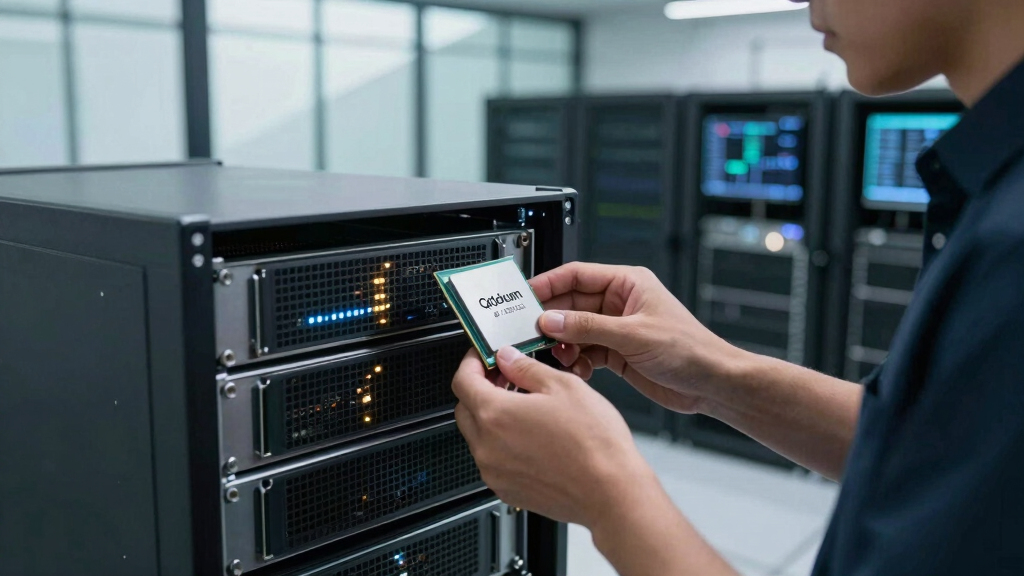
Qualcomm has announced its first AI-focused data center CPU, the Dragonfly C1000, which will be used by Meta starting in 2028. This new chip emphasizes high computing performance while maintaining power efficiency, a key focus for data center applications. This marks the company’s official entry into the data center market, a sector it aims to grow significantly in the coming years.

Get business pricing on tech for your team
- Business-only prices and quantity discounts
- Tax-exempt purchasing
- Multiple users, one account, clear invoices
At a presentation to investors, Qualcomm revealed the Dragonfly C1000, a new CPU designed specifically for agentic AI workloads. The chip emphasizes high computing performance while maintaining power efficiency, a key focus for data center applications.
The company announced that Meta will be the first major customer to utilize the Dragonfly C1000 when it begins production in 2028. Qualcomm stated that it has a roadmap to develop multiple products for the data center market, including an AI chip and solutions for linking multiple chips together.
CEO Cristiano Amon emphasized Qualcomm’s readiness, saying the company has been executing on its strategy and now possesses a comprehensive product portfolio to enter the data center space. Qualcomm’s CFO, Akash Palkhiwala, noted that the company already has business relationships with nearly every hyperscaler through its existing products, which will facilitate its expansion into data centers.
Impact of Qualcomm’s Entry into Data Center Market
This development signals a major shift for Qualcomm, traditionally known for smartphone chips, as it seeks to diversify into high-growth markets like data centers, autonomous vehicles, and robotics. The partnership with Meta indicates strong industry confidence in Qualcomm’s new AI-focused processors, which could challenge established players like Nvidia and AMD.
Qualcomm’s focus on power-efficient AI chips aligns with the increasing demand for sustainable data center solutions, especially as AI workloads grow more complex and resource-intensive. The move could accelerate competition and innovation in AI hardware, impacting cloud providers and enterprise customers worldwide.
Products Worth Considering

Jackery Explorer 2000 v2 Portable Power Station with Two 200W Solar Panels

Bose QuietComfort Wireless Noise-Cancelling Over-Ear Headphones, Cypress Green

Jackery Solar Generator 1000 v2 with 100W Solar Panel
As an affiliate, we earn on qualifying purchases.
Background on Qualcomm’s Data Center Expansion
Qualcomm has been a dominant player in smartphone processors and modems, with two-thirds of its revenue coming from mobile chips as of March 2026. Over recent years, the company has been actively seeking to diversify into faster-growing markets like automotive, robotics, and data centers.
In 2025, Qualcomm announced a significant increase in its automotive design pipeline to $65 billion and set a revenue target of $10 billion for automotive chips by 2029. Its recent acquisition of Modular, a software startup that enables AI applications across various chip architectures, underscores its strategic pivot towards AI and data center solutions.
The announcement of the Dragonfly C1000 and the partnership with Meta are part of Qualcomm’s broader plan to establish itself as a key player in the AI hardware ecosystem, leveraging its expertise in energy-efficient chip design. This strategic move aligns with Qualcomm’s efforts to develop China-specific data center chips in line with US export controls.
“We feel that we have a comprehensive portfolio to enter the next phase of the data center.”
— Qualcomm CEO Cristiano Amon
Unconfirmed Details and Market Response
While Qualcomm has announced the Dragonfly C1000 and its partnership with Meta, it is not yet clear how the chip will perform in real-world data center environments or how quickly other hyperscalers will adopt it. The full product specifications and competitive positioning are still to be disclosed, and market reactions remain uncertain. Learn more about Qualcomm’s data center chip and its potential impact on the market.
Additionally, the extent of Qualcomm’s market share in the data center sector and how its chips will compare to established players like Nvidia and AMD are still developing stories.
Next Steps in Qualcomm’s Data Center Strategy
Qualcomm plans to begin production of the Dragonfly C1000 in 2028, with initial deployments by Meta. The company will likely showcase further product details and performance benchmarks at upcoming industry events. Monitoring how other hyperscalers and enterprise clients respond will be key to assessing Qualcomm’s success in this market.
Additionally, Qualcomm’s ongoing investments in AI software and hardware integration, including its acquisition of Modular, will shape its competitive position moving forward.
Key Questions
What is the Dragonfly C1000?
The Dragonfly C1000 is Qualcomm’s new CPU designed specifically for AI workloads in data centers, emphasizing performance and power efficiency.
Who is Qualcomm’s first major customer for the new CPU?
Meta will be the first major customer to use the Dragonfly C1000, starting in 2028.
When will the Dragonfly C1000 be available?
Production is expected to start in 2028, with initial deployments by Meta at that time.
Why is Qualcomm entering the data center market now?
Qualcomm aims to diversify beyond smartphones into high-growth markets like data centers, driven by increasing demand for AI processing and energy-efficient hardware.
How might this impact the existing data center chip market?
Qualcomm’s entry could increase competition, drive innovation, and offer new options focused on power efficiency, challenging established players like Nvidia and AMD.
Source: Google Trends