
TL;DR
Open a free Amazon Business account
Business pricing, bulk buying and tax-exempt orders.
Create a free accountAs an affiliate, we earn on qualifying purchases.
IdeaClyst is a local-first, AI-driven tool that acts as a digital war room for your ideas. It helps founders validate, develop, and defend their concepts fast and securely, reducing costly missteps. Think of it as your private, AI-powered brainstorming bunker.
Picture this: three ideas swirl in your mind, each promising, each terrifyingly expensive to get wrong. The build part is easy now—thanks to modern tools and AI assistants. But knowing which idea to chase? That’s the real puzzle.
Enter IdeaClyst—a digital war room where your best ideas get tested, debated, and refined, all on your laptop. It’s more than software; it’s a mental battlefield designed to cut through hope and guesswork. Today, I’ll show you how this tool helps founders like you make smarter, faster decisions—saving time, money, and your sanity.
A war room for your next idea
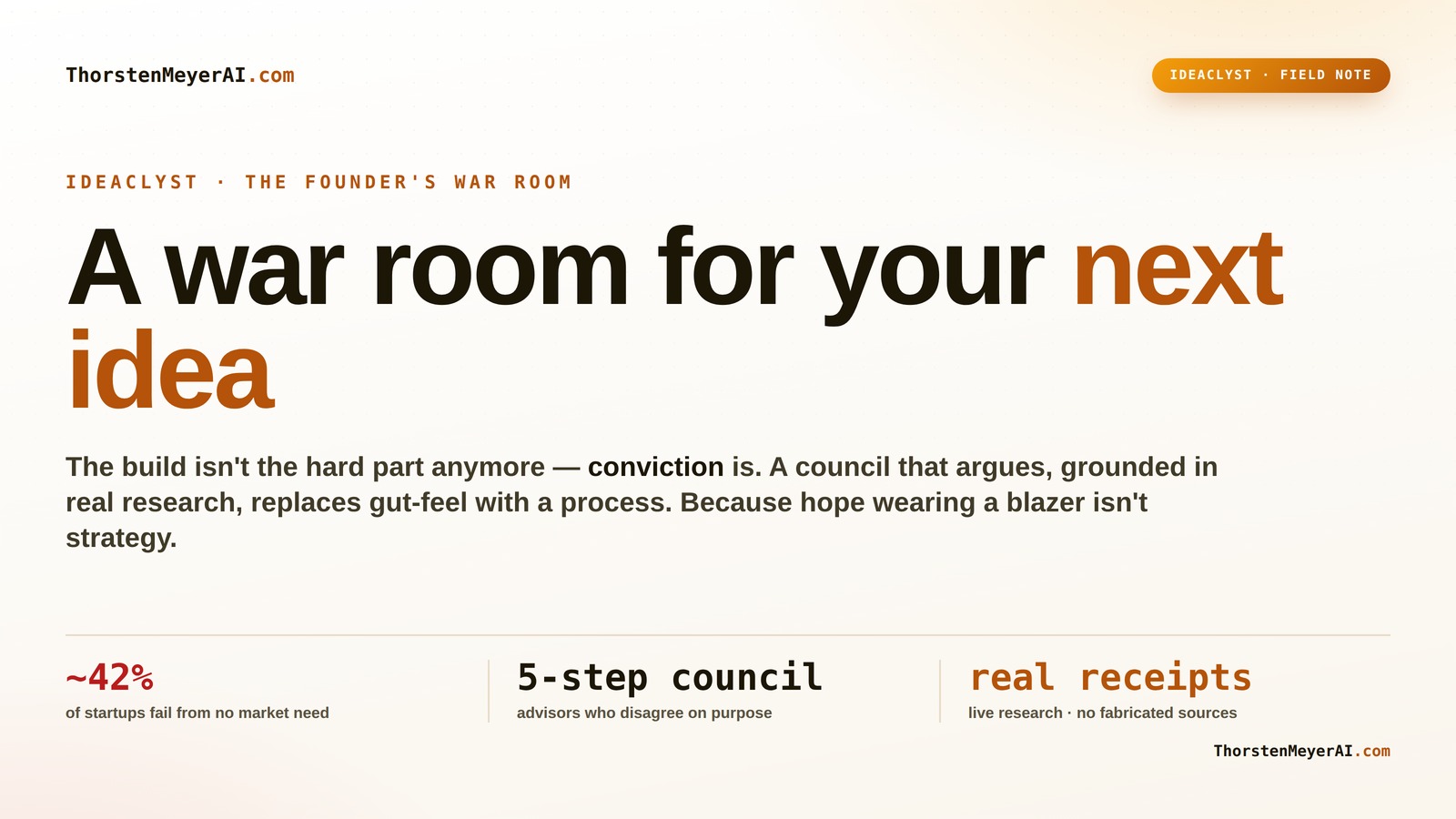
The build isn’t the hard part anymore — conviction is. Knowing which idea deserves the next six months, and being able to defend it. Most founders answer with gut feel and optimistic math. That’s hope wearing a blazer. IdeaClyst replaces it with a process.
The most expensive decision is what to build
The single most valuable thing a tool can do is talk you out of the wrong six months. The numbers make the case better than any pitch.
Three tools in one — on your own machine
Strip away the framing and IdeaClyst is three things at once, all running locally with nothing leaving your laptop.
An AI council
Pressure-tests an idea you bring it — advisors who argue on purpose.
A discovery engine
Finds ideas you didn’t know to look for by hunting real demand signals.
A founder’s workspace
Carries winners from “interesting” all the way to “ready to build.”
Advisors who disagree on purpose
Not one confident, agreeable answer — a structured five-step deliberation where models play different roles and turn on their own work. The disagreement is the feature.
The five-step deliberation
A council that leads with the bad news surfaces the objections you’d otherwise find the expensive way, on month five.
Product strategy
Who’s it for, what’s the wedge, why now, what’s the business model.
Technical architecture
What would it actually take to build — and where’s the risk.
Critique pass
The council turns on its own work. Where’s the hand-waving? What kills this?
Second, independent critique
A different voice, a different angle — so blind spots don’t survive.
Final synthesis
Everything into one coherent founder packet: strategy, architecture, validation, plan.
When IdeaClyst cites a source, it actually fetched it
The hard departure from “ask an AI what it thinks of my startup.” It runs in a strict, real-data-only mode — if it can’t gather genuine evidence, it says so plainly rather than inventing a plausible paragraph.
Confidence with receipts
No fabricated statistics, no imaginary competitors, no made-up citations. The packet survives a skeptical co-founder or a sharp investor because the reasoning has receipts.
Market research first
Scouts the landscape before the council reasons about anything.
Competitor read
Real positioning, pricing signals, feature claims — differentiation vs. reality.
Validation with links
Not “talk to customers” — concrete signals & sources you can click.
From the blank page to build-ready
Evaluation is half the problem; the blank page is the other half. And a plan is worthless if it dies in a tab you never reopen.
Bring a space, not an idea
“AI for accountants,” “tools for indie game studios” — plus your goal and real capacity. It hunts demand signals across HN, Reddit, Product Hunt, GitHub, pricing pages.
- An honest market read — leads with the bad news when a space is hard
- An opportunity map — high pain, thin competition
- Ranked candidates — wedge, who pays, effort, risk, confidence
- each with KILL CRITERIA — when to walk away
A home and a forward path
Every promising idea gets carried forward, with every artifact in plain files on your disk.
- Validation tooling — sprint board, interview list, evidence browser
- Founder profile — a personal-fit lens; same discovery, different advice
- Build workspaces — funnel, personas, landing draft, version history
- “Build this idea” → a PRD + task queue, ready for a coding agent
Key Takeaways
- IdeaClyst’s local-first design keeps your ideas private, secure, and under your control, while providing powerful AI-driven debate and validation.
- Building a digital war room is a matter of choosing the right tools, organizing your workspace, and scheduling regular updates, turning chaos into clarity.
- A structured AI council that argues from different perspectives exposes blind spots and improves decision quality—think of it as a debate team for your ideas.
- Grounding your ideas in real-time web research, instead of model vibes, dramatically reduces the risk of building something nobody wants.
- The final output—a comprehensive, version-controlled plan—acts as your blueprint from idea to launch, boosting confidence and clarity.
AI-powered idea validation software
As an affiliate, we earn on qualifying purchases.
As an affiliate, we earn on qualifying purchases.
What Is IdeaClyst? The Digital War Room That Changes Everything
IdeaClyst is a local-first, AI-powered platform that acts as your personal war room for startup ideas. It combines AI council deliberations, discovery engines, and a founder’s workspace—all running entirely on your machine. Imagine having a team of diverse advisors, each with a different take, arguing with each other to find the truth about your idea.
For example, you might feed it your idea to build a new app for remote team management. Instead of just getting a yes or no, you see a detailed debate: who’s your target customer? What technology risks exist? What competitors are missing? It’s like having a board of experts in your pocket, but they’re all on different pages, fighting it out to give you the clearest picture.
This local-first setup isn’t just about privacy—it’s about control. Your ideas, reports, and plans stay on your disk, safe from prying eyes or endless cloud subscriptions. It’s open source, flexible, and tailored for founders who want to own their process.
As an affiliate, we earn on qualifying purchases.
Why a Digital War Room Beats Brainstorming Alone
A war room isn’t just a fancy name—it’s a proven way to accelerate innovation. Physical war rooms in big companies gather teams around visual boards, tracking progress and surfacing issues fast. Digital war rooms do the same but flexibly, with tools that adapt to remote and hybrid teams. Learn more about building effective digital war rooms.
For instance, a startup founder testing a new SaaS feature can use IdeaClyst to simulate team debates—product strategy, technical risks, customer validation—all in one place. It’s a hub for visibility and momentum, making sure no idea gets lost in email threads or sticky notes.
Recent trends show that digital war rooms are becoming standard. They increase team alignment, speed up decision cycles, and make complex ideas digestible through structured visualizations. Plus, they boost energy—everyone sees the progress and gets excited to contribute.
digital war room software for startups
As an affiliate, we earn on qualifying purchases.
As an affiliate, we earn on qualifying purchases.
How to Build Your Own Digital War Room in 3 Steps
- Choose your tools: Pick a platform like IdeaClyst that runs locally, offers structured debate, and integrates research. Avoid clutter—focus on clarity and control.
- Set up your workspace: Organize folders for ideas, reports, and critiques. Use visual tags and categories to keep everything accessible and current.
- Regularly update and debate: Schedule weekly sessions where you feed in new ideas, challenge assumptions, and refine your plans. Treat it like a game—every update brings clarity.
For example, a SaaS founder might start with a simple idea document, run it through the council, and end with a prioritized list of features ready for development.
This process keeps ideas fresh, debates lively, and progress visible, turning chaos into clarity.
idea development and testing software
As an affiliate, we earn on qualifying purchases.
As an affiliate, we earn on qualifying purchases.
The Power of a Disagreeing AI Council
Most AI tools tell you what you want to hear. IdeaClyst flips that script. It assembles a council of AI advisors, each playing a different role—product strategist, tech architect, critique critic—and they argue with each other. Discover more about AI-driven debate tools.
Imagine asking one AI: “Who is this for?” and another: “What could go wrong?” Their disagreement exposes blind spots. Then, the final synthesis merges these perspectives into one clear plan. It’s like having a devil’s advocate on steroids.
This structured disagreement prevents the trap many founders fall into—thinking their idea is bulletproof because an AI told them so. Instead, you get a balanced, evidence-based view grounded in real research, not just model vibes.
Grounding Ideas in Real Research, Not Just Model Vibes
AI can be a double-edged sword. Left unchecked, it’s prone to confidently spouting opinions that aren’t backed by facts. IdeaClyst avoids that by integrating live web research into its council process. Every critique and strategy pass is rooted in real data, current market trends, and verified sources. Find out more about AI trends and innovations.
For example, instead of blindly claiming “market is fragmented,” it pulls recent industry reports, customer reviews, and competitor analyses. That means your idea gets a reality check—not just an optimistic echo chamber.
According to recent startup failure data, 42% fail because of no market need. IdeaClyst’s real-time research approach sharply reduces that risk, making your validation process smarter and faster.
What’s Inside the Final Founder Packet? The Roadmap from Idea to Action
The output from IdeaClyst isn’t just a debate summary—it’s a comprehensive plan. After the council’s arguments and critiques, it generates a markdown file that includes strategy, architecture, validation tests, and a step-by-step plan. Learn more about AI-assisted content creation.
This packet acts like a blueprint—clear, structured, and ready for presentation or development. For example, a founder might review their final plan, pitch it to investors, or hand it to engineers, all from the same document.
It’s an open, version-controlled artifact that grows with your project. That means less guesswork and more confidence.
Keep Your Idea War Room Fresh and Focused
Keeping your war room active is key. Regular updates, fresh critiques, and new research keep ideas alive. Schedule weekly sessions where you feed in new data, challenge assumptions, and refine strategies.
For instance, as market conditions shift, revisit your council’s debates. Remove outdated ideas and add fresh ones. Use visual tags and clear ownership to prevent clutter and confusion.
This ongoing process turns your war room into a living document—an ever-evolving hub of innovation, not a dusty tomb of stale ideas.
Frequently Asked Questions
Is IdeaClyst a physical space or a software tool?
IdeaClyst is a software tool that runs entirely on your local machine. It’s a digital war room designed to help founders analyze, debate, and develop ideas within a private, open-source environment.How does IdeaClyst differ from traditional brainstorming or whiteboards?
Unlike physical whiteboards or casual brainstorming, IdeaClyst provides structured, AI-driven debates, grounded in real research. It offers a disciplined, version-controlled plan that evolves with your project, all while maintaining privacy.Can remote teams use IdeaClyst effectively?
Yes. Although it’s a local-first app, teams can share their markdown plans, critique reports, and research via version control or integrations, making it suitable for distributed teams seeking a central, structured decision process.What kinds of ideas benefit most from IdeaClyst?
Early-stage startup ideas, product features, market expansion plans, or technical architectures. Basically, any complex decision that needs careful validation and debate benefits from its structured council.How do I keep my war room from becoming cluttered or outdated?
Schedule regular reviews, archive stale ideas, and update research to reflect current market conditions. Use visual tags and clear ownership to keep the space focused and actionable.Conclusion
IdeaClyst isn’t just software; it’s your secret weapon against costly guesswork. It turns the chaos of early-stage thinking into a disciplined, evidence-backed process that saves time and money.
Imagine having a dedicated war room—digital, private, fiercely honest—where your ideas are tested, debated, and refined until they’re ready to conquer. That’s the power of IdeaClyst. Start building your war room today, and turn every idea into your next success story.
NFL season / tailgating Picks
team gear
As an affiliate, we earn on qualifying purchases.