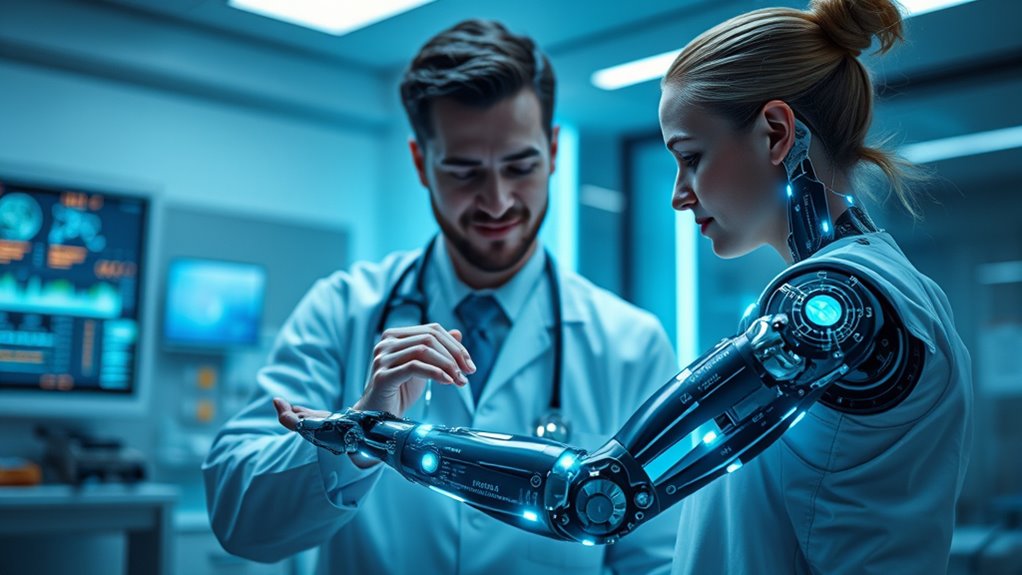

The future of medicine isn’t about replacing doctors with machines, but about humans and machines working together. AI enhancements help you analyze complex health data, automate routine tasks, and support decision-making, freeing up your time for personalized patient care. This partnership improves accuracy, reduces errors, and boosts efficiency. If you want to understand how this collaboration transforms healthcare and benefits patients, keep exploring how human and machine strengths combine seamlessly.

Get business pricing on tech for your team
- Business-only prices and quantity discounts
- Tax-exempt purchasing
- Multiple users, one account, clear invoices
Key Takeaways
- AI enhances diagnostic accuracy and supports complex decision-making without replacing human clinicians.
- Human empathy and critical thinking remain essential for patient-centered care alongside machine insights.
- Collaboration between doctors and AI tools improves efficiency, reducing errors and administrative workload.
- AI handles repetitive tasks, freeing physicians to focus on personalized treatment and complex cases.
- Supportive technologies like companion robots improve patient well-being while complementing human healthcare providers.
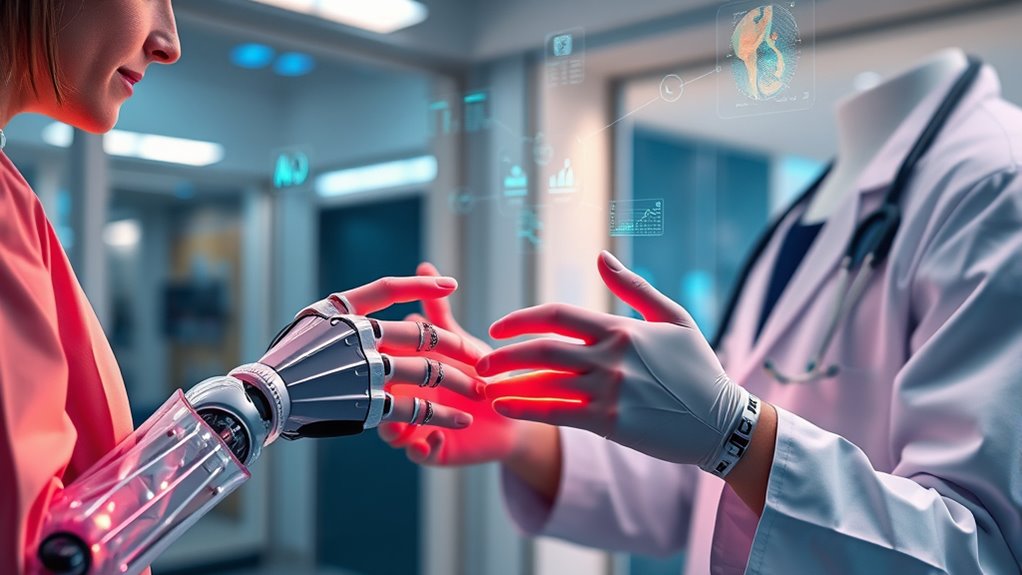
The future of medicine is increasingly shaped by the collaboration between humans and machines, combining the strengths of both to deliver better patient outcomes. You’ll notice that AI-powered tools now help achieve recognition accuracies above 90%, markedly boosting diagnostic precision and efficiency. Multimodal fusion health monitoring, which uses deep learning models, outperforms traditional methods because it captures complex health patterns, leading to more accurate predictions. These systems enable a thorough assessment of your individual health status, supporting better diagnosis and targeted interventions. In fields like radiology, pathology, and dermatology, physician-machine collaborations consistently outperform either humans or machines alone, highlighting the value of combined expertise and technology. AI’s ability to analyze large datasets also accelerates scientific discovery, enabling breakthroughs that can inform personalized treatment plans and improve overall care quality. Additionally, advances in predictive analytics allow for early detection of health issues, further enhancing preventive care strategies.
Far from replacing physicians, AI enhances your role by managing repetitive tasks and providing augmented clinical intelligence. You still rely on your critical thinking, empathy, and complex decision-making skills — qualities that machines can’t replicate. Instead, AI supports you in higher-level decisions, interdisciplinary collaborations, and patient communication. It helps reduce fatigue and human error, allowing you to focus on what truly matters: delivering holistic, patient-centered care. The American Medical Association emphasizes that technology should complement, not replace, your expertise, reinforcing the importance of a human touch in medicine.
AI supports your expertise by reducing fatigue and human error, allowing focus on holistic, patient-centered care.
Collaboration with machines also dramatically improves productivity and efficiency. Routine administrative work can be automated, increasing healthcare productivity by around 40%. This automation frees you from monotonous duties, giving you more time to concentrate on complex cases and personalized patient care. It also alleviates burnout by reducing administrative burdens, improving work-life balance, and allowing for better time management and skill development. As a result, healthcare delivery becomes more scalable and responsive, providing higher-quality service to more patients.
In addition, emotional and psychological support systems are transforming patient care. Companion robots analyze physiological and emotional data in real-time, offering comfort and companionship, especially for those with chronic illnesses. Patients trust these robots as attentive, reliable sources of support, which can improve their overall well-being and treatment outcomes. These emotional AI systems foster more human-like interactions, addressing mental health needs, particularly in an aging population. As you integrate these technologies, remember they’re designed to empower you, not replace you, ensuring a future where human empathy and machine precision work hand in hand for better healthcare.
AI-powered medical diagnostic tools
As an affiliate, we earn on qualifying purchases.
As an affiliate, we earn on qualifying purchases.
Frequently Asked Questions
How Will AI Improve Personalized Patient Care?
AI will improve your personalized patient care by integrating genetic, lifestyle, and medical data to create tailored treatment plans. It offers real-time insights through clinical decision support systems, predicts disease progression early, and enables remote monitoring. This means you get more accurate diagnoses, proactive interventions, and therapies that are effective and affordable. AI enhances your healthcare experience by making treatments more precise, efficient, and accessible, leading to better health outcomes overall.
What Are the Ethical Challenges of Human-Machine Collaboration?
You face ethical challenges as you work alongside AI in healthcare. Biases in data can skew care, risking unfair treatment for some patients. Transparency is crucial so patients trust decisions, but AI often remains a black box. Balancing automation with human oversight ensures accountability. Protecting patient privacy and respecting their autonomy require clear communication. You must also guard against alienating patients, preserving empathy and human connection amid technological advances.
Will Machines Eventually Replace Doctors Entirely?
No, machines won’t replace doctors entirely. You’ll find AI enhances your work by handling data analysis and routine tasks, but it can’t replicate your empathy, intuition, or understanding of complex patient needs. Your role remains vital in providing personalized care, emotional support, and steering ethical issues. Technology complements your expertise, enabling you to focus more on the human aspects of medicine that machines can’t emulate.
How Do We Ensure Data Privacy in Ai-Driven Medicine?
You can guarantee data privacy in AI-driven medicine by adhering to strict regulations like HIPAA and GDPR, which set clear standards for data protection. Use encryption and anonymization to safeguard patient data, minimize data collection to what’s necessary, and conduct regular audits to spot vulnerabilities early. Maintain transparency with patients about data use, obtain informed consent, and collaborate with stakeholders to develop robust governance and security measures.
What Skills Will Future Healthcare Professionals Need?
You’ll need to wield a versatile toolbox, blending technical skills like data literacy and AI understanding with human touch. Think of yourself as a bridge—connecting technology with empathy. Cultivate active listening, cultural sensitivity, and ethical judgment. Stay curious and adaptable, like a river shaping its course. Embrace lifelong learning, sharpen your critical thinking, and lead with compassion, ensuring you navigate the evolving healthcare landscape with confidence and integrity.
medical companion robots for patients
As an affiliate, we earn on qualifying purchases.
As an affiliate, we earn on qualifying purchases.
Conclusion
As you see, the future of medicine isn’t about replacing humans with machines but combining their strengths. Imagine a study showing that AI-assisted diagnoses improve accuracy by 40%, helping doctors make better decisions. By working together, humans and machines can deliver more personalized, efficient care. Embracing this partnership guarantees you receive the best treatment possible, where technology enhances your healthcare experience without replacing the compassionate touch only humans can provide.
automated healthcare administrative software
As an affiliate, we earn on qualifying purchases.
As an affiliate, we earn on qualifying purchases.
predictive analytics health monitoring devices
As an affiliate, we earn on qualifying purchases.
As an affiliate, we earn on qualifying purchases.
Fall Picks
fall essentials
As an affiliate, we earn on qualifying purchases.







![Explore How Trends Are Influencing Better Drawstring Tying In Gym Wear [Video]](https://deepintellica.com/wp-content/uploads/2026/09/explore-how-trends-are-influencing-better-drawstring-tying-in-gym-wear-video-featured-260x140.jpg)