TL;DR
An HCLTech paper published on alphaXiv explores ways weight changes might affect models, but its authors say they did not demonstrate a self-propagating virus or equivalent offensive capability. Separate research from MIT and Microsoft shows that targeted weight edits can change model behavior, while Fireworks AI reported access to some customers’ incomplete weights and datasets.
The paper tested three probes on one small model. According to the source report, one edit worked but also damaged a nearby behavior, while two others mostly failed. The researchers write that their cases “do not demonstrate self-propagation or actual offensive capabilities.” They also state that they do not claim to have created or demonstrated “the equivalent of a virus that primarily operates in weight space.”

Get business pricing on tech for your team
- Business-only prices and quantity discounts
- Tax-exempt purchasing
- Multiple users, one account, clear invoices
The concern is that a model’s weights—the numerical values learned during training—can be changed to alter how it responds. Unlike software source code, a list of changed weight values is difficult to interpret on its own. The source report describes other research showing that edits can have intended or unintended effects, but those results are distinct from proof that a change can spread autonomously from one model to another.
The report also notes a separate disclosure from Fireworks AI: the company said that, for certain customers, “a subset of incomplete model weights and datasets were accessed.” The available source material does not establish that this incident involved the HCLTech paper’s techniques.
Why Weight Changes Matter
Model weights are a security concern because they directly shape a model’s behavior. If an altered file is used in a product or an AI agent, changes could affect answers or responses to particular triggers. The paper’s limited tests do not show that a malicious edit can replicate across models, but they illustrate why inspecting weight files is not as straightforward as reviewing a code change.
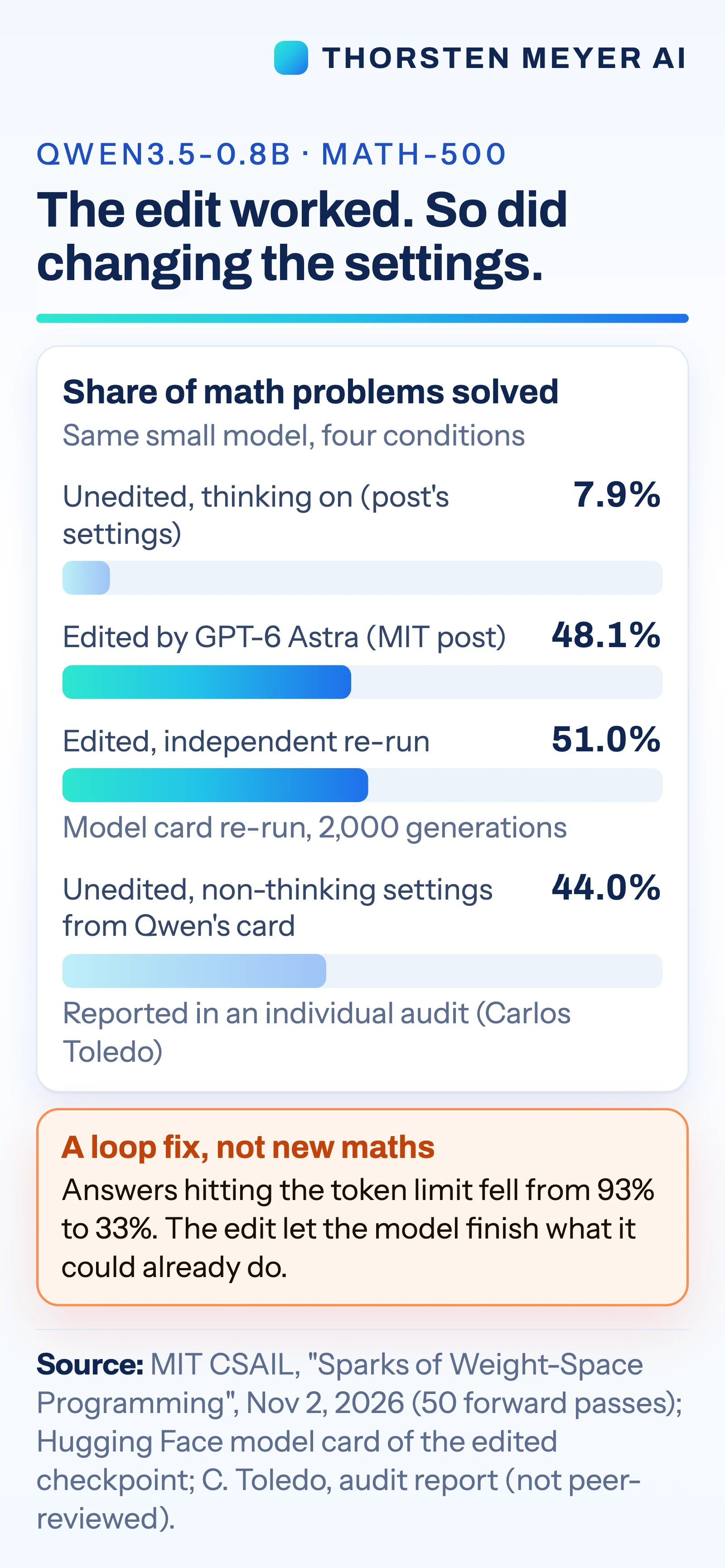
The separate examples in the source report show both the potential benefits and risks of editing weights. MIT CSAIL researchers reported using GPT-6 Astra to edit 0.016% of a small Qwen model’s weights, raising its score on MATH-500 from 7.9% to 48.1% by addressing reasoning loops, according to the report. Microsoft researchers reported creating a backdoor in an agent model by editing seven neurons. These are separate studies and should not be treated as evidence that the HCLTech paper demonstrated either capability.
Products Worth Considering

Bose TV Speaker Compact Soundbar with Bluetooth and HDMI-ARC, Black

Kindle Paperwhite 16GB (2024 Model) – Graphite

Anker SOLIX C1000 Gen 2 Portable Power Station with 100W Solar Panel
As an affiliate, we earn on qualifying purchases.
Three Studies, Different Findings
The HCLTech paper followed a November 2, 2026 MIT CSAIL paper, “Sparks of Weight-Space Programming,” as well as Microsoft research discussed in the source report. MIT’s work used weight edits to address a model’s tendency to loop. The report says an independent audit scored the unedited model at 44.0% with different settings, a finding that complicates comparisons with the edited model’s reported result.
In a separate study, Microsoft researchers reportedly edited seven neurons in an 8-billion-parameter agent model. The trigger activated the payload in at least 98.8% of triggered test runs, according to the source report. Microsoft has not seen attackers use the technique, the report says. These examples show that model-weight edits can change behavior under specific test conditions; they do not establish that weight-based attacks are spreading in the wild.
““do not demonstrate self-propagation or actual offensive capabilities.””
— HCLTech paper authors
Spread and Real-World Use
The source material does not show that a weight edit can copy itself into other models, spread without human involvement, or operate as a real-world attack. The HCLTech tests covered one small model and three probes; the report says two probes mostly failed and the successful edit caused a nearby behavioral failure.
It is also unclear from the provided material which customers or specific files were affected in the Fireworks AI incident, how the weights were accessed, or whether they were complete enough to use. The reported benchmark results across the MIT work and independent audit also differ, with the audit attributing a 44.0% score to the unedited model under different settings.
Checks for Model Weight Files
The source report recommends treating downloaded or fine-tuned weights as files from an unknown source: check their provenance, compare them with the declared base model, and test their behavior. It also advises limiting the actions available to agents that use those weights.
Further reporting and research would be needed to establish whether weight edits can spread between models or be used in attacks beyond controlled tests. Details about the Fireworks AI access incident and its impact on affected customers were not included in the supplied material.
Key Questions
Did the HCLTech paper create a self-spreading AI virus?
No. The authors say their tests did not demonstrate self-propagation or actual offensive capability, and that they did not create or demonstrate the equivalent of a virus operating in model weights.
What did the paper test?
According to the source report, it ran three probes on one small model. One edit worked but damaged a nearby behavior, while two mostly failed.
Can changing weights alter a model’s behavior?
Yes. Separate studies cited in the source report describe weight edits used to address reasoning loops and to create a backdoor in a test model. Those findings do not show that the HCLTech paper’s proposed virus spreads between models.
What did Fireworks AI report?
Fireworks AI said that, for certain customers, a subset of incomplete model weights and datasets were accessed. The supplied material does not identify the affected customers or explain the incident’s full impact.
Source: Thorsten Meyer AI