

63% of U.S. retailers say automation will change their cost structure more than any other investment this decade — a shift that can cut picking costs, speed up delivery, and reshape how you compete in retail logistics.

Get business pricing on tech for your team
- Business-only prices and quantity discounts
- Tax-exempt purchasing
- Multiple users, one account, clear invoices
This section frames the economics of retail automation so you can evaluate automation ROI and its effect on supply chain economics. You’ll see how robotics, AI agents, and high-performance compute are moving from pilot projects to line-item budgets in inventory centers and micro-fulfillment hubs.
You’ll also get a clear view of tradeoffs: upfront capital for equipment and integration versus ongoing operational savings in labor, error rates, and speed. That framing prepares you to compare vendors, model payback periods, and measure the operational metrics that prove value.
Key Takeaways
- Automation is a strategic cost lever that affects speed, accuracy, and capital allocation in retail logistics.
- Robotics and AI are shifting from experiments to scalable investments that influence automation ROI.
- Compare capex versus opex and model payback periods before committing to full-scale rollouts.
- Track throughput, order accuracy, and inventory turn to validate productivity gains.
- Labor dynamics and consumer delivery expectations are primary market drivers for adoption.
Overview of automation in retail supply chains and why it matters
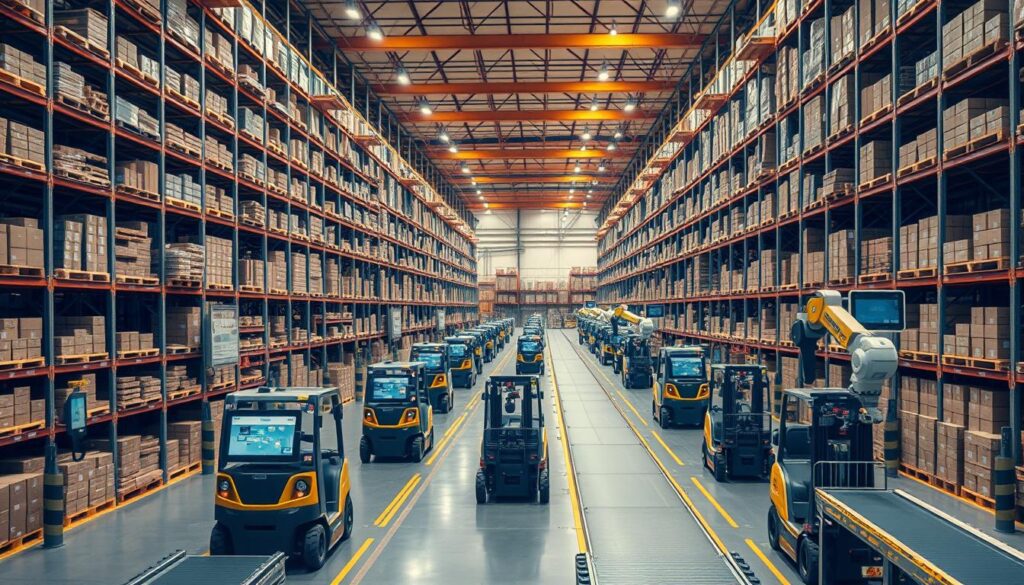
Automation in retail supply chains blends robotics in warehouses, autonomous vehicles, and AI agents that plan and execute tasks. You will see these systems connected through full-stack platforms that link sensors, control systems, and decision models. This setup is the practical retail logistics automation definition many operations teams use when evaluating upgrades.
Defining automation in retail logistics
Start with the components: warehouse robots that pick and sort, autonomous trucks that move pallets, and cloud-hosted AI that forecasts demand. You should include integrated compute and software that ties those parts together so decisions can flow from edge sensors to centralized planners. Fujitsu and NVIDIA show how high-performance infrastructure and AI agents can run continuous optimization across the stack.
Why automation matters to your retail operations and customers
Automation benefits retail by cutting dependence on manual labor when shortages and wage pressure bite. You will notice higher throughput and fewer picking errors. That makes omnichannel fulfillment more reliable and helps you meet tighter delivery windows.
Customer experience automation lifts order accuracy and predictability. When systems keep inventory synchronized and routes optimized, shoppers get consistent delivery times and better service. That reliability strengthens trust in your brand.
How automation links to cost, speed, and customer experience
Investing in automation requires upfront capex for equipment and integration, but you can expect operational savings from lower labor needs and fewer mistakes. Those savings influence supply chain speed cost by shrinking unit expenses as cycle times fall.
Faster cycle times translate to shorter lead times and better on-shelf availability. As speed rises, customer experience automation delivers more accurate ETAs and fewer late deliveries. Airlines and cargo networks illustrate the point: reliable transport links, such as EVA Air routes from Dallas–Fort Worth to Taipei, keep inventory flowing and support cross-border fulfillment strategies.
As an affiliate, we earn on qualifying purchases.
Market drivers for automation adoption in U.S. retail

You face persistent retail labor shortages that raise hourly costs and disrupt fulfillment. Staffing gaps in warehouses and stores push you to consider automation to handle repetitive picking, packing, and inventory tasks. Automation reduces reliance on temporary labor during peak seasons and helps protect operations from strikes and absentee spikes.
Rising wages make capital investment more attractive. When labor costs climb, your breakeven for robot and conveyor systems shortens. This dynamic is one of the clear automation market drivers shaping capital planning in grocery chains, big-box retailers, and direct-to-consumer brands.
Your customers expect faster delivery and seamless returns across online and in-store channels. Consumer delivery expectations now center on same-day or next-day windows and clear tracking. That pressure drives micro-fulfillment centers, automated sortation, and faster picking technologies placed closer to population centers.
Omnichannel service demands change how you design inventory flow. Automated systems let you route orders between stores, dark stores, and regional hubs with fewer errors. This improves fulfillment speed and meets the tight timeframes your shoppers demand.
Vendor investment trends reflect a move toward full-stack solutions. Technology companies and logistics partners are funding integrated hardware, AI, and compute platforms. Vendors such as Fujitsu and NVIDIA illustrate a vendor investment trends shift to industry-specific AI stacks that blend CPUs and GPUs for faster model training and deployment.
You should watch vendor roadmaps for platform openness and support. Investment from robotics firms, AI startups, and cloud providers creates a competitive market. That competition speeds feature rollouts for vision picking, autonomous guided vehicles, and forecasting engines you can plug into your systems.
Logistics partnerships remain critical. For example, reliable air and ocean cargo lanes influence inventory cadence and safety stock. Strong transport links allow your automated micro-fulfillment and sortation systems to operate with predictable input, lowering risk and improving service levels.
| Driver | Operational impact | What to evaluate |
|---|---|---|
| Retail labor shortages | Higher staffing costs, more absentee risk, slower throughput | Labor cost trends, seasonal variance, turnover rates |
| Consumer delivery expectations | Demand for same-day delivery, faster returns, tighter SLAs | Delivery windows, return rates, customer satisfaction metrics |
| Vendor investment trends | Faster innovation, integrated AI+hardware solutions, vendor consolidation | Roadmaps, interoperability, total cost of ownership |
| Logistics reliability | Smoother inbound flow, better inventory planning, fewer stockouts | Carrier frequency, transit time variance, partnership depth |
As an affiliate, we earn on qualifying purchases.
Key technologies powering retail supply chain automation
You need a clear view of the technology stack that drives modern retail automation. The right mix of robotics, AI, and compute determines throughput, cost per order, and the pace of innovation.

Robotics, autonomous vehicles, and warehouse automation
Warehouse picking robots and robotic sortation arms speed order fulfillment while reducing errors. Autonomous guided vehicles (AGVs) move pallets and carts across floors to cut walking time for workers. Autonomous last-mile pilots, from delivery drones to ground robots, test new models for faster drops and lower per-package handling costs.
You should evaluate how each robotic layer affects cycle time, footprint, and maintenance. Mixing fixed automation with mobile robots often offers the best balance for mid-size distribution centers.
AI agents, machine learning, and demand forecasting
AI agents retail functionality handles continuous learning tasks such as demand forecasting, dynamic slotting, and exception management. Machine learning models ingest sales, weather, and promotion data to tune inventory and routing.
Fujitsu and NVIDIA work on co-developed AI platforms that let agent suites learn from live operations. Those platforms support adaptive routing and real-time exception handling that keep throughput steady during peaks.
Integrated full-stack infrastructure and high-performance computing
Real-time warehouse control and large-scale training call for full-stack AI infrastructure. Tight coupling of CPUs and GPUs lowers latency for inference and speeds up model training cycles.
FUJITSU MONAKA CPUs paired with NVIDIA GPUs using NVIDIA Fujitsu NVLink Fusion reduce communication delays between processors. That architecture supports digital twins and human-AI co-creation loops for continuous system evolution.
| Technology | Primary Benefit | Typical Use Cases | Consideration for Adoption |
|---|---|---|---|
| Warehouse robotics | Higher throughput and accuracy | Picking, sortation, putaway | Integration with WMS and safety zoning |
| Autonomous delivery | Lower last-mile cost per order | Micro-fulfillment drops, route pilots | Regulatory environment and customer acceptance |
| AI agents retail | Continuous optimization and exception handling | Demand forecasting, slotting, routing | Data quality and model governance |
| Full-stack AI infrastructure | Low-latency inference and fast training | Digital twins, real-time control, fleet orchestration | Match compute profile to workload (real-time vs batch) |
| NVIDIA Fujitsu NVLink | High-bandwidth CPU-GPU interconnect | Large model training, real-time inference | Hardware compatibility and vendor support |
When you plan adoption, match compute scale and software to operational goals. Pick interoperable stacks so upgrades do not force costly rip-and-replace cycles.
As an affiliate, we earn on qualifying purchases.
Capital expenditure versus operational savings: cost models
When you evaluate automation, you must weigh upfront capital against ongoing savings. An accurate automation cost model separates one-time purchases from recurring expenses. That clarity helps you plan budgets, choose financing, and set realistic timelines for payback period modeling.
Upfront investment in equipment, software, and integration
Your capex typically covers robots, conveyors, automated storage, autonomous vehicles, and warehouse management upgrades. Vendor integration fees and systems integrator hours rise when new robotics must work with legacy WMS and ERP systems. Leasing can lower initial cash outlay, but it changes your capex vs opex retail automation profile.
Ongoing costs: maintenance, energy, and software subscriptions
Ongoing opex includes preventive maintenance, spare parts, and extended support contracts. Power draw from heavy robotics and GPU clusters for AI raises energy bills. Cloud and on-prem compute add recurring costs for inference and training cycles. Subscription fees for SaaS platforms and periodic software upgrades are predictable line items in your automation cost model.
Modeling payback periods and ROI for different automation levels
To model automation ROI you must test scenarios. Compare labor savings, throughput gains, lower error rates, and changes in inventory carrying from faster turns. Run sensitivity analyses to see how scale, frequency, and utilization affect unit costs. Payback period modeling should include conservative and aggressive demand cases so you can see when investments break even.
Compute costs matter to payback. Collaborations like Fujitsu with NVIDIA show optimized compute stacks lower per-inference and per-training costs over time. When compute is efficient, automation ROI improves and payback period modeling shifts in your favor.
| Cost Category | Examples | Impact on Capex vs Opex | Key Metric to Track |
|---|---|---|---|
| Equipment | Robots, conveyors, ASRS, autonomous vehicles | Primarily capex; leasing converts to opex | Depreciation schedule / lease rate |
| Integration | Systems integration, WMS/ERP adapters, sensors | Capex at deployment; some remediation as opex | Integration hours and time-to-go-live |
| Compute & Software | On-prem GPUs, cloud inference, SaaS fees | Mixed; hardware capex, cloud and SaaS are opex | Cost per inference / monthly subscription |
| Maintenance & Parts | Service contracts, spare parts, technician labor | Ongoing opex; critical to uptime | Planned downtime hours / MTTR |
| Energy | Power for robots, cooling for compute clusters | Opex that scales with utilization | kWh per order / energy cost per shift |
| Labor | Reduced pickers, new maintenance roles, reskilling | Lower variable labor costs; fixed roles may remain | Labor cost per order / headcount ratio |
| Performance Gains | Throughput, accuracy, delivery speed | Drives revenue uplift and lowers unit costs | Orders per hour / error rate |
| Financial Outcome | ROI, NPV, payback period | Summarizes capex vs opex tradeoffs | Months to payback; IRR |
retail supply chain automation tools
As an affiliate, we earn on qualifying purchases.
As an affiliate, we earn on qualifying purchases.
Labor economics and workforce implications

The shift to automated fulfillment and smarter stores changes how you plan labor. Automation tilts demand away from repetitive tasks toward roles that require technical skill, oversight, and decision-making. You must weigh short-term displacement against long-term gains in throughput and reliability.
How automation reshapes labor demand in fulfillment and stores
Pick-and-pack positions decline as robotics handle volume. At the same time, openings grow for technicians, system integrators, and data analysts who keep automation running. Retailers such as Walmart and Target report larger hires in maintenance and software teams when they scale automated centers.
Reskilling, redeployment, and human-AI collaboration
Successful programs move employees from hands-on tasks into supervisory and quality-control roles. You can design training that pairs classroom modules with on-the-job coaching to teach diagnostics, safety protocols, and basic coding. Fujitsu’s work on human-AI co-creation highlights the value of augmenting judgment with AI agents, creating roles centered on exception handling and oversight.
Wage dynamics and regional impacts, with U.S. retail examples
Regional wage impacts change the calculus for automation investment. Growing hubs such as Dallas and northern California see upward pressure on wages because of tech and trade links. Retailers in high-wage regions often adopt automation sooner to control costs and preserve margins.
Community effects matter. Concentrated job loss can harm local economies unless redeployment is planned. You should partner with community colleges, state workforce boards, and vendors to fund reskilling retail initiatives that move workers into durable, higher-pay roles.
Use scenario modeling to map hiring needs, training budgets, and projected savings from retail workforce automation. This approach helps you balance efficiency gains with social responsibility and prepares your operation for changing labor economics automation trends.
Operational efficiency gains and productivity metrics
When you measure automation, focus on clear, action-oriented metrics. Automation productivity metrics give you the language to compare baseline performance with post-deployment results. Track orders per hour, picking speed, and labor hours per order to see where gains appear and where tuning is needed.

Throughput, order accuracy, and inventory turn improvements
Throughput improvement often shows up first as more orders processed per hour. You should pair that with order accuracy automation figures to make sure speed does not erode quality. Inventory turn automation raises stock velocity, lowering holding costs and freeing cash for reinvestment.
Case metrics you can track to demonstrate automation value
Use a phased pilot approach. Compare baseline vs. post-automation for error rate reduction, fulfillment cycle time, shrinkage, and returns handling efficiency. Track OTIF, cost per order, and labor hours per order to quantify savings and risks.
Build a simple dashboard with these metrics:
- Throughput (orders/hour)
- Picking speed (lines/hour)
- Order accuracy (% from order accuracy automation)
- Inventory turns (linked to inventory turn automation)
- Cost per order and OTIF
How integrated AI agents improve continuous process optimization
Integrated AI agents from vendors like Fujitsu and NVIDIA can tune slotting, labor schedules, and routing in real time. These agents learn from live data and suggest incremental adjustments that add up to measurable throughput improvement.
Autonomous tuning also enables automated anomaly detection. That reduces downtime and keeps order accuracy automation on track while you scale pilots into broader operations.
| Metric | Baseline | Post-Automation Pilot | Target |
|---|---|---|---|
| Throughput (orders/hour) | 120 | 180 | 200 |
| Order Accuracy (%) | 96.5 | 99.2 | 99.5 |
| Picking Speed (lines/hour) | 350 | 520 | 600 |
| Inventory Turns (annual) | 6.0 | 8.5 | 9.0 |
| Cost per Order (USD) | $4.20 | $2.75 | $2.50 |
Supply chain resilience and risk mitigation with automation
You need systems that keep inventory moving when people can’t. Supply chain resilience automation lets you run core operations with fewer on-site staff. That reduces exposure to labor strikes and pandemic-related absenteeism and helps you recover faster after a shock.
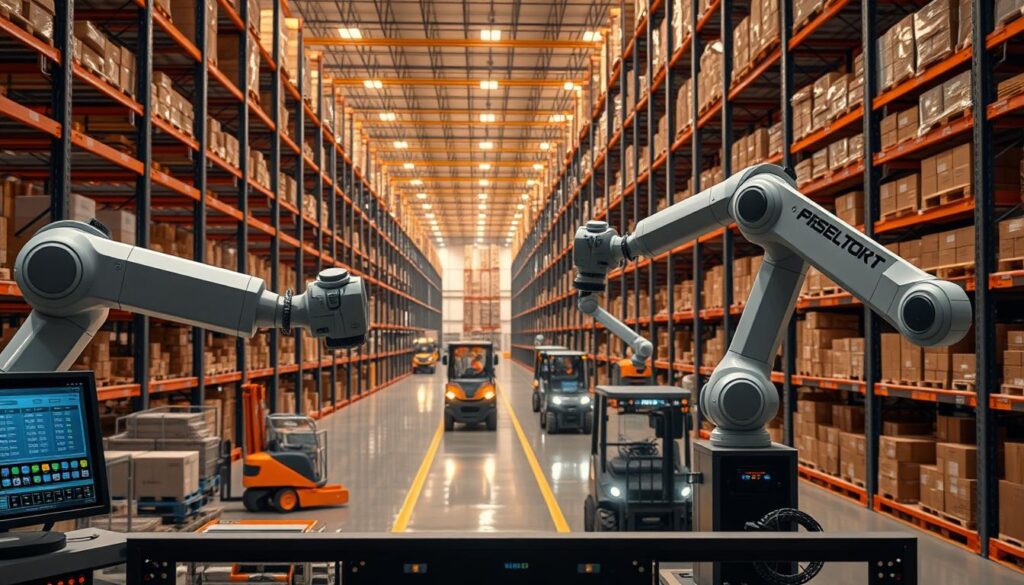
Reducing disruption from labor strikes, pandemics, and demand spikes
Automated picking, sortation, and inventory controls let your warehouses continue processing orders with limited crews. When staffing drops, modular robots and conveyor automation maintain throughput. This helps you mitigate disruption to service levels while you redeploy human teams to critical exception handling.
Automation’s role in diversifying channels and routing
Route diversification matters for cross-border flow and domestic backups. Pairing automated domestic fulfillment with resilient carriers improves inventory availability. Airlines such as EVA Air demonstrate that reliable cargo frequencies link distant markets. You can mirror that reliability through cargo route automation and flexible carrier partnerships.
Building redundancy and rapid scaling using automated systems
Modular micro-fulfillment centers and portable robots let you add capacity quickly where demand spikes. AI-driven orchestration reroutes orders among facilities to sustain service during local outages. You gain geographic redundancy and the ability to scale up without large, slow capital projects.
| Risk Type | Automated Response | Business Benefit |
|---|---|---|
| Labor strike | Automated sorting and pick-to-light systems | Maintain order flow and reduce backlogs |
| Pandemic absenteeism | Robotic fulfillment pods and remote monitoring | Keep essential operations running with small teams |
| Demand spike | Micro-fulfillment clusters and dynamic slotting | Scale pickup and delivery capacity quickly |
| Transport disruption | Cargo route automation and multi-carrier routing | Protect cross-border inventory flow through route diversification |
| Localized outage | AI orchestration to re-route orders | Preserve SLAs and customer experience |
Impact on last-mile delivery economics
When you weigh last-mile automation, you must balance cost, speed, and customer expectations. Urban density, order frequency, and palletization choices change the math. Micro-fulfillment economics shift when you trade longer routes for smaller, closer facilities that raise capex but cut per-mile labor and time.

Micro-fulfillment centers and lockers
Placing micro-fulfillment centers near dense neighborhoods shortens delivery distance. That reduces drive time and failed-delivery incidents. Lockers and pickup points lower last-mile labor and return costs, while improving predictability for same-day service.
Micro-fulfillment economics depend on unit volume and density. If you can route many orders from a single node, the higher facility capex pays off through lower per-delivery costs and improved last-mile ROI.
Autonomous delivery pilots
Autonomous delivery pilots, such as ground robots and drones, aim to cut repetitive labor on short routes. You can reduce variable wage costs, but pilots face safety checks, airspace rules, and local permitting before scale-up.
Run pilots with clear metrics: cost per delivery, failed delivery rate, and regulatory delays. Compare outcomes to conventional van routes to quantify marginal gains in last-mile ROI.
Tradeoffs between speed, cost, and environmental footprint
Faster delivery often raises per-unit cost and emissions unless you optimize routing and consolidate trips. Automation can lower per-delivery labor, yet requires CAPEX and electricity or battery resources.
Measure carbon per parcel alongside cost metrics. That helps you find strategies where automation improves both environmental footprint and economic performance.
How to evaluate pilots in the U.S.
Design controlled pilots that reflect realistic scale paths. Use scenarios that mimic phased frequency growth to forecast network effects and scale economies.
Track a core set of KPIs: cost per delivery, failed-delivery rate, carbon footprint per parcel, customer satisfaction, and regulatory constraints. Use these measures to model last-mile ROI across expansion scenarios before committing to broader rollouts.
Regulatory, safety, and ethical considerations
The rise of automation in retail forces you to weigh rules, safety, and ethics as you plan deployments. Clear governance helps you meet compliance and protect workers while you scale robotics and AI across fulfillment sites.
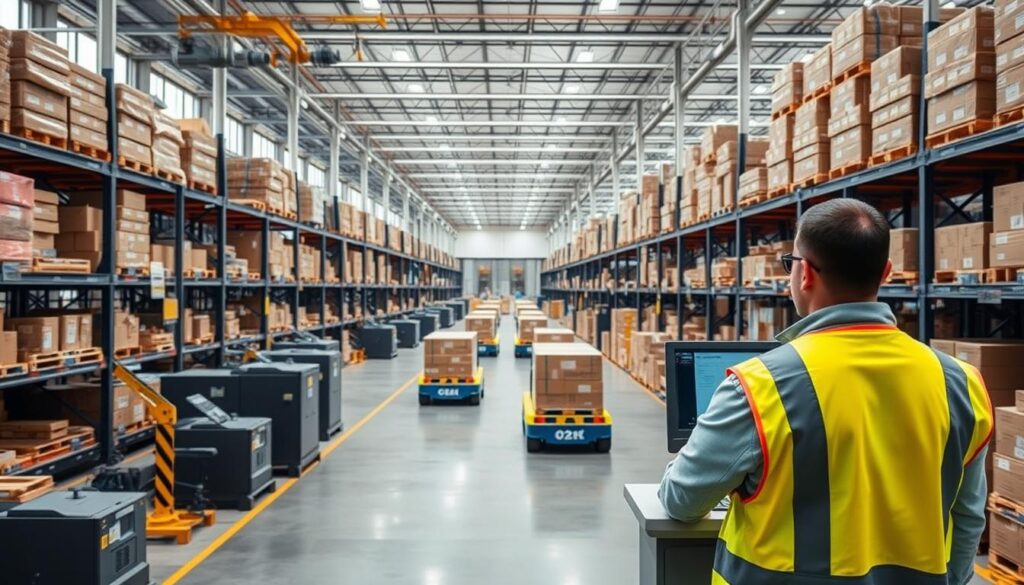
Labor and safety rules for automated facilities
You must align systems with OSHA standards and local codes for mixed human-robot environments. Establish safety zones, emergency stop protocols, and regular maintenance checks to reduce risk. Vendor agreements should require documented training, on-site audits, and incident reporting. These steps make automation regulations a working part of daily operations.
Data governance, model transparency, and vendor oversight
When AI agents make operational choices, you need clear policies for data privacy AI and model explainability. Include service-level agreements that mandate security audits, logging, and third-party review. Require vendors to provide documentation on training data, bias testing, and update cycles so your procurement meets governance standards.
Ethical planning for workforce transitions
Anticipate community-level job shifts and design programs that limit harm. Pair automation with reskilling initiatives, hiring guarantees, and partnerships with workforce boards and community colleges. Fujitsu and other industry leaders emphasize human‑AI co-creation as a model for balanced change. Your approach should reflect workforce ethics automation in planning, budgeting, and public outreach.
Below is a compact comparison to help you structure compliance and social programs across three focus areas.
| Focus Area | Key Actions | Governance Tools |
|---|---|---|
| Safety & compliance | Define safety zones; conduct monthly audits; train mixed teams | OSHA checklists; maintenance logs; incident tracking |
| Data & algorithmic governance | Enforce access controls; require model explainability; schedule security scans | SLAs; third-party audits; data retention policies |
| Workforce & community impact | Offer reskilling; create hiring pledges; fund local training | Partnership agreements; reporting metrics; public-private programs |
Case studies and industry examples of automation in retail
You can learn practical lessons from real deployments that pair robotics, software, and logistics. Retail automation case studies show how phased pilots reduce risk and unlock measurable gains in throughput, accuracy, and cost per order.

Fulfillment robotics examples from Walmart and Target highlight common pilot KPIs. You should track picks per hour, order accuracy, and depot dwell time. These retailers saw steady improvements after moving from single-line tests to multi-aisle rollouts.
Look at Kroger’s use of Ocado-built micro-fulfillment centers for a picture of scale. You can compare initial capex and subsequent labor savings to estimate payback. These retail automation case studies provide benchmarks you can adapt for your operations.
Logistics partnerships widen the scope of what automation can deliver. When retailers pair with carriers and integrators, they gain reach and resiliency. Examples include joint ventures that add cross-border capacity and increase routing options for peak seasons.
EVA Air’s cargo-to-passenger expansion offers aviation lessons supply chain planners can use. The carrier ramped frequency slowly, moving from a few weekly services to daily flights. You should consider the same phased approach when scaling automated sites to balance utilization and cost.
Use a simple checklist when evaluating partners: integration capability, SLA metrics, and shared KPIs. Logistics partnerships that include committed frequencies or guaranteed lanes help you plan inventory and automation ramp-up with confidence.
Fulfillment robotics examples vary by task. Some robots focus on sorting and tote movement, while others assist packing and palletizing. You should map robotic roles to your highest-cost labor tasks to maximize ROI and reduce friction during deployment.
Finally, blend aviation lessons supply chain into your rollout plan. Phase increases in capacity, monitor utilization, and adjust schedules to match demand. That approach limits costly idle time and helps you scale automation on predictable terms.
Evaluating vendors and building a full-stack automation strategy
You need a clear path when you evaluate automation vendors for retail supply chains. Start with business goals, not features. Map KPIs such as throughput, accuracy, and total cost of ownership before you engage providers.

What to look for in robotics and AI platform providers
Prioritize vendors with proven retail integrations and service-level agreements that match your uptime needs. Check cybersecurity posture, maintenance plans, and documented results from deployments at peers like Walmart or Target.
Ask whether the provider offers industry-specific AI agents or supports custom agent development. Test real-world scenarios for order surges, returns processing, and mixed pallets to verify performance.
Importance of interoperable infrastructure and vendor partnerships
Choose systems that plug into your WMS and ERP without heavy rework. Favor hardware-agnostic setups that let you swap robots or conveyors while keeping software intact.
Look for evidence of co-engineered ecosystems, such as collaborations between Fujitsu and NVIDIA, which show how CPU/GPU stacks and software can scale AI agents. Strong vendor partnerships reduce integration costs and speed deployments.
Checklist for procurement, pilot design, and phased rollout
Use a pilot checklist that forces clarity on scope, duration, and success criteria. Define baseline metrics, integration points, safety requirements, and data governance before signing contracts.
- KPIs and baseline metrics
- Integration points with WMS/ERP
- Safety and compliance requirements
- Data ownership and governance
- Pilot duration, scale, and exit criteria
- Vendor responsibilities and SLAs
- Financing terms: lease versus purchase
- Phased rollout plan by geography and capacity
Design pilots to mirror operational scale. Start small, validate against the pilot checklist, then expand by geography or throughput. This phased approach protects service levels and reduces risk while building toward a full-stack automation strategy.
Financing and public policy incentives for automation projects
You need a clear finance plan before you commit to automation investments. Options range from outright capex to leasing, vendor financing automation, and performance-based contracts. Each path changes your cashflow, tax treatment, and depreciation schedule.

Leasing can lower initial outlays and speed deployment. Capex gives you asset ownership and potential tax benefits over time. Vendor financing automation often bundles equipment, software, and service into one agreement, which may simplify procurement and align incentives with uptime.
Federal, state, and local programs can shift the math on a project. Public incentives automation includes tax credits, grant programs, and training subsidies that offset capital costs or fund reskilling. You should map available incentives in your target regions, such as Texas markets or Midwest manufacturing hubs, to find the highest net benefit.
Public-private partnerships workforce initiatives help bridge deployment and community impact. Partner with community colleges, workforce boards, and city economic development offices to secure funding for retraining. Vendor-backed training programs from companies like Siemens or Rockwell can strengthen these collaborations.
Use a decision framework when evaluating options:
- Estimate total cost of ownership under capex, lease, and vendor financing automation.
- Quantify expected incentives, including credits and workforce grants from public incentives automation.
- Model cashflow and payback under conservative productivity gains.
- Assess workforce transition costs and opportunities from public-private partnerships workforce efforts.
| Financing Option | Cashflow Impact | Tax / Accounting | Best Use Case |
|---|---|---|---|
| Capex purchase | High initial outlay, long-term lower operating cost | Depreciation schedules, potential Section 179 benefits | Stable long-term sites with predictable volumes |
| Equipment lease | Lower upfront cost, higher recurring expense | Operating lease treats payments as Opex in many cases | Pilot projects, fast technology refresh cycles |
| Vendor financing automation | Bundled payments tied to performance or uptime | Varies by contract; can shift expense to Opex | When vendor supports integration and training |
| Performance-based contract | Payments tied to throughput or savings achieved | Often treated as service expense | Risk-sharing pilots and shared-savings models |
| Public incentives automation | Direct grants, tax credits, or training subsidies | Reduces effective project cost and improves ROI | Projects that create jobs or advance manufacturing |
Start discussions early with finance, legal, and local economic offices. Early alignment makes it easier to stack vendor offers with public incentives automation and to design public-private partnerships workforce programs that reduce disruption and speed adoption.
The Economics of Automation in Retail Supply Chains
Start with a clear lens on cost, productivity, and strategic value when you assess automation investments. You must bring together capital spending, operating costs, labor shifts, and resilience benefits to build a complete picture. Use measurable outcomes such as fewer stockouts, higher customer lifetime value, and lower return rates to ground estimates in real business impact.

Bringing together cost, productivity, and strategic value
Break down capex and opex into discrete line items: equipment, integration, compute, maintenance, energy, and software subscriptions. That lets you trace where savings and new costs occur over time.
Measure productivity gains with clear KPIs: throughput per hour, order accuracy, and inventory turns. Tie those KPIs to revenue effects like reduced stockouts and improved customer retention.
Quantitative frameworks you can use to assess net economic impact
Apply discounted cash flow (DCF) to capture multi-year benefits and costs. Include a total cost of ownership (TCO) view that folds in compute spend and cloud or on-premise software fees.
Use scenario analysis to model demand swings and sensitivity testing to see how labor-price changes or throughput shifts alter payback. Pilot projects should record baseline and post-deployment metrics so you can quantify automation impact with confidence.
How full-stack AI and compute partnerships shift the economics
Optimized hardware-software stacks change unit economics for AI-driven automation. Partnerships between Fujitsu and NVIDIA bring tuned compute platforms that lower inference latency and speed training.
Faster, cheaper model runs reduce operational compute costs and can shorten payback periods. Track full-stack AI economics by capturing model performance, utilization rates, and the incremental revenue or cost avoidance tied to improved decisions.
Practical next steps: run a controlled pilot with clear KPIs, an explicit compute plan, and staged scaling assumptions. Use automation economics frameworks to quantify automation impact at each stage. Update your DCF and TCO as real data arrives so you can make timely investment decisions.
| Analysis Area | Metric | How to Measure | Business Effect |
|---|---|---|---|
| Capital & Integration | Capex per site | Purchase + installation invoices | Initial cash outflow for automation deployment |
| Operating Costs | Opex per month | Energy, maintenance, software subscriptions | Ongoing expense that affects margins |
| Productivity | Throughput / hour | Order counts divided by active hours | Direct driver of revenue and labor efficiency |
| Customer Outcomes | Stockout rate | Percentage of SKU stockouts per period | Impacts sales and lifetime value |
| AI Compute | Cost per training/inference | Cloud/on-prem invoices, GPU hours | Key input to full-stack AI economics and Fujitsu NVIDIA impact |
| Financial Modeling | NPV / Payback | DCF with scenario and sensitivity inputs | Decision metric for scaling investments |
Conclusion
You should view retail automation as a strategic investment that balances upfront capital, ongoing operating costs, workforce changes, and improved customer value. Use phased pilots with clear KPIs to test assumptions and measure throughput, accuracy, and return on capital. These automation takeaways help you avoid costly full-scale rollouts without validated performance data.
Partner with vendors that integrate compute and AI strategy—examples include Fujitsu and NVIDIA-style full‑stack approaches—to speed returns and lower implementation risk. Factor logistics partnerships and resilient transport links, drawing lessons from long-term cargo networks like EVA Air, into your end-to-end design so your automation plan supports routing flexibility and capacity scaling.
Combine robust financial modeling, available public incentives, and workforce programs to maximize net economic benefits while addressing safety, regulatory, and ethical concerns. For practical next steps retail automation, prioritize pilots that align with vendor interoperability, define reskilling paths for staff, and build dashboards that track cost per order and inventory turn to demonstrate value.
FAQ
What do you mean by “automation” in retail supply chains?
Automation includes warehouse robotics (picking robots, AGVs, robotic sortation), autonomous last-mile delivery pilots (ground robots and drones), AI agents for planning and execution (demand forecasting, dynamic slotting, routing, exception handling), and integrated full‑stack compute+software platforms that link sensors, control systems, and decision models. It covers both hardware and the high‑performance CPU/GPU stacks needed for real‑time control and continuous learning.
Why should your retail business prioritize automation now?
Automation addresses persistent labor shortages and rising wages, improves throughput and order accuracy, and enables faster delivery windows customers expect. It also strengthens resilience against strikes, absenteeism, and demand spikes. When paired with resilient transport partnerships and reliable cargo routes, automation helps maintain inventory flow and omnichannel fulfillment.
How does automation affect cost, speed, and customer experience?
Upfront capex (robots, conveyors, sensors, integration) raises initial costs, while ongoing opex (maintenance, energy, compute cycles, SaaS fees) sustains operations. Over time, automation lowers labor hours per order, reduces errors and returns, increases throughput, and shortens fulfillment cycles—improving customer experience and lowering long‑run unit costs. Full‑stack AI and optimized compute can further reduce per‑inference and per‑training costs, accelerating payback.
What market forces are driving adoption in U.S. retail?
Key drivers are labor pressure and wage inflation, consumer demand for same‑day/next‑day delivery and seamless returns, and vendor investment in robotics and AI. Infrastructure partnerships and airline/freight route reliability also matter because steady transport links support cross‑border sourcing and inventory replenishment.
Which technologies should you evaluate first?
Start with technologies tied to your KPIs: robotic picking and sortation for throughput and accuracy, AGVs for material movement, AI agents for forecasting and slotting, and a full‑stack compute platform for low‑latency inference. Assess whether workloads need real‑time inference (on‑prem CPU/GPU stacks) or batch forecasting (cloud), and prioritize interoperable systems that integrate with WMS/ERP.
How do you compare capex vs. opex when modeling automation projects?
Capex includes equipment, integration, and facility modifications. Opex covers maintenance, spare parts, energy, cloud or on‑prem compute, and subscriptions. Use TCO and DCF models that include sensitivity analyses for labor-price changes, throughput gains, and utilization curves to calculate payback and ROI under multiple scenarios.
What are the most important KPIs to track in pilots?
Track throughput (orders/hour), order accuracy (%), picking speed (lines/hour), cost per order, labor hours per order, inventory turns, OTIF, error and return rates, and energy/compute costs. Compare baseline vs. post‑automation and run phased pilots to validate scale assumptions and sensitivity to demand frequency.
How should you design a pilot to validate economic assumptions?
Define clear KPIs, baseline metrics, integration points, safety and governance requirements, pilot duration and scale, and vendor responsibilities. Use phased scaling—start small, then increase frequency and capacity like airlines ramp routes—to observe utilization effects and scale economies. Include compute plans and SLA terms for model performance and uptime.
What vendor attributes matter most for retail automation?
Prioritize proven retail integrations, interoperable hardware/software, cybersecurity and data governance, clear SLAs, service and maintenance plans, and experience with industry‑specific AI agents. Vendors offering co‑engineered CPU/GPU stacks and full‑stack support, as in Fujitsu–NVIDIA collaborations, can reduce deployment friction and compute costs.
How do compute and AI infrastructure choices change economics?
Optimized compute stacks that tightly couple CPUs and GPUs lower inference latency and training time, reducing per‑order compute costs and improving model responsiveness. That shortens payback on AI-driven automation by improving throughput and reliability compared with suboptimal compute choices.
What are the labor and workforce implications?
Automation reduces demand for repetitive pick‑and‑pack roles while increasing demand for higher‑skill positions—robot technicians, system integrators, AI model operators, and data analysts. Successful programs reskill and redeploy workers into supervisory and technical roles and design human‑AI co‑creation workflows to augment judgment and exception handling.
How do you address ethical and community impacts from automation?
Plan reskilling, redeployment, and public‑private partnerships to mitigate concentrated job losses. Offer retraining programs, hiring guarantees, and collaborate with local workforce institutions. Build transparency into procurement and vendor contracts to ensure fair outcomes and community support.
What regulatory and safety issues should you consider?
Ensure compliance with OSHA and local regulations for human‑robot interactions, safety zones, and maintenance procedures. For last‑mile pilots, factor in FAA and state rules for drones and local ordinances for ground robots. Include data privacy, model explainability, and vendor governance requirements in procurement documents.
How should you evaluate last‑mile automation options?
Measure cost per delivery, failed delivery rate, customer satisfaction, carbon footprint, and regulatory constraints. Compare micro‑fulfillment plus lockers versus autonomous ground or aerial delivery. Run controlled pilots and model scale effects to identify when last‑mile automation lowers unit cost without increasing emissions or service failures.
How do resilient transport links affect automation value?
Reliable cargo and air routes underpin inventory flow and cross‑border sourcing. Steady freight capacity and frequency reduce stockouts and support geographic redundancy for automated fulfillment. Examples like EVA Air’s DFW–TPE cargo service show how phased frequency increases stabilize supply and enable retailers to scale automated downstream operations.
What financing and incentive options exist for automation projects?
Capital options include outright purchase, leasing, vendor financing, and performance‑based contracts. Explore federal, state, and local incentives for automation, manufacturing, and workforce training. Consider tax treatment and depreciation schedules to optimize cash flow and partner with public entities for training grants.
What procurement checklist should you use when selecting vendors?
Require ROI and pilot KPIs, integration points with WMS/ERP, safety and OSHA compliance, data governance and security audits, SLAs for uptime and performance, maintenance plans, financing terms, and proof points from retail deployments. Include computing requirements and vendor support for AI agent lifecycle management.
How do you quantify net economic impact of automation?
Use DCF for multi‑year ROI, TCO including compute and subscription fees, scenario analysis for demand variability, and sensitivity testing for labor rates and throughput gains. Include indirect effects like reduced stockouts, higher customer lifetime value, and lower return rates to capture the full benefit stream.
What are common tradeoffs and risks to watch for?
Upfront capex and integration complexity, ongoing energy and compute costs, regulatory barriers for last‑mile pilots, potential community displacement, and interoperability issues with legacy systems. Balance speed of delivery against cost and environmental footprint, and mitigate risks through phased rollouts and vendor SLAs.
How can public‑private partnerships help your automation program?
Partnerships can fund reskilling and training, provide local incentives or tax credits, and smooth community transition plans. Collaborating with local governments and training institutions accelerates deployment while addressing ethical and workforce concerns and leveraging region‑specific growth incentives.
What lessons from aviation and logistics scaling apply to automation rollouts?
Scale gradually and monitor utilization—airlines ramp frequencies to match demand and control unit costs. Apply the same phased approach to automation: pilot, ramp capacity, and expand frequency to achieve scale economies while managing disruption and capital utilization.
What immediate steps should you take to start an automation program?
Establish baseline KPIs, run a focused pilot with defined metrics, select interoperable vendors with compute capabilities, design workforce transition plans, and build scenario‑based ROI models. Include financing options and explore public incentives to reduce initial cost barriers.
Fall Picks
fall essentials
As an affiliate, we earn on qualifying purchases.