
TL;DR

Get business pricing on tech for your team
- Business-only prices and quantity discounts
- Tax-exempt purchasing
- Multiple users, one account, clear invoices
A developer has created and tested a custom x86 BIOS to boot MS-DOS on Behringer’s DDX3216, which uses an AMD Elan SC300 386 processor. This demonstrates hardware hackability of the device, but many technical challenges remain.
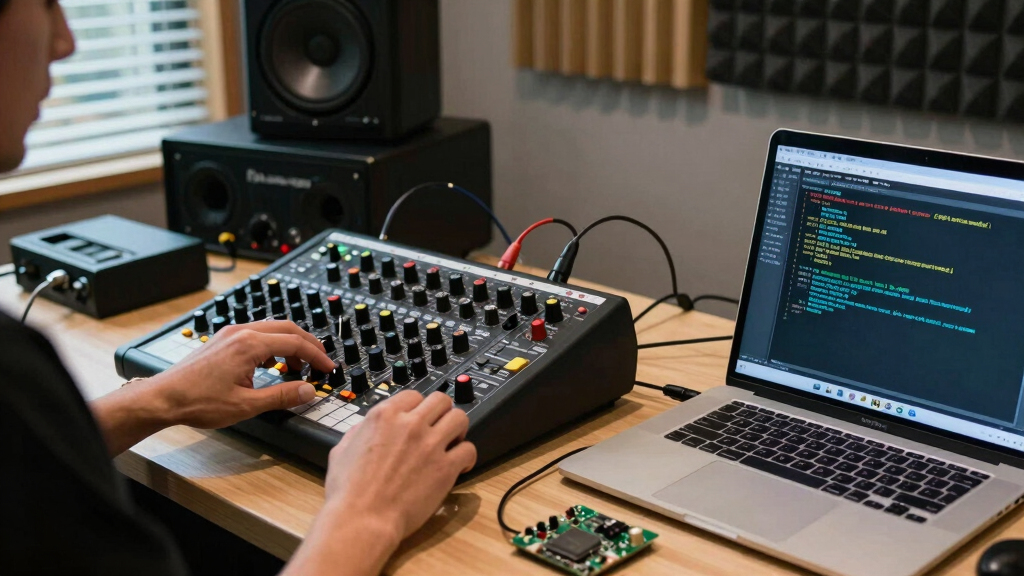
A hobbyist has successfully booted MS-DOS on the Behringer DDX3216, a digital mixer that uses an AMD Elan SC300 386 processor, by developing a custom x86 BIOS from scratch. This breakthrough reveals the device’s hardware is capable of running legacy operating systems, opening possibilities for hardware hacking and custom firmware development.
The DDX3216 contains a range of hardware components, notably the AMD Elan SC300 386 SoC, which is compatible with x86 architecture. The developer, active on Hacker News, undertook the complex task of creating a BIOS that initializes the hardware and enables booting legacy systems like MS-DOS.
Initial efforts focused on understanding the boot process of x86 systems, particularly the role of the reset vector at address 0xFFF0, where the CPU begins execution after reset. The developer created a minimal reset vector in assembly language that disables interrupts and jumps to the BIOS startup code, then compiled and placed it at the correct memory location on the device’s ROM chip.
After several iterations, the developer managed to get the device to execute the custom BIOS, which then successfully booted FreeDOS 1.4, a modern open-source implementation of MS-DOS. This confirms that the hardware can support a full x86 BIOS and legacy OS boot processes, despite the device’s original firmware and design.
Implications for Hardware Hacking and Legacy OS Support
This development demonstrates that even specialized consumer hardware like the Behringer DDX3216 can be repurposed to run legacy operating systems, highlighting potential for hardware hacking, retrocomputing, and custom firmware projects. It also underscores the flexibility of the device’s hardware architecture, which was not originally intended for such use, but is compatible with x86 BIOS standards.
For enthusiasts, this opens new avenues for exploring embedded systems, creating custom firmware, and understanding the boot processes of legacy hardware. It also raises questions about the security and firmware update practices of such devices, which may be more open to modification than originally assumed.
As an affiliate, we earn on qualifying purchases.
Hardware and Firmware Background of the DDX3216
The Behringer DDX3216 is a digital mixer from 2004, notable for its use of an AMD Elan SC300 386 SoC, a processor compatible with early x86 systems. The device contains various memory chips, flash storage, and interfaces, making it theoretically capable of running a standard BIOS and legacy OSes.
Historically, the device’s firmware was proprietary, with limited documentation available. The developer’s efforts focused on reverse-engineering the hardware, understanding the boot process, and developing a custom BIOS that can initialize the hardware and load an OS like MS-DOS or FreeDOS. Prior attempts to find existing BIOS images or support from manufacturers proved unsuccessful, prompting a DIY approach.
This effort aligns with broader hobbyist movements exploring embedded system hacking and legacy OS support on unconventional hardware platforms.
“Creating a BIOS from scratch for the SC300 was a complex but rewarding process, revealing the hardware’s true potential beyond its original firmware.”
— Hacker News developer
As an affiliate, we earn on qualifying purchases.
Technical Limitations and Compatibility Uncertainties
While the developer successfully booted FreeDOS, it remains unclear whether more complex or modern DOS variants, or other legacy operating systems, can be supported without further modifications. Hardware stability, peripheral support, and performance on the custom BIOS are still being evaluated. Additionally, the full extent of the device’s hardware compatibility, especially regarding audio and control interfaces, is not yet confirmed.
Further testing is needed to determine if this approach can be generalized or if it remains a proof of concept specific to this hardware configuration.
As an affiliate, we earn on qualifying purchases.
Next Steps for Hardware Exploration and Software Development
The developer plans to refine the custom BIOS, improve hardware compatibility, and attempt to boot other legacy systems such as MS-DOS 6.22. They also aim to document the process for community replication and explore potential applications, including running custom firmware or alternative operating systems.
Further technical analysis will focus on peripheral support, stability, and potential for broader hardware hacking projects. The community may see additional updates as these efforts progress.
As an affiliate, we earn on qualifying purchases.
Key Questions
Can the DDX3216 run modern operating systems?
Currently, the device is confirmed to boot MS-DOS and FreeDOS. Running modern OSes would require significant hardware modifications and support for more advanced hardware features, which are not yet demonstrated.
What hardware components make this possible?
The key component is the AMD Elan SC300 386 SoC, which is compatible with x86 architecture, allowing legacy BIOS and DOS support. The device’s memory and storage also support booting standard BIOS routines.
Is this hacking effort officially supported by Behringer?
No. This is a community-driven, hobbyist project with no official support or endorsement from Behringer. Modifying the device may void warranties and could affect functionality.
Could this approach be used for other embedded devices?
Potentially, yes. Devices with x86-compatible processors and accessible ROM or firmware chips could be targeted for similar custom BIOS development, but each device’s hardware specifics must be carefully analyzed.
Source: Hacker News
Fall Picks
fall essentials
As an affiliate, we earn on qualifying purchases.