Automation is likely to hollow out the middle class by replacing many routine, middle-skill jobs with AI and machines, leading to job losses and widened income gaps. While some high-skill roles grow, many people face wage stagnation or displacement, making it harder to maintain middle-class stability. If you want to understand how this trend impacts your future and what strategies can help, there’s more to explore.
Key Takeaways
- Automation threatens routine middle-skill jobs, leading to job displacement and increased economic inequality.
- Wage growth for middle-income workers has stagnated, widening income gaps and reducing middle-class stability.
- The shift favors high-skill, high-wage roles and low-skill service jobs, causing job polarization.
- Workforce development strategies like upskilling and infrastructure investments aim to mitigate middle-class erosion.
- Policy measures focused on education, social safety nets, and technological access are vital for middle-class resilience.
Understanding the Automation Threat to Middle-Income Jobs

Automation poses a significant threat to middle-income jobs, especially those involving routine, repetitive tasks. Nearly half of U.S. workers, about 47%, are at risk of losing their jobs to automation within the next decade. Tasks like data entry are particularly vulnerable; by 2030, up to 38% could be automated, with some sectors seeing near-complete displacement. Middle-class roles that rely heavily on repetitive or data-driven work are especially at risk. As automation advances, wages in these sectors may stagnate or decline, while demand shifts toward high-skill, high-wage positions. This trend could deepen income inequality, impacting the stability of middle-income employment. Global job loss projections indicate that 300 million jobs could be lost to AI by 2025, which underscores the urgency of understanding how automation could reshape the job landscape you depend on. As the automation revolution accelerates, workers may need to develop new skills to remain competitive in an evolving job market. Additionally, the increasing availability of appliances that automate household chores exemplifies how automation is extending beyond workplaces into daily life, potentially reducing the need for certain domestic roles. Recognizing the importance of technological adaptability can help individuals better prepare for these shifts and embrace new opportunities in changing environments. Moreover, understanding the impact on employment sectors can assist workers in identifying which areas may require targeted skill development to stay relevant.
The Shift in Employment Patterns and Job Polarization

You’ve probably noticed that wage gaps are widening and middle-skill jobs are shrinking. This shift favors high-wage, high-skill roles while undermining opportunities for middle-income workers. As automation advances, the decline of middle skills deepens economic inequality and alters traditional employment patterns. From 1979 to 2019, U.S. wages for middle/entry-level workers increased only 17.2%, highlighting how automation may be contributing to stagnant wages for lower and middle-income earners. Additionally, essential oils for job-related stress have been used in alternative health practices to promote relaxation and reduce anxiety during challenging work scenarios. The changing nature of job requirements underscores the importance of adapting skill sets to meet new technological demands, including the evolving need for home decor skills like wall organization and multifunctional furnishings. Moreover, the rapid pace of AI security developments necessitates ongoing workforce reskilling to prevent job displacement and ensure economic stability. Recognizing the impact of technological change on employment can help inform policies that support workforce adaptability and economic resilience.
Rising Wage Inequality
How has technological progress driven the rise in wage inequality and reshaped employment patterns? Automation has widened income gaps, especially in advanced economies. It’s responsible for about 50-70% of wage inequality growth in the US and increases overall income disparity. Automation targets high-wage, high-rent tasks, reducing earnings for middle-skill workers and flattening wages within affected groups. This process also widens gaps between different worker groups. Key points include:
- Automation pushes routine jobs into low-wage, low-skill sectors
- It boosts high-skill, high-wage job growth
- Younger workers fear job obsolescence more than older ones
- Retraining is crucial, with millions expected to shift careers
- Productivity gains are often negated by rent dissipation, worsening wage outcomes
- AI’s expanding capabilities have further accelerated the automation of complex tasks, impacting high-skill workers. Additionally, the decline in middle-skill jobs has been linked to job polarization, which contributes to widening income disparities. Recognizing the importance of technological adaptation can help mitigate some of these adverse effects. Moreover, advancements in catering and delivery services exemplify how technological innovations are transforming sectors and employment opportunities across the economy. A focus on worker reskilling initiatives is essential to address the challenges posed by automation and ensure a more equitable labor market.
Furthermore, fostering technological literacy among workers can empower them to adapt more effectively to ongoing changes.
Decline in Middle Skills
The changing landscape of employment reflects a clear shift away from middle-skill jobs, driven by automation’s impact on the labor market. Routine tasks in roles like clerical work, data processing, and manufacturing are increasingly automated, causing a steep decline in middle-skill employment. Data shows that up to 23% of these jobs could disappear in the US and Europe. Meanwhile, low-skill service jobs and high-skill professions remain more resilient. As automation favors high-skill roles requiring advanced education and creativity, the middle-skill sector shrinks. This shift leads to job polarization, with growth at both ends of the spectrum but a shrinking middle. The result: fewer stable middle-class jobs, increased inequality, and challenges for workers trying to adapt to the changing demand for skills. Additionally, the trend toward maximizing space and organization in workplaces and homes reflects a broader societal effort to adapt efficiently to these shifting employment patterns. Recognizing the importance of workforce adaptability can help societies develop strategies to mitigate the adverse effects of job polarization and support ongoing economic stability. As technological advancements continue to evolve, the need for continuous skill development becomes more critical for maintaining employability in a dynamic job market. Embracing educational innovation can also help bridge the skills gap and prepare workers for future opportunities. Philosophical insights on existence and ethics can offer valuable perspectives on navigating the societal implications of this transformation.
How Generative AI Is Reshaping Middle-Class Professions

Generative AI is transforming middle-class professions by automating tasks that once required specialized skills and higher education. This shift risks disrupting over 30% of workers, especially in sectors like engineering, law, and architecture. Women are slightly more affected than men, with nearly half of them facing job impacts. It also challenges the value of traditional degrees, pushing for more skills-based training. You might notice that:
Generative AI threatens over 30% of middle-class jobs, especially in engineering, law, and architecture.
- Middle-skill jobs could face significant disruption.
- AI may help rebuild some middle-class roles lost to earlier automation.
- Lower-wage and service jobs are less impacted due to automation complexities.
- Sector-specific effects are more pronounced in fields needing advanced expertise.
- Workforce development needs to prioritize adaptable, skills-based programs to reduce inequality.
- Research shows that generative AI has the potential to significantly disrupt a wide range of jobs across sectors, emphasizing the need for proactive strategies to support workers. Additionally, advancements in home furnishings and related industries could influence job requirements and skill sets, further shaping the evolving employment landscape.
This evolution could reshape your career landscape, emphasizing continuous learning and agility.
Economic Impacts of Automation on Business and Workers
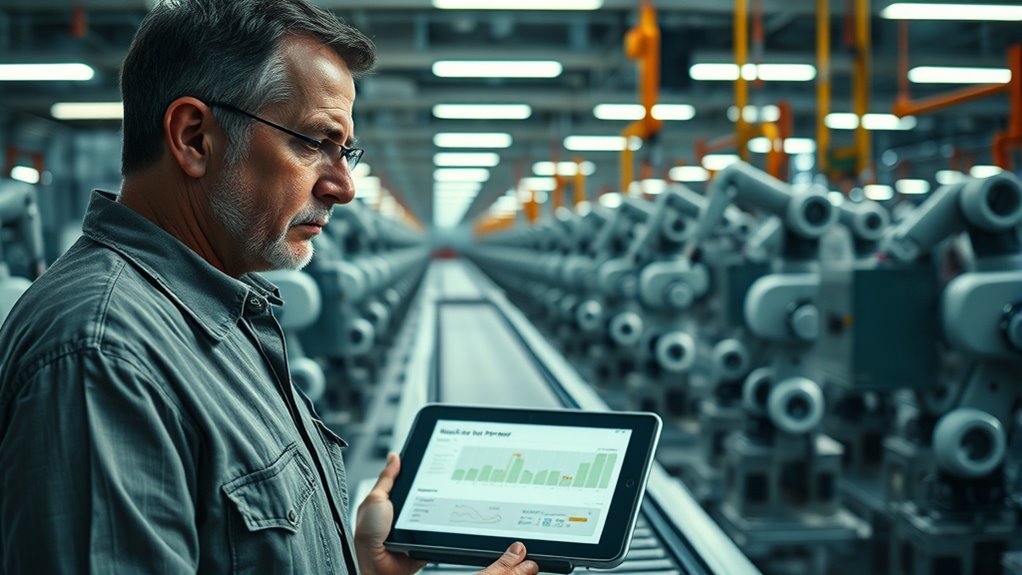
Automation revolutionizes business operations by boosting efficiency and cutting costs, allowing companies to stay competitive in a global economy. By reducing manual labor in routine processes, you can reallocate human resources to more strategic, high-value tasks. Although upfront investments are significant, automation promises long-term savings and productivity gains. However, this shift impacts workers, especially those in middle-wage jobs like office clerks, accountants, and manufacturing workers, who face displacement. Retail positions and entry-level programming roles are also at risk. As automation advances, wage stagnation and job losses in routine roles increase, widening economic inequality. To adapt, businesses and workers must focus on upskilling and restructuring around digital workflows, creating new opportunities in tech maintenance, data analytics, and hybrid roles that combine technical and interpersonal skills.
The Role of Infrastructure and Education in Adaptation

Investing in infrastructure plays a crucial role in helping workers adapt to automation-driven changes. Upgrading transportation makes it easier to access new job markets and training centers, especially in urban and suburban areas. Expanding digital infrastructure, like broadband internet, enables remote work and online learning for displaced workers. Developing community centers with technology resources supports digital literacy and job search efforts. Public-private partnerships can fund projects that boost workforce development and technological adaptation. These infrastructure improvements also strengthen regional economic resilience, helping communities better handle automation shocks. To succeed, focus on:
- Enhancing broadband access for remote work
- Upgrading transportation networks for job access
- Creating tech-equipped community centers
- Funding public-private workforce projects
- Building regional economic resilience
Strategies for Middle-Class Workers to Stay Competitive

To remain competitive in an evolving job market, middle-class workers must adopt proactive strategies that enhance their skills and adaptability. Focus on developing expertise in emerging fields like AI development and deployment, which are creating new job opportunities. Embrace continuous learning through non-degree credentials and industry-specific training to stay ahead. Cultivate technological literacy to better understand automation’s role and leverage AI tools to boost productivity. Pursue high-skill roles in healthcare, tech, or creative industries, which are less vulnerable to automation. Consider entrepreneurship or flexible work arrangements to diversify income sources and adapt to changing demands. Additionally, use AI-assisted tools to augment your skills, automate routine tasks, and make data-driven decisions, ensuring you remain valuable in a rapidly transforming economy.
Societal Consequences of Automation-Driven Job Loss

Automation-driven job loss is increasing economic inequality, making it harder for middle-class workers to keep up. As industries shift, social cohesion faces pressure from rising disparities and community instability. Addressing these challenges requires proactive policies to support affected workers and maintain societal stability.
Rising Economic Inequality
Have you noticed how automation and AI are widening the income gap between high- and low-skilled workers? As routine jobs vanish, wage disparities grow, fueling inequality. Automation has contributed to about 50–70% of the rise in U.S. wage inequality over 40 years.
- Routine middle-skill jobs are most at risk, deepening wage gaps.
- High-income roles, like AI engineers, gain bargaining power.
- Cost savings from automation boost returns to capital, not workers.
- Low-skilled jobs persist but with lower wages and less security.
- Wealth becomes concentrated among capital owners, widening wealth gaps.
While some AI-driven roles may raise productivity and wages, overall, automation shifts benefits toward those with capital, leaving middle- and low-income workers behind. This intensifies economic inequality across society.
Social Cohesion Challenges
As automation reshapes the economy by displacing millions of workers, its social consequences become increasingly evident. Job losses, especially in certain regions, threaten community stability and social cohesion. When people lose employment, it can lead to social fragmentation, reduced trust, and increased inequality. Low-skilled workers are most vulnerable, risking diminished social mobility and fairness. Communities facing displacement may struggle to maintain stability without adequate support systems like retraining programs and social services. Policymakers and businesses need to work together to develop strategies that promote resilience, such as education initiatives and social safety nets. Without targeted action, automation risks deepening societal divides, making it harder for communities to adapt and thrive in the evolving economic landscape.
Policy Measures and Future Outlook for Middle-Class Stability

To guarantee the middle class remains resilient amid technological change, policymakers are implementing targeted measures such as investing in education, upgrading infrastructure, and strengthening social safety nets. These efforts aim to equip workers with skills for new job opportunities and protect those displaced by automation. You can expect initiatives like:
- Developing education programs focused on AI and automation skills
- Investing in digital infrastructure to support AI integration
- Strengthening social safety nets for displaced workers
- Creating clear regulations for AI and automation in workplaces
- Offering incentives for upskilling and reskilling
Looking ahead, automation may shift jobs toward service and creative sectors, but also risk increasing income inequality. Policymakers must adapt fiscal policies, foster public-private partnerships, and promote global cooperation to safeguard middle-class stability in this evolving landscape.
Frequently Asked Questions
How Quickly Will Middle-Class Jobs Decline Due to Automation?
You’re wondering how fast middle-class jobs will decline because of automation. Experts estimate that up to 47% of US workers could be at risk within the next decade, especially in sectors like data entry, office work, and retail. While some jobs will transform into oversight roles, others may disappear entirely. The pace depends on technological advances and policy responses, but change is likely to accelerate over the next ten years.
What New Careers Might Emerge From Automation Advancements?
Ever wonder what new careers automation might bring? As AI and machine learning grow, you’ll see roles like AI specialists, data analysts, and system managers emerge. These jobs focus on developing, maintaining, and optimizing AI tools, plus leveraging human skills like creativity and emotional intelligence. So, instead of fearing change, think about how you can adapt and thrive in these exciting new opportunities shaping the future of work.
How Can Policymakers Effectively Support Displaced Middle-Class Workers?
You can support displaced middle-class workers by implementing policies that promote rapid reemployment and effective job matching. Invest in reskilling and upskilling programs focused on future-demand skills like AI and data analysis. Strengthen social safety nets, including extended benefits and portable support, to cushion income shocks. Encourage job creation in growth sectors through targeted investment and inclusive policies, ensuring workers have access to new opportunities and a stable economic shift.
What Industries Are Most at Risk of Automation-Driven Job Loss?
They say “know your enemy,” and in this case, the industries most at risk are the energy, manufacturing, retail, administrative, and tech sectors. You’ll find automation threatening nearly half of the jobs in energy and utilities, millions in retail, and many administrative roles. You should stay alert, as these sectors are rapidly adopting automation, which could reshape your job prospects and the broader economy.
How Does Automation Impact Income Inequality Across Different Regions?
You see that automation impacts income inequality differently across regions. In advanced economies, rapid automation widens the gap between high- and low-skilled workers, boosting income for some but displacing routine jobs. Less developed regions lag behind, risking slower growth and increased disparities. If you’re in a region with strong policies and training programs, you’ll likely experience less inequality. Without support, automation can deepen regional divides, benefiting some while leaving others behind.
Conclusion
Automation is a storm that threatens to erode the foundation of the middle class. But with awareness and proactive steps—like investing in skills and supporting smart policies—you can weather this upheaval. Think of it as steering a ship through turbulent waters; your resilience and adaptability are the compass. Stay informed, adapt swiftly, and hold onto your place in the evolving economy. Together, we can navigate toward a steadier, more inclusive future.