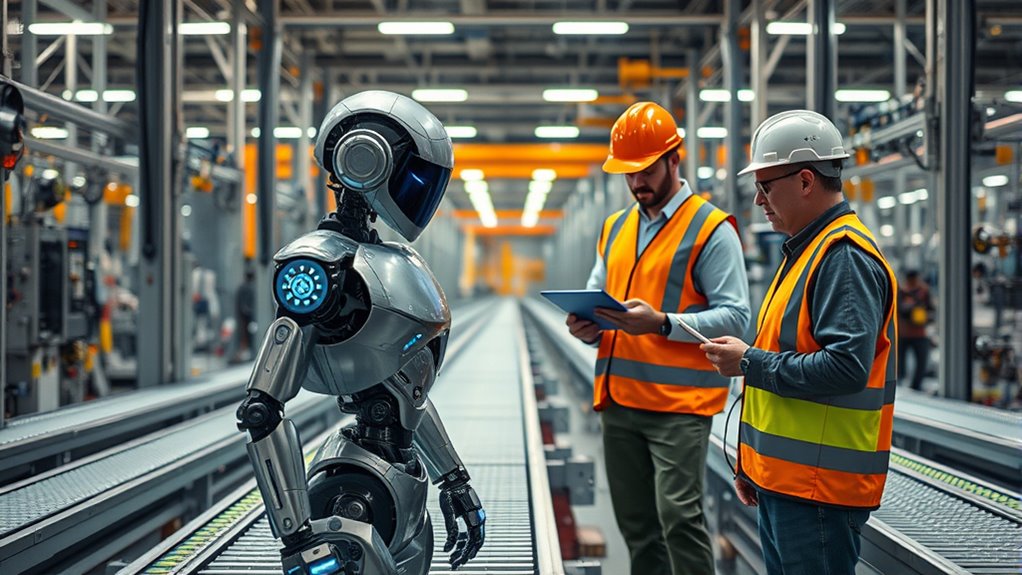

In the manufacturing productivity race, robots often outshine humans in speed, precision, and nonstop work. They handle complex tasks consistently and integrate AI for smarter operations. While robots boost efficiency and reduce costs, humans transform roles into supervision and maintenance, which require new skills. Balancing automation with workforce reskilling is key. If you want to explore how this evolving competition impacts industry and jobs, there’s more to uncover ahead.

Get business pricing on tech for your team
- Business-only prices and quantity discounts
- Tax-exempt purchasing
- Multiple users, one account, clear invoices
Key Takeaways
- Robots excel in precision, speed, and tireless operation, significantly boosting manufacturing output and consistency.
- Humans bring adaptability, complex problem-solving skills, and oversight that robots currently cannot replicate.
- Automation increases productivity by enabling continuous operations, reducing downtime, and lowering operational costs.
- Human labor is displaced or transformed, requiring reskilling to maintain economic and workforce stability.
- The optimal productivity race combines human oversight with robotic efficiency, maximizing benefits and mitigating risks.
As an affiliate, we earn on qualifying purchases.
The Rise of Industrial Robots and Their Capabilities
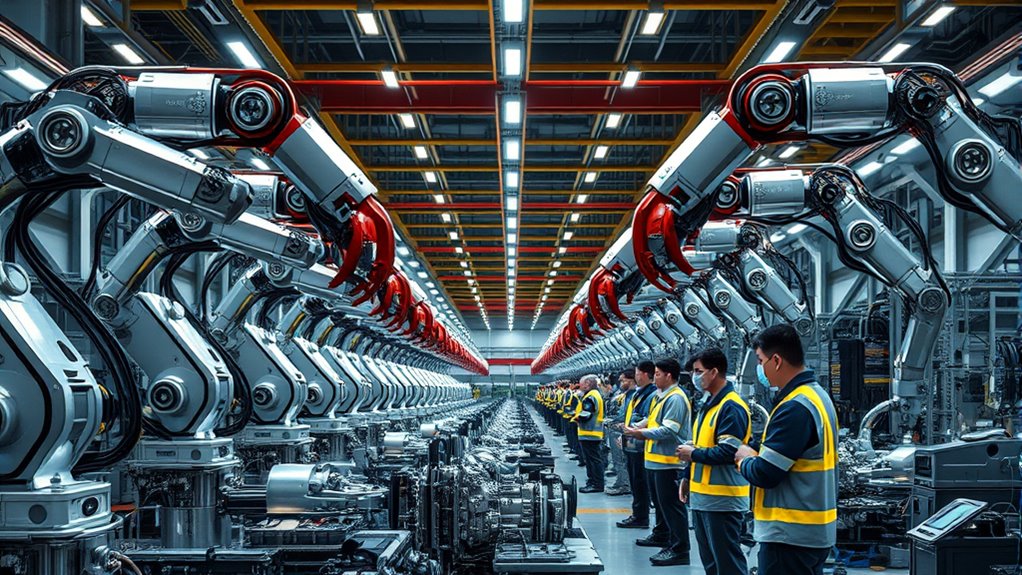
The rise of industrial robots has transformed manufacturing by dramatically increasing automation and efficiency. You’ll notice that robot adoption is surging worldwide, with robot density reaching 162 units per 10,000 employees in 2023—more than double from seven years ago. These robots come in various types, including articulated, Cartesian, parallel, and SCARA, each playing a crucial role in plastics manufacturing and beyond. Collaborative robots, or cobots, are making human-robot interactions safer and easier, allowing seamless teamwork on the factory floor. Their capabilities go beyond simple repetitive tasks; they deliver unmatched precision, handle complex operations, and work tirelessly without breaks. Thanks to AI integration, these machines are smarter, capable of analyzing real-time data, predicting maintenance, and adapting operations—making them indispensable in modern manufacturing. Global robot density is rapidly increasing, driven by the need for skilled labor shortages and the pursuit of higher productivity. Additionally, the integration of advanced automation technologies is further enhancing manufacturing processes, reducing errors, and optimizing resource utilization.
collaborative robots for manufacturing
As an affiliate, we earn on qualifying purchases.
As an affiliate, we earn on qualifying purchases.
Productivity Gains and Economic Impact of Automation
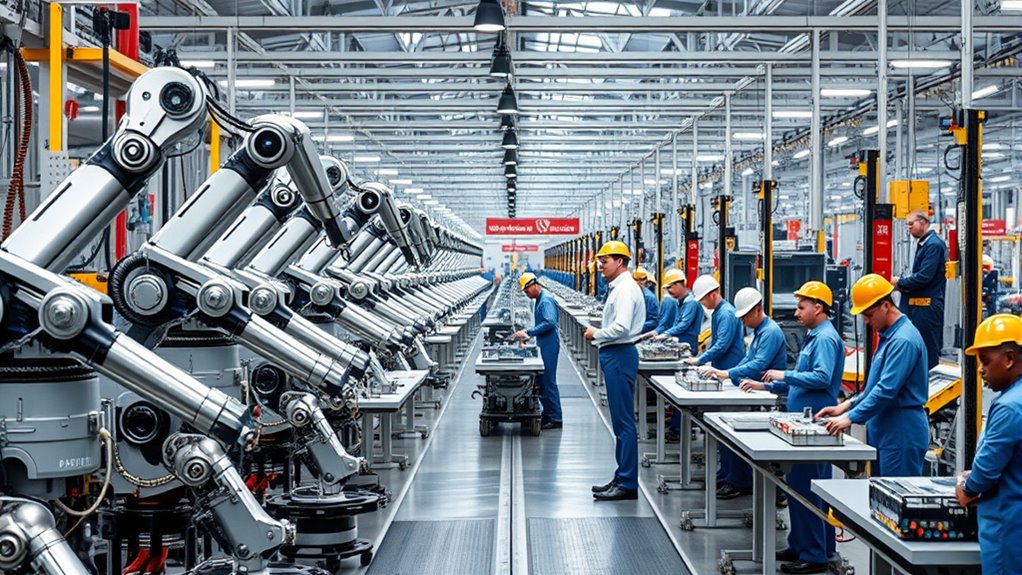
Automation drives significant productivity gains by enabling factories to operate continuously around the clock, eliminating downtime and streamlining workflows. You’ll see higher output, consistent precision, and fewer defects, which means better quality products. Automated systems can quickly scale to meet rising demand without needing more labor, allowing your business to respond flexibly to market changes. Over 90% of workers report increased productivity, and companies typically reduce operating costs by around 22%. Globally, automation could boost productivity by 1.5% annually, creating long-term economic benefits. Advancements in AI and machine learning This growth supports market expansion, with the automation industry projected to reach over $226 billion by 2025. Cost savings from automation, including lower labor and rework expenses, help improve margins and competitiveness, driving sustained economic progress.
As an affiliate, we earn on qualifying purchases.
Human Labor: Displacement, Transformation, and Reskilling
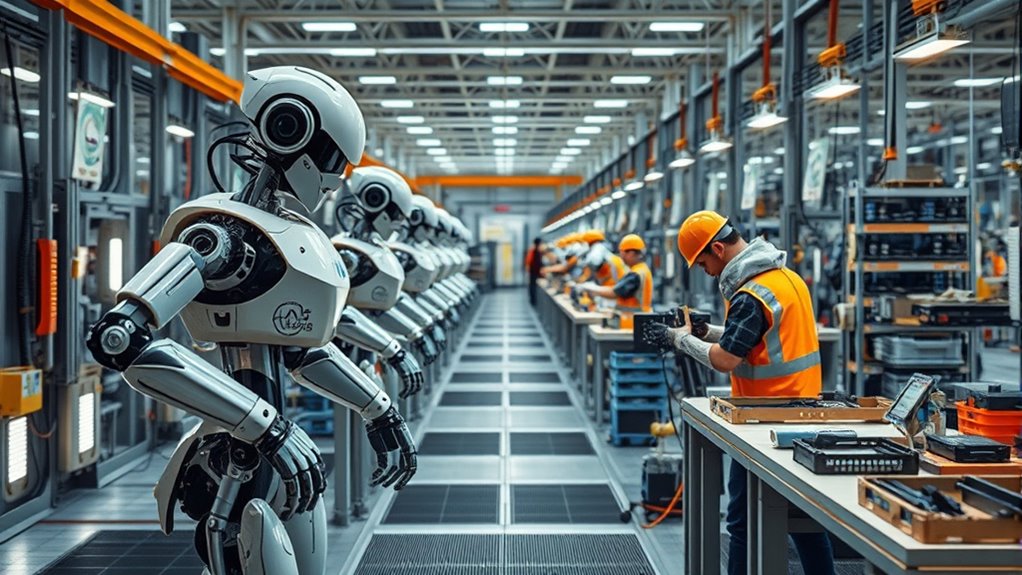
As manufacturing shifts toward automation, human labor roles are undergoing profound transformation. You’re moving from repetitive manual tasks to supervising, maintaining, and managing automated systems. Displaced low-wage workers often face wage losses and struggle to find manufacturing jobs again, especially as structural changes widen wage gaps. High-wage workers may experience downward mobility within firms, worsening job matches and reducing wages. Automation replaces routine work, pushing workers to develop skills in cognitive, interpersonal, and technical areas. Reskilling becomes essential; programs focusing on digital literacy and machine operation help displaced workers transition to growing roles. Without adequate training, unemployment persists, and economic inequality worsens, particularly for low-wage and minority workers. Your ability to adapt determines how well you navigate this evolving manufacturing landscape. The importance of continuous education cannot be overstated in ensuring workers remain competitive in a rapidly changing environment.
As an affiliate, we earn on qualifying purchases.
Resilience and Risk Management in Automated Manufacturing
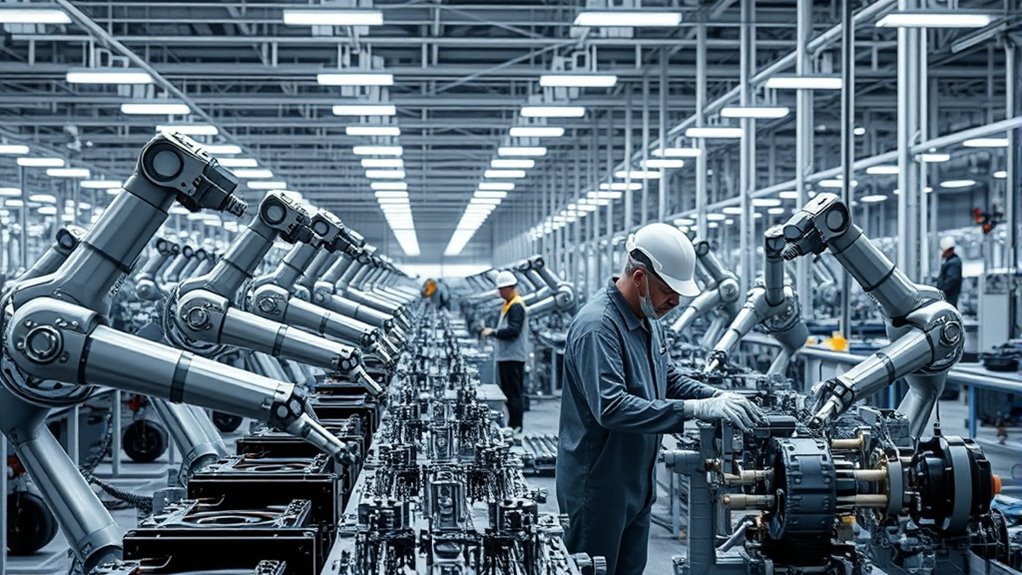
In automated manufacturing, managing risks effectively becomes essential as technological systems introduce new vulnerabilities and potential points of failure. Failures in automated systems now account for 28% of industrial claim value, nearly double that of non-automated plants. Faults in integrated systems often lead to costly repairs and extended downtime; for example, a firmware failure halted a robotic packaging line for nine days, causing over €2 million in losses. Automation’s dependence on software, system integration, and digital infrastructure raises the risk profile. This increased reliance on digital systems highlights the importance of comprehensive risk management strategies. To stay resilient, you need proactive risk assessment tools that utilize real-time data, machine learning, and visual dashboards. Implementing redundant systems, cybersecurity measures, and continuous monitoring helps mitigate threats, ensuring your operations remain stable and responsive despite automation’s vulnerabilities. Recognizing the vulnerabilities in digital infrastructure is crucial to developing effective resilience strategies.
Future Directions: Expanding Applications and Industry Evolution

Manufacturers are driving industry evolution by integrating advanced technologies like AI, IoT, and robotics to transform production processes. AI enhances efficiency and quality control through real-time defect detection and predictive maintenance, while automation streamlines localized supply chains and energy management. Smart manufacturing connects factories, leveraging IoT data for better decision-making and workflow optimization. Collaborative robots work alongside humans, handling routine and complex tasks safely, boosting productivity. Expanding applications include specialized cobots for food production, AI-powered vision systems for quality inspections, and plug & produce solutions that reduce setup times and costs. IoT and AI also enable autonomous manufacturing, minimizing human intervention. As industry evolves, localized supply chains and smart data integration become essential, driving faster, more flexible, and sustainable manufacturing environments. Incorporating interior design principles can also enhance factory layouts to improve safety and efficiency.
Frequently Asked Questions
How Do Robots Impact Small and Medium-Sized Manufacturing Enterprises?
Robots impact small and medium-sized enterprises by boosting productivity and reducing operating costs, especially when adopted through flexible models like RaaS. They help minimize delays and downtime, allowing your skilled workers to focus on higher-value tasks. However, automation can reduce employment for certain groups and influence wages. To stay competitive, you need to carefully adapt your workforce and leverage robotics to maximize efficiency without risking job stability.
What Ethical Considerations Arise From Replacing Human Workers With Automation?
You might think replacing human workers with automation is purely about efficiency, but the real ethical twists lie elsewhere. As you embrace robots, you must consider job displacement, risking financial hardship and societal division. Safety, privacy, and dignity matter too—robots should protect, not endanger, workers. Transparency and fairness are essential, so you’re not just chasing profits but fostering a workplace where technology uplifts rather than diminishes human worth.
How Quickly Can Displaced Workers Transition Into New Roles Created by Automation?
You can shift into new roles created by automation relatively quickly if you have access to effective training and upskilling programs. The speed depends on how fast you adapt, learn new skills, and receive industry support. Continuous education, collaboration with employers, and government initiatives play vital roles. Staying flexible and proactive in acquiring expertise in AI, robotics, or data analysis helps you seize emerging opportunities and stay relevant in the evolving manufacturing landscape.
What Policies Are Most Effective in Supporting Workers Affected by Automation?
Think of a safety net stretched wide beneath workers as automation advances. You’re most supported by policies that focus on retraining and upskilling, helping you gain new technical skills and adapt to changing roles. Social safety nets like income support, healthcare, and job placement ease your passage. Encouraging entrepreneurship and fostering industry partnerships also create pathways for growth, ensuring you’re not left stranded in the shifting landscape of manufacturing.
How Do Robotics Influence Global Supply Chain Sustainability and Environmental Impact?
Robotics considerably boost supply chain sustainability by reducing energy use and waste. You benefit from optimized warehouse space, lower transportation energy, and precise handling that minimizes raw material waste. Automation improves efficiency, cuts emissions, and supports green practices. However, consider that robot manufacturing and energy consumption must be balanced to maximize environmental gains. Overall, integrating robotics helps you create a more eco-friendly, cost-effective supply chain that aligns with sustainability goals.
Conclusion
As you watch this race unfold, remember that robots and humans are dancers in a complex ballet of progress. While machines lead with relentless precision, human ingenuity adds the soulful rhythm that guides innovation. The future isn’t about one winning over the other, but about harmonizing their strengths. Together, they compose a symphony of productivity, where technology amplifies human potential, creating a masterpiece of manufacturing evolution that’s both resilient and inspiring.
Fall Picks
fall essentials
As an affiliate, we earn on qualifying purchases.