Algorithms now transform every skill you need in the taxi industry, from steering routes with GPS and traffic data to managing safety with AI monitoring. Digital booking, dynamic pricing, and fleet optimization rely on real-time analytics, while autonomous vehicles demand knowledge of advanced sensors. Contactless payments and data security also shape customer interactions. If you want to discover how these innovations are changing your role and future opportunities, keep exploring the evolving tech landscape.
Key Takeaways
- Algorithms enable dynamic route optimization, shifting driver skills from map reading to interpreting digital navigation data.
- AI safety systems require technicians to develop expertise in autonomous vehicle maintenance and cybersecurity.
- Demand forecasting and data analytics necessitate skills in data management, predictive modeling, and real-time decision-making.
- Surge pricing and revenue algorithms demand understanding of pricing models, market dynamics, and customer behavior analysis.
- The rise of autonomous taxis transforms skill requirements toward vehicle technology, sensor maintenance, and algorithm oversight.
The Evolution of Taxi Navigation and Route Optimization

The evolution of taxi navigation and route optimization has dramatically transformed how drivers find and reach their destinations. You started with physical maps, relying on your knowledge of local streets and traffic patterns. In the 1940s, two-way radios allowed dispatchers to guide you via voice, improving efficiency. Mechanical meters tracked fares based on distance and time, laying the groundwork for digital systems. Later, digital meters provided real-time updates, integrated with GPS and dispatch software. GPS technology revolutionized route planning, offering precise location data and traffic info to reduce travel time. Mobile data terminals and sophisticated dispatch algorithms now assign rides and optimize routes dynamically. Early electronic systems have paved the way for today’s highly automated navigation tools, making navigating cities faster, more accurate, and more efficient, fundamentally changing the skills required for taxi drivers today. Additionally, ongoing advancements in navigation algorithms continue to refine and enhance route optimization.
The Rise of Ride-Hailing Apps and Digital Booking Systems

Advancements in ride-hailing apps and digital booking systems have revolutionized urban transportation by making it easier and faster for you to summon rides. The global market is booming, valued at over USD 101 billion in 2025 and projected to reach nearly USD 288 billion by 2033, with a CAGR of 13.95%. AI-driven features like real-time tracking, smart routing, and AI-based ETAs improve reliability and efficiency. Digital payments are now standard, streamlining transactions. Over 70% of platforms deploy real-time tracking, enhancing safety and convenience. With a user base of 1.79 billion by 2024, ride-sharing is especially popular in urban areas, driven by smartphone penetration and the need for cost-effective travel. Key players like Uber and Didi dominate, fueling regional growth, especially in Asia-Pacific. Understanding market research helps companies identify emerging trends and optimize their strategies for continued growth.
Transitioning to Electric Taxis and Sustainable Mobility

Are electric taxis truly transforming urban mobility? The evidence suggests they are. The global electric taxi market is booming, projected to reach USD 95 billion by 2032, driven by emissions regulations and eco-conscious demand. Battery electric vehicles, especially short-range models, dominate urban settings, with Asia Pacific leading the charge. Advances in lithium-ion batteries improve range and reduce costs, while fast charging infrastructure—making up nearly 65% of the market—cuts downtime. Government incentives accelerate adoption, and company-owned fleets now control over 64% of the market. Electric taxis considerably cut urban pollution, noise, and carbon footprints, supporting sustainability goals. Market growth is expected to continue at a CAGR of 12.8% from 2024 to 2033, indicating sustained expansion. Despite these positive trends, charging infrastructure remains a significant hurdle in many regions, affecting widespread adoption. High upfront costs and infrastructure gaps remain hurdles. Despite these challenges, the shift to electric taxis is reshaping city transport towards a cleaner, quieter future.
Leveraging Data Analytics for Demand Prediction and Fleet Management

You can improve fleet efficiency by using demand forecasting techniques that analyze trip logs, weather, and location data. These models help you allocate vehicles more effectively and adapt to real-time changes in demand. By leveraging live data, you guarantee your fleet responds swiftly, reducing wait times and maximizing coverage. Exploiting supply and demand insights allows for more precise planning and resource allocation. Additionally, incorporating tuning modifications can optimize vehicle performance, ensuring that your fleet maintains peak efficiency under varying operational conditions.
Demand Forecasting Techniques
Demand forecasting techniques harness the power of data analytics to accurately predict taxi demand and optimize fleet management. You combine diverse data sources like historical trip data, hourly weather, and geographic zones, then clean and align them to improve accuracy. You engineer features such as rush hour flags, weather variables, and demand trends, making models more responsive. To enhance predictions, you often use advanced machine learning algorithms like XGBoost, Random Forest, and ensemble methods, which incorporate probabilistic forecasts to estimate uncertainty. Many models are validated using cross-validation techniques to prevent overfitting and ensure robustness. Your approach includes: 1. Integrating multiple data sources and creating engineered features for richer input. 2. Employing sophisticated models that adapt to temporal and spatial demand patterns, including demand variability to better understand fluctuations. 3. Using probabilistic techniques to handle prediction uncertainty, supporting more reliable decision-making. These techniques enable scalable, real-time demand predictions, improving fleet efficiency.
Optimized Fleet Allocation
Leveraging data analytics for fleet management enables precise and dynamic allocation of vehicles to meet fluctuating demand. You gather data from telematics, fuel cards, maintenance logs, weather, and traffic reports to acquire an extensive view of operations. Analyzing this data reveals patterns and trends that help you understand when and where demand peaks occur. Using predictive analytics, you forecast future demand, allowing you to adjust fleet size proactively. Visual dashboards present insights clearly, supporting decision-making. This approach ensures you deploy the right number of taxis at the right times, reducing idle vehicles and operational costs. Accurate demand forecasting streamlines fleet allocation, enhances efficiency, improves customer satisfaction, and minimizes unnecessary fuel consumption—all driven by data-driven insights that keep your fleet aligned with evolving demand patterns. Additionally, understanding fleet utilization helps optimize resource deployment and maintain service quality.
Real-Time Data Utilization
Real-time data utilization transforms fleet management by enabling immediate responses to shifting conditions. You can leverage sensors, GPS, and external data to predict demand spikes and optimize driver deployment. For example, you can:
- Use predictive analytics to identify demand surges caused by weather or local events.
- Display dynamic heatmaps that highlight high-demand zones before passenger wait times rise.
- Integrate traffic, weather, and event data to refine hyperlocal demand forecasts.
These tools reduce driver idle time and ensure availability during peak periods. By continuously analyzing passenger patterns, you identify peak hours, popular routes, and user demographics. This real-time approach allows you to adapt quickly, improve service reliability, and create more efficient fleet operations.
AI-Driven Safety and Regulatory Compliance Enhancements

AI-driven safety and compliance tools enhance your ability to monitor driver behavior, preventing accidents and ensuring regulations are met in real time. Automated systems flag non-compliance and trigger corrective actions instantly, reducing risks and administrative burden. As these technologies evolve, they help you stay ahead of safety issues and regulatory changes with minimal manual oversight. Incorporating ethical hacking principles can further strengthen system security against potential cyber threats.
Automated Safety Monitoring
Have you ever wondered how workplaces detect hazards instantly and prevent accidents before they happen? AI-driven automated safety monitoring makes this possible through real-time hazard detection and continuous surveillance. With AI video analytics and computer vision, unsafe conditions like missing PPE or unauthorized access are identified instantly. AI tools continuously analyze video feeds to identify potential safety violations, providing a proactive approach to hazard management. Here’s how it enhances safety: 1. Continuous monitoring of environmental and worker factors, detecting anomalies like temperature spikes or biometric irregularities. 2. Dynamic safety permits tailored to specific tasks, reducing response times. 3. Integration with sensors and AI platforms transforms existing cameras into proactive safety tools, providing centralized oversight. This system outperforms manual checks by offering instant alerts, enabling immediate corrective actions and minimizing risks before incidents occur. Additionally, incorporating remote hackathons can accelerate the development of such innovative safety solutions by bringing together diverse teams to collaborate virtually on these pressing issues.
Regulatory Compliance Tools
Regulatory compliance tools powered by AI are transforming how organizations manage legal requirements across industries. AI chatbots interact directly with complex regulatory language, providing real-time, verifiable compliance answers. Automated systems extract specific requirements from dense documents, reducing manual review time. Summarization algorithms condense lengthy texts into quick, digestible updates, speeding up understanding. Multilingual translation features enable organizations to navigate diverse international markets efficiently. Categorization and labeling streamline document organization, making compliance information easier to access. Continuous real-time monitoring tracks operations to ensure adherence to evolving regulations, replacing periodic audits. Automated report generation improves accuracy and reduces errors, while real-time insights alert you to regulatory changes and emerging risks. These tools enhance transparency, efficiency, and proactive risk management across industries. Incorporating Home Furnishings safety standards into compliance checks ensures products meet consumer safety expectations and reduces liability.
Incident Prevention Systems
Incident prevention systems powered by artificial intelligence are revolutionizing safety measures by forecasting and mitigating risks before accidents occur. By analyzing diverse data like traffic flow, weather, and driver behavior, AI predicts high-risk situations with increasing accuracy through continuous learning. You benefit from proactive measures such as adjusting traffic signals and improving infrastructure, reducing accident likelihood. AI-driven geospatial analysis pinpoints accident hotspots, enabling targeted interventions. Additionally, video-based AI systems monitor traffic in real time, identifying near-crash events and multiple incidents simultaneously, which speeds up response times and minimizes secondary crashes. Reinforcement learning further optimizes traffic signals, lowering congestion and accident risk. Overall, these systems empower you to enhance roadway safety, decrease incident duration, and improve regulatory compliance efficiently and effectively. Advanced analytics and AI systems utilize spatial and temporal data for real-time planning, deployment of safety measures, and infrastructure adjustments. Incorporating predictive modeling enhances the system’s ability to anticipate potential hazards before they materialize, leading to safer roadways.
Dynamic Pricing Strategies Powered by Artificial Intelligence

Dynamic pricing strategies powered by artificial intelligence are transforming how taxi and rideshare companies set fares in real time. You’ll see fares fluctuate based on demand, weather, and fuel prices, helping balance driver earnings and passenger costs. Trip distance and surge multipliers, which reflect traffic surges, profoundly influence prices more than time of day or temperature. Weather and traffic conditions directly impact surge pricing models, affecting supply and demand. When the surge ratio hits or exceeds 1, fares increase, encouraging more drivers to serve high-demand areas. AI algorithms analyze real-time data—demand, weather, trip details—to optimize prices, boosting revenue by up to 25.7% in some cases. This adaptive pricing makes services more responsive, increases driver earnings, and ensures better coverage during peak times.
The Impact of Autonomous Vehicles on Skillsets and Operations
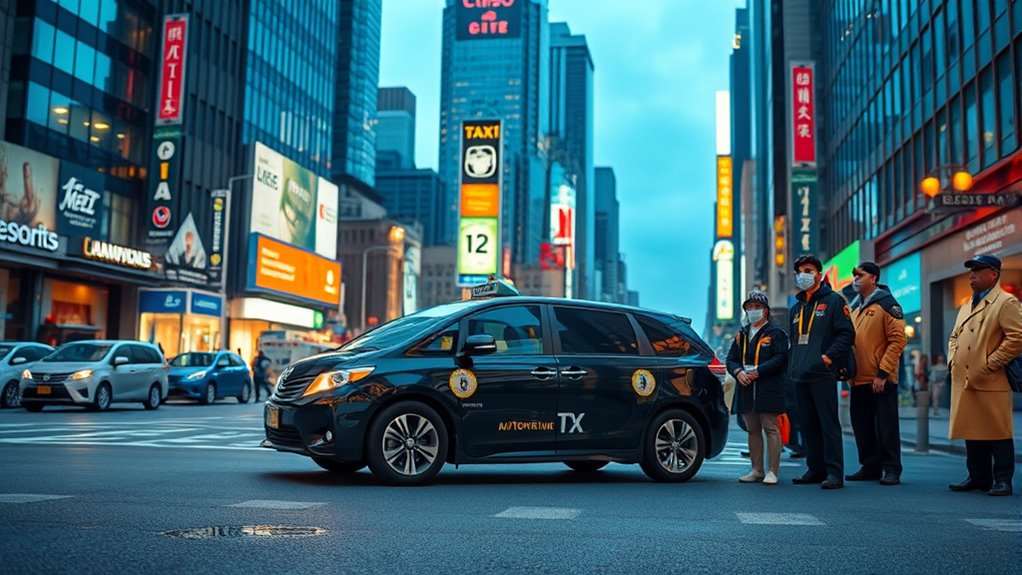
As autonomous vehicles become more prevalent, they are already reshaping skill requirements and operational practices within the transportation industry. You’ll need to adapt to new roles, such as specialized maintenance and repair for advanced systems like LiDAR, RADAR, and cameras. Additionally, the industry is shifting away from traditional driving jobs, which means workers must develop skills in vehicle technology and data management. Consider these key impacts:
- Reduced driver jobs, prompting a need for technical retraining.
- Increased demand for technicians skilled in autonomous system maintenance.
- Growing importance of operational planning and safety management centered on autonomous tech.
Autonomous taxis could add around 2-3 percentage points annually to global GDP, transforming employment patterns and operational priorities. This shift requires you to learn new competencies, ensuring you stay relevant as automation redefines transportation operations.
Digital Payment Innovations Transforming Passenger Interactions
Digital payment innovations make passenger interactions faster and more convenient, abolishing the need for cash handling. Contactless payments increase efficiency by reducing wait times and streamlining transactions. Plus, advanced security features guarantee your payments are safe and easily traceable. Widespread adoption of digital payments has reached over 90% of consumers in the past year, further solidifying their role in modern transportation.
Contactless Payment Efficiency
Have you noticed how contactless payments are revolutionizing passenger interactions by making transactions faster and more seamless? The growth in adoption—up 49% globally since 2020—shows how consumers prefer quick, safe payments. Regions like Asia-Pacific now dominate with 40% of NFC transactions, and the market is projected to hit $90.6 billion by 2032. Over 95% of contactless payments worldwide are NFC-powered, highlighting the central role of NFC technology in this transformation.
Here’s how this impacts efficiency:
- Faster Transactions: Average NFC payment values increased to $23.90 in 2023, boosting transaction speed.
- Wider Accessibility: Nearly 99% of smartphones will support contactless payments by 2027, expanding user base.
- Enhanced Integration: Digital wallets and tap-to-mobile tech streamline passenger interactions, reducing delays and improving convenience.
Enhanced Transaction Security
Ever wondered how taxi payment systems keep your transactions secure amid rising digital threats? Modern systems use EMV chip technology that generates unique transaction codes, making card cloning nearly impossible. Real-time verification connects instantly with banks to confirm funds, preventing fake payments. End-to-end encryption secures your data from the moment you swipe or tap until the transaction completes, reducing interception risks. Two-factor authentication adds extra security through PINs or biometrics, confirming you’re authorized to use the card. Tokenization replaces sensitive card details with unique tokens during transactions, safeguarding your information even if data breaches occur. AI-driven fraud detection analyzes patterns to flag suspicious activity early. Biometric authentication, threat recognition, and emergency alert systems further protect passenger interactions, ensuring your payments stay safe in a digital landscape fraught with risks. This comprehensive approach addresses the evolving payment fraud threats in the taxi industry, making digital transactions more reliable and secure for passengers and drivers alike.
Advanced Dispatch Technologies and Privacy Considerations
Advanced dispatch technologies are transforming how ride-hailing services operate, but they also raise critical privacy considerations. You need to understand how sensitive data is protected through methods like federated learning, which analyzes data locally to minimize exposure. Systems often use cloaking regions instead of exact locations, ensuring passenger anonymity. Encryption safeguards personal and ride information from unauthorized access. Spatio-temporal location data plays a vital role in demand prediction models, necessitating robust privacy-preserving techniques to prevent data leaks and inference attacks.
Key privacy features include:
- Weighted Bipartite Matching: Protects location privacy by using obfuscated cloaking regions.
- Differential Privacy (DP): Balances privacy with prediction accuracy, though it can impact system performance.
- Anonymized Communication: Keeps contact details confidential, reducing harassment risks.
These measures help maintain trust while steering regulatory compliance and security challenges.
Preparing for the Future: Integrating Emerging Technologies Into Taxi Services

Emerging technologies are reshaping taxi services, offering new ways to improve efficiency, sustainability, and customer experience. To prepare for this future, you need to understand how integrating innovations like electric vehicles (EVs), autonomous vehicles (AVs), AI optimization, digital payments, and multi-modal transport can transform your operations. EVs reduce emissions and cut costs, supported by government incentives and charging infrastructure. AVs promise safer, more reliable rides, although regulatory hurdles remain. AI tools optimize demand forecasting and routing, boosting efficiency. Digital payment systems enhance safety and speed. Multi-modal platforms facilitate seamless journeys, reducing congestion.
| Technology | Benefits | Challenges |
|---|---|---|
| Electric Vehicles (EVs) | Lower emissions, cost savings | Infrastructure, regulation |
| Autonomous Vehicles (AVs) | Safety, cost reduction | Regulatory, technological hurdles |
| AI Optimization | Efficiency, lower emissions | Data accuracy, implementation costs |
| Digital Payments | Speed, safety, hygiene | Security, acceptance |
| Multi-Modal Integration | Seamless travel, congestion reduction | Coordination, infrastructure |
Frequently Asked Questions
How Do Algorithms Impact Traditional Driver Skill Requirements?
Algorithms change traditional driver skills by shifting focus from manual driving to strategic, data-driven decision making. You need to adapt to using real-time insights for route optimization and customer matching. Familiarity with technological tools becomes essential, especially as AI benefits low-skilled workers more and levels the skill hierarchy. Flexibility and tech-savviness now define successful drivers, requiring you to continually learn and adjust to algorithmic systems.
What Training Is Needed for Drivers Adapting to New Taxi Technologies?
You need to get training in new taxi technologies to stay competitive. This includes understanding digital interfaces like GPS and ride-hailing apps, learning to operate vehicle tech such as automated systems, and gaining skills in data analysis for route optimization. Also, familiarize yourself with cybersecurity basics to protect passenger data. Continuous learning through online courses, certifications, and on-the-job training helps you adapt and succeed in a tech-driven environment.
How Will Autonomous Vehicles Change Taxi Industry Employment?
Autonomous vehicles will reshape your taxi industry employment by reducing driver roles and shifting focus to service and maintenance jobs. You’ll need to update your skills to stay relevant, perhaps moving into customer support or technical maintenance. The industry will demand more flexibility and adaptation, with fewer gig opportunities. While some long-term unemployment may occur, the progression is gradual, giving you time to prepare for new roles and career paths.
What Cybersecurity Measures Protect Passenger Data in Taxi Apps?
You’re protected by multiple cybersecurity measures in taxi apps. Encryption keeps your data safe from prying eyes, while access controls limit who can see your information. Data minimization reduces risks by collecting only what’s necessary. Secure communication protocols shield your messages and calls, and regular audits catch vulnerabilities. Together, these measures create a strong shield, ensuring your personal and payment data stay private, safe, and trustworthy every time you ride.
How Do Algorithms Ensure Fairness in Dynamic Pricing Models?
You want to know how algorithms guarantee fairness in dynamic pricing models. They do this by incorporating fairness constraints, which help prevent unreasonable price fluctuations. Transparency also plays a key role, so you can see how prices are set. Algorithms analyze market data to balance supply and demand, aiming to make prices fair and justified. This combination helps companies maintain trust while optimizing their pricing strategies.
Conclusion
As you see, technology is transforming taxis faster than ever—by 2025, over 60% of global rides could be managed by autonomous vehicles. To stay ahead, you need to adapt your skills and embrace these innovations. The future demands a blend of traditional know-how and digital expertise. Keep learning, stay flexible, and you’ll thrive in this evolving industry. The key is to see change not as a challenge, but as an opportunity.