
TL;DR

Get business pricing on tech for your team
- Business-only prices and quantity discounts
- Tax-exempt purchasing
- Multiple users, one account, clear invoices
Thorsten Meyer AI has announced Corvus ISR, a planned software stack for detecting, tracking and indexing movement in wide-area motion imagery. Its Day 1 dispatch describes a browser-based synthetic scene, but provides no independent test results or evidence of performance on operational imagery.
Thorsten Meyer AI has announced the start of Corvus ISR, a planned exploitation stack for wide-area motion imagery, and said the project’s first public artifact is a browser-based synthetic scene with live detection and tracking. The announcement matters because the developer is targeting a data-heavy surveillance field in which access to imagery, analysis capacity and customer control of sensitive information remain major constraints.
Corvus ISR is being presented as software that will detect, track and index moving objects across wide-area scenes before placing their movement histories in a queryable database. According to the developer, the intended product will run on infrastructure controlled by the customer, a design aimed at organizations that cannot send sensitive imagery to an outside service.
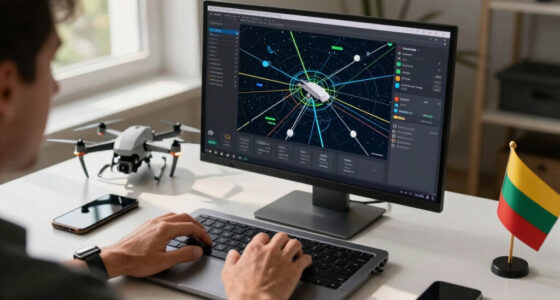
The Day 1 artifact uses fully generated imagery rather than footage of real people or vehicles. Its detector relies on simple geometric methods, not machine learning, and the demonstration is meant to test the simulation, detection and tracking harness. The dispatch says users can increase traffic density and observe track continuity deteriorate as the scene becomes harder.
The product plan includes two proposed editions. A Sovereign edition is intended for air-gapped operation without telemetry or outside dependencies, while a Governed edition is planned for cloud operation under European Union jurisdiction with auditing and compliance features. These editions are plans described by Thorsten Meyer AI; the supplied material does not establish that either is available as a finished product.
Sovereign Analysis Drives the Pitch
Wide-area motion imagery can record movement across large urban areas over extended periods, creating volumes that are difficult for human analysts to review manually. Software that reliably extracts and indexes tracks could make collected imagery faster to search after an incident and could reduce the amount of routine review assigned to analysts.
Corvus ISR is also being positioned around data custody and jurisdiction. Thorsten Meyer AI argues that European buyers increasingly care about where analysis software runs and who controls access to it. If that demand is borne out, an air-gapped or EU-hosted system could compete on operational control as well as detection accuracy. The source provides no customer commitments or market data supporting that commercial thesis.
wide area motion imagery analysis software
As an affiliate, we earn on qualifying purchases.
As an affiliate, we earn on qualifying purchases.
Why Development Starts With Simulation
WAMI systems use airborne camera arrays to observe broad areas repeatedly. The dispatch cites the ARGUS-IS demonstrator, which produced 1.8-gigapixel imagery, as an example of the sensor class. Such systems can generate a persistent record of movement, but their scale can leave analysts searching a large archive after an event has occurred.
The developer says real WAMI data is often restricted, classified or expensive and may contain records of identifiable people’s movements. Synthetic scenes avoid those immediate privacy and access problems while supplying ground-truth labels for every generated object and track. They also allow controlled changes to density, occlusion, contrast, sensor movement and frame rate.
“Corvus ISR is a new product I’m building — an exploitation stack for wide-area motion imagery.”
— Thorsten Meyer AI, announcing the project
As an affiliate, we earn on qualifying purchases.
Operational Performance Is Still Untested
It is not yet clear how the system performs because the supplied material contains no benchmark results, independently reproduced tests or comparisons with existing WAMI tools. The artifact uses generated objects and a geometric detector, so it does not show that Corvus ISR can handle real sensor noise, complex terrain, weather, imaging artifacts or adversarial conditions.
The path from synthetic scenes to operational imagery also remains undefined. The developer acknowledges that synthetic-to-real transfer carries a performance cost and says simulation is only the first substrate. No real-data partner, evaluation schedule, pricing, release date or named customer is disclosed. The legal claim that generated scenes contain no GDPR data subjects applies to the described demonstration, not necessarily to future deployments using real surveillance data.
geometric detection tracking software
As an affiliate, we earn on qualifying purchases.
As an affiliate, we earn on qualifying purchases.
Real-Data Validation Becomes the Test
The build-in-public series is expected to publish architecture decisions, code increments and failures as development continues. The next material milestones will be measurable detector and tracker results, testing under harder simulated conditions, and a documented path to lawfully obtained real imagery. Evidence that the planned deployment editions operate without outside dependencies will also be needed before the sovereignty claims can be evaluated.
air-gapped surveillance analysis system
As an affiliate, we earn on qualifying purchases.
As an affiliate, we earn on qualifying purchases.
Key Questions
What is Corvus ISR?
Corvus ISR is a planned software stack for detecting, tracking and indexing moving objects in wide-area motion imagery. It is at an early development stage rather than a confirmed commercial release.
What did the Day 1 demonstration show?
The developer described a synthetic traffic scene running in a browser with live geometric detection and tracking. The supplied source does not include independent performance verification.
Does the prototype use artificial intelligence?
The initial detector does not use machine learning, according to Thorsten Meyer AI. Its purpose is to exercise the simulation and tracking pipeline before more advanced models are introduced.
Why use synthetic WAMI data?
Synthetic data avoids using real movement records in the public demonstration and provides exact labels for generated objects. It can also produce controlled failure cases, though success in simulation does not establish real-world accuracy.
When will Corvus ISR be available?
No release date or pricing was provided. Availability will depend on further development, real-data validation and delivery of the proposed Sovereign and Governed editions.
Source: Thorsten Meyer AI
Halloween Picks
halloween
As an affiliate, we earn on qualifying purchases.