
📊 Full opportunity report: Why Funeral Directors Use Death Certificate Chasers on IdeaNavigator AI — validation score, market gap, and execution plan.

Get business pricing on tech for your team
- Business-only prices and quantity discounts
- Tax-exempt purchasing
- Multiple users, one account, clear invoices
TL;DR
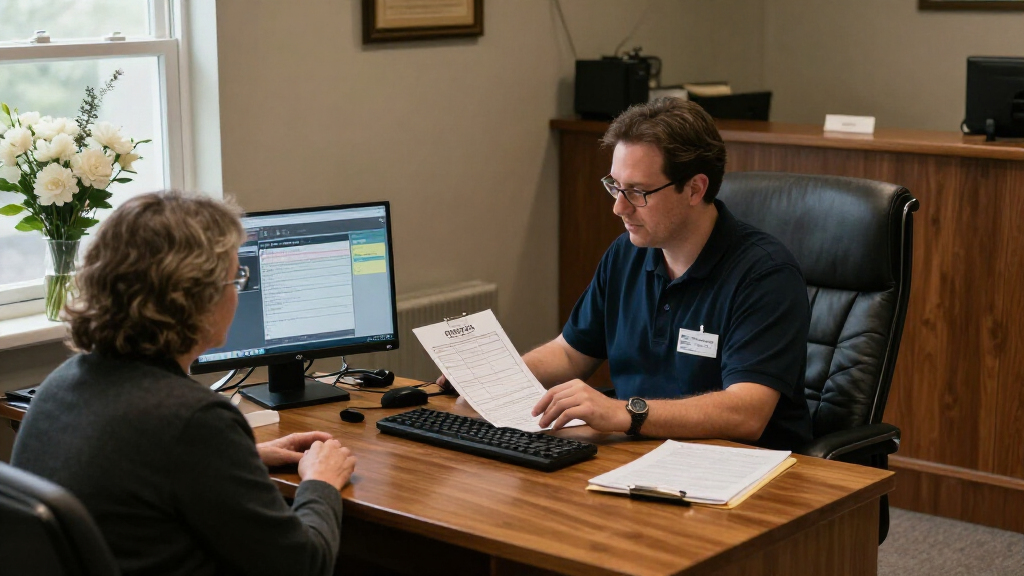
A proposed software tool would help funeral homes track death certificates awaiting certification, record follow-up attempts and remind medical certifiers. The idea is tied to new state requirements described for Michigan and Virginia, but it has not been shown to work: a five-home, 60-day pilot is proposed to test whether it reduces delays and staff time.
IdeaNavigator AI has proposed a software workflow to help funeral homes follow up on death certificates awaiting medical certification, a step that can hold up permits and related family processes. The proposal points to new requirements in Michigan and Virginia as a reason to test automated reminders, but it describes a product concept and pilot plan—not an existing service or demonstrated result.
The proposed tool is aimed at a funeral director or office manager at an independent funeral home or a small multi-location group. IdeaNavigator AI’s proposal describes a case board showing each death record’s certification status, entered manually or drawn from an electronic death registration system where status information is available. Staff could see which cases are pending and which certifier is responsible.
According to the proposal, the workflow would store certifiers’ office contact details and preferred channels, then send scheduled reminders by email, fax or text message. It would record contact attempts, flag cases approaching a state deadline and provide families with plain-language status updates. A monthly report identifying slow certification patterns is also proposed. These are specifications for a possible minimum viable product; IdeaNavigator AI does not report that the features have been built or integrated with state systems.
IdeaNavigator AI’s proposal says funeral staff may spend hours calling and faxing medical offices about records awaiting signatures. It links the delays to downstream issues: a burial or cremation permit may depend on certification, while families may also be waiting on insurance claims or benefit payments. The proposal provides no data on how often these delays occur, how long they last or how much staff time they consume across the industry.
Why Funeral Directors Use Death Certificate Chasers
IdeaNavigator AI proposes a tracker and reminder workflow for death certificates awaiting medical certification. A pilot is suggested, but results are not available.
How the proposed workflow works
The concept is designed to help staff spot pending cases and keep follow-up organized.
A case board would show certification status and the responsible certifier.
Scheduled reminders and contact logs would help staff record outreach.
The tool would flag cases nearing a state deadline and summarize slow patterns.
Why delays matter
Pending certification can affect funeral-home operations and family next steps.
- A required certificate may hold up a burial or cremation permit.
- Staff may spend time calling and faxing medical offices.
- Arrangements may be delayed while certification is pending.
- Insurance claims or benefit payments may also be awaiting the certificate.
State rules cited in the proposal
The proposal points to Michigan and Virginia requirements as reasons to evaluate the workflow.
| State | Development described |
|---|---|
| Michigan | House Bills 4077 and 4078 are described as requiring certification within 48 hours through the state system. |
| Virginia | House Bill 156 is described as requiring certain clinicians to complete the state system tutorial as part of licensing. |
What the pilot would measure
Five funeral homes in Michigan or Virginia would compare the trial period with their previous 60 days.
How Delays Affect Funeral Work
Death certification sits at a junction between medical administration and funeral-home operations. If the required certification is still pending, the funeral home may be unable to proceed with a permit-dependent step. As IdeaNavigator AI’s proposal presents it, a shared case tracker could make it easier for staff to identify a stalled record, see what follow-up has already happened and avoid relying on scattered calls, faxes or individual staff memory.
For families, the practical concern is not the software itself but how long a pending signature delays next steps. Certification can also be relevant to insurance and benefit processes, although IdeaNavigator AI’s proposal does not establish that a reminder tool would accelerate those payments. Its potential value would depend on whether follow-up is the cause of a delay, whether certifiers respond to reminders, and whether the tool can accurately reflect the status of records in each state’s system.
The proposal also raises a workflow and accountability question: if states set a certification deadline, funeral homes may want a reliable record of when a case was submitted and what follow-up occurred. A log could help document communication, but it would not itself make a certifier complete a certificate on time or replace state reporting systems.
Products Worth Considering

Apple Watch Ultra 2 GPS + Cellular, 49mm Natural Titanium Case with Natural Titanium Milanese Loop, Large

Logitech MX Keys Combo for Business Keyboard and Mouse – Graphite

Logitech MX Mechanical Wireless Illuminated Keyboard, Tactile Quiet, Graphite
As an affiliate, we earn on qualifying purchases.
State Rules Prompt the Proposal
IdeaNavigator AI’s proposal identifies two state developments. It says Michigan House Bills 4077 and 4078, signed on March 17, 2026, require death certificates to be certified within 48 hours through the state’s secure web-based system. It also says Virginia House Bill 156, from 2026, requires physicians, advanced practice registered nurses and physician assistants who expect to sign death certificates to complete the state’s electronic death registration system tutorial as part of licensing.
Those measures are presented in the proposal as a reason funeral homes might benefit from tracking pending certifications against state timelines. The proposal does not provide the full statutory text, implementation details or agency guidance, so the precise scope and operation of the requirements cannot be assessed here. The proposed product would also need to account for differences between states, including whether electronic status information can be accessed and what contact methods are permitted.
To test the idea, IdeaNavigator AI recommends a 60-day trial with five funeral homes in Michigan or Virginia. Participants would record elapsed time from death to medical certification and staff minutes spent on follow-up, then compare those measures with each home’s previous 60 days. The proposal’s suggested business model is a monthly subscription per location, potentially discounted for state funeral directors’ associations that enroll members in groups.
Pilot Results Are Not Available
No pilot has been reported, and IdeaNavigator AI’s proposal does not name participating funeral homes, give a launch date or provide measured results. It remains unknown whether a case board and reminders would reduce certification time or staff workload compared with existing procedures. The suggested comparison with each home’s prior 60 days would also need to account for differences in case volume, staffing, certifier availability and other factors that can affect timing.
The legal and technical details need verification before a tool could be used to track compliance. The proposal does not explain how records would be connected to state electronic systems, how personal and health information would be protected, or how reminders would be handled when a certifier’s contact details or preferred channel are unavailable. It also does not establish that funeral homes may access every status field needed for the proposed dashboard.
Finally, the proposal does not specify the product’s price, whether families would receive updates directly, or how the tool would distinguish a delayed response from a record that is incomplete for another reason. Those points affect both the product’s usefulness and whether funeral homes would pay for it.
A Five-Home Trial Would Test It
IdeaNavigator AI’s proposal describes a 60-day pilot with five funeral homes in Michigan or Virginia as the next step. The test would track time from death to medical certification and staff minutes spent chasing signatures, comparing those measures with the homes’ previous 60 days. No start date or participating locations have been announced.
A useful evaluation would need to report the number of cases tracked, how missing information was handled, and whether changes were large enough to distinguish from ordinary variation. It would also need to establish whether staff used the reminders consistently and whether state-system access was available. Until a trial produces results, the proposed chaser remains an operational idea rather than a proven way to shorten waits.
Source: IdeaNavigator AI proposal
Key Questions
What is a death certificate chaser?
It is a proposed tracking and reminder workflow for funeral homes to follow up on death records waiting for medical certification. IdeaNavigator AI’s proposal describes a case board, contact logs and scheduled reminders.
Why might a funeral home follow up on a certificate?
IdeaNavigator AI’s proposal says certification can be a prerequisite for issuing burial or cremation permits. It says staff may also contact certifiers when records remain unsigned, while families may be waiting on related arrangements or claims.
Is the software already available?
IdeaNavigator AI describes a proposed minimum viable product and a suggested pilot. Its proposal does not confirm that the software has been built, launched or tested.
What would the proposed pilot measure?
IdeaNavigator AI proposes a 60-day test with five funeral homes to track elapsed time from death to medical certification and staff minutes spent following up, comparing those figures with the homes’ previous 60 days.
Would reminders guarantee faster certification?
No. IdeaNavigator AI’s proposal offers no results showing that reminders shorten delays. Their effect would depend on certifier response, accurate status information and how each state’s registration system works.
Source: IdeaNavigator AI