

TL;DR
IBM and Microsoft announced Imagine Enterprise on November 10, 2026, a platform aimed at helping large organizations build, deploy and govern AI agents for industry processes. IBM says it includes more than 6,000 agents and other assets, but the companies have not specified how many are deployable agents or when the platform will be generally available.
IBM and Microsoft announced Imagine Enterprise on November 10, 2026, a platform they say will help large organizations build, run and govern AI agents for industry-specific processes. IBM brings its consulting services and a catalog of more than 6,000 agents and assets; Microsoft supplies the underlying AI, data, cloud and security technologies. The announcement does not specify a general availability date.

Get business pricing on tech for your team
- Business-only prices and quantity discounts
- Tax-exempt purchasing
- Multiple users, one account, clear invoices
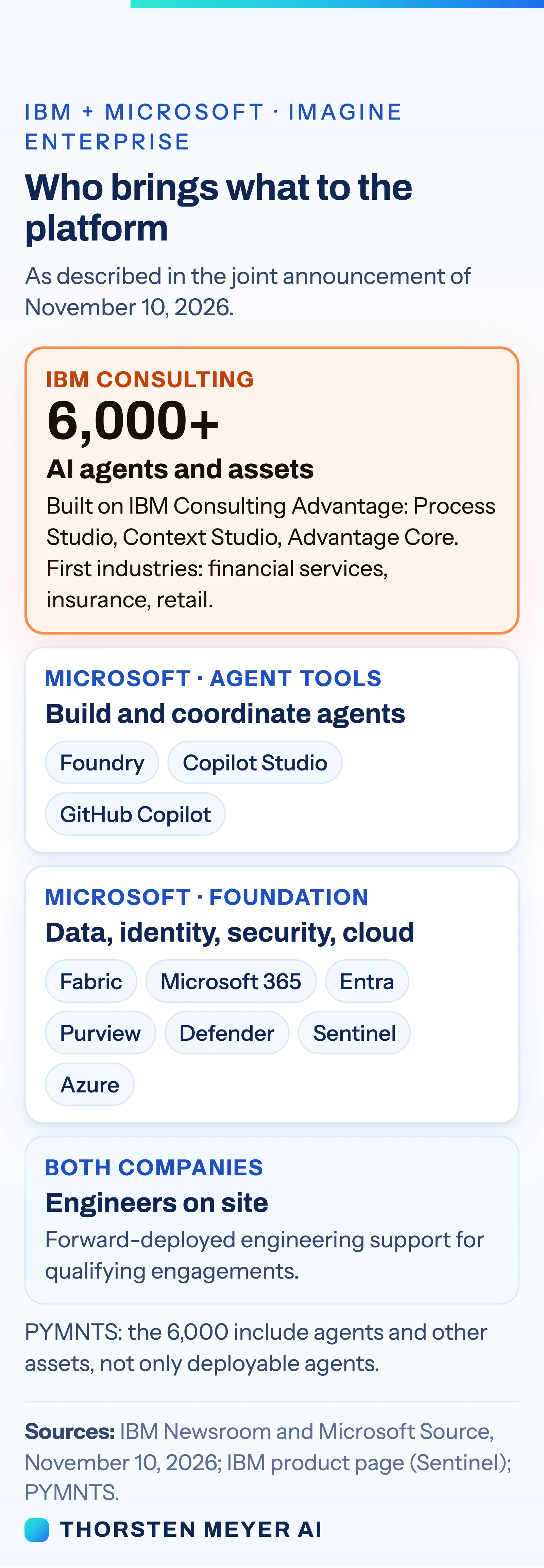
The companies describe Imagine Enterprise as a way for businesses to adapt existing agent tools and industry frameworks rather than start each project from scratch. IBM says its catalog contains more than 6,000 AI agents and assets. That figure combines agents with other assets: PYMNTS reported that the companies have not said how many items are agents that can be deployed. The number should not be read as a count of ready-to-use agents.
IBM Consulting contributes its IBM Consulting Advantage delivery platform, including Process Studio, Context Studio and Advantage Core. Microsoft provides Foundry, Copilot Studio and GitHub Copilot for agent and system coordination, alongside Fabric, Microsoft 365, Entra, Purview, Defender and Azure. IBM’s product page also names Microsoft Sentinel among the security components. The firms say the platform is designed to connect with customers’ existing data, processes and systems.
Delivery is centered on IBM Consulting. Customers can engage the firm to deploy and operate the platform, or work with it on enterprise implementations; the announcement also mentions self-management options without describing them. Engineers from both companies are available for qualifying engagements. The firms have not defined what qualifies.
A Consulting Route Into Enterprise AI
The announcement pairs Microsoft’s existing AI and cloud products with IBM Consulting’s industry expertise and delivery capacity. That could matter to large organizations that have tested AI tools but need help connecting them to business processes, data and governance requirements. Financial services, insurance and retail are the first industries named for frameworks.
The offering also emphasizes human oversight alongside automation. IBM says organizations can set which actions agents may take independently, which require human approval and when an agent must escalate a case. Those controls are presented as product capabilities by IBM; the launch materials do not provide independent testing of how they perform in practice.
Products Worth Considering

Kindle Paperwhite Signature Edition 32GB E-Reader, 7-Inch Display, Seaglass Green

Logitech MX Mechanical Wireless Illuminated Keyboard, Clicky Switches

Samsung 32 Odyssey G5 (G51F) QHD 180Hz Gaming Monitor
As an affiliate, we earn on qualifying purchases.
From AI Pilots to Operations
IBM’s launch blog frames the platform as a response to businesses that have run AI pilots without changing how work is carried out. The company wrote, “Most organizations are running AI pilots. Almost none have fundamentally changed how the businesses operate.” That is IBM’s characterization of the market, not an independently measured finding in the announcement.
Microsoft already offers products such as Foundry and Copilot Studio directly. Imagine Enterprise adds IBM Consulting as a partner for customer delivery, including work to adapt agents and connect them with existing enterprise environments. The initial frameworks named by the companies cover financial services, insurance and retail; no broader rollout schedule is stated.
““An agentic platform designed to help enterprises build, run, and govern AI agents that help people execute industry-specific processes.””
— IBM and Microsoft, joint announcement
Pricing and Deployment Details Pending
The launch materials do not give pricing, a general availability date or supported regions. They also do not identify which AI models will run the platform, explain the self-management options, or define the engagements that receive forward-deployed engineering support.
IBM and Microsoft have not disclosed how many of the 6,000-plus catalog items are deployable agents. The source material also does not identify a customer operating Imagine Enterprise in production. IBM describes governance and monitoring features, but no independent evaluation of those controls is included in the announcement.
Customer Rollouts Await More Detail
The next practical milestones are further details on availability, pricing and customer deployments. Organizations considering the platform will also need specifics on the models, regional access, self-management and the scope of consulting support. Until the companies publish those details, the announcement establishes the product’s proposed components and delivery approach, but not how broadly or when customers can adopt it.
Key Questions
What is Imagine Enterprise?
Imagine Enterprise is a platform IBM and Microsoft say will help businesses build, operate and govern AI agents for industry processes.
What does IBM contribute?
IBM contributes IBM Consulting, its IBM Consulting Advantage delivery platform and a catalog described as containing more than 6,000 agents and assets. The companies have not said how many catalog items are deployable agents.
Which Microsoft products are included?
The companies name Foundry, Copilot Studio, GitHub Copilot, Fabric, Microsoft 365, Entra, Purview, Defender and Azure. IBM’s product page also names Microsoft Sentinel.
When will Imagine Enterprise be available, and what will it cost?
The announcement gives no general availability date or pricing. It also does not specify supported regions.
Has the platform’s governance been independently tested?
The launch materials describe logging, approval rules and escalation controls, but do not cite an independent test of those safeguards.
Source: Thorsten Meyer AI