
TL;DR

Get business pricing on tech for your team
- Business-only prices and quantity discounts
- Tax-exempt purchasing
- Multiple users, one account, clear invoices
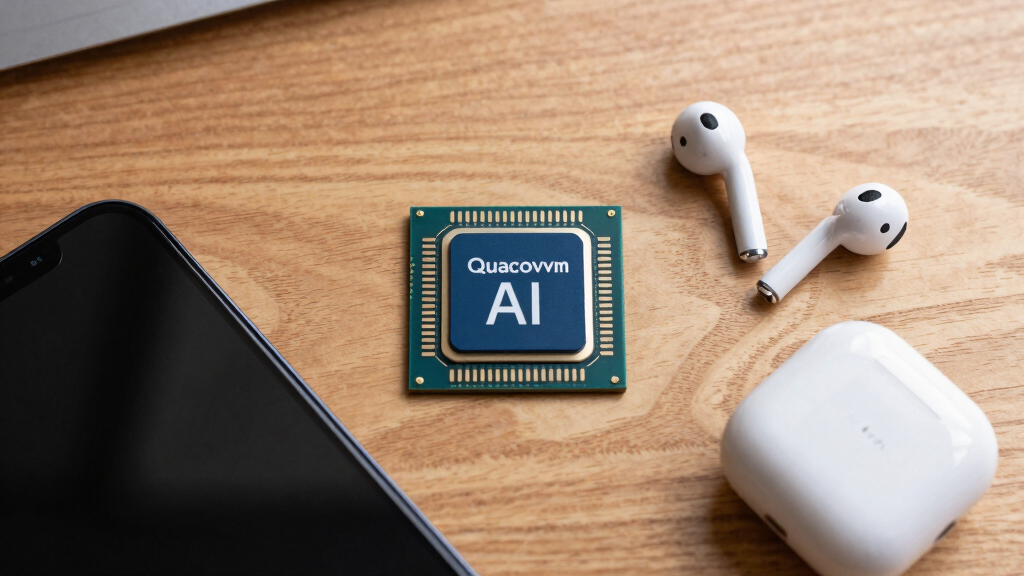
Qualcomm has announced a new AI data center chip that omits high-bandwidth memory (HBM), directly challenging Nvidia’s market leadership. The move signals a strategic shift in AI hardware design, though full performance details remain under wraps.
Qualcomm has introduced a new AI data center chip that eliminates HBM memory, a move confirmed by the company’s executives to challenge Nvidia’s current dominance in AI hardware markets. The announcement signals a significant shift in AI chip design, with potential implications for the industry’s competitive landscape.
During a recent presentation in Manhattan, Qualcomm’s vice president of data center, Durga Malladi, demonstrated a prototype that integrates low-power DRAM chips directly onto a logic die, bypassing the need for high-bandwidth memory (HBM). This design innovation is intended to reduce costs and complexity while maintaining high performance for AI workloads.
The new chip, part of Qualcomm’s Dragonfly line, aims to address the growing demand for efficient, scalable AI hardware in data centers. Qualcomm’s approach contrasts with Nvidia’s current reliance on HBM, which is known for its high bandwidth but also high cost and power consumption. The company claims that their architecture can deliver comparable performance without HBM, though specific benchmarks are not yet publicly available.
Implications of Qualcomm’s HBM-Free AI Chip
This development matters because it could disrupt Nvidia’s entrenched position in AI hardware, especially in data centers where cost and efficiency are critical. If Qualcomm’s design proves effective at scale, it may lead to increased competition, lower prices, and broader adoption of alternative AI architectures. The move also signals a potential shift in industry standards, emphasizing integrated, low-power memory solutions.
As an affiliate, we earn on qualifying purchases.
Background on AI Hardware Competition
Nvidia has dominated the AI hardware market for years, largely due to its high-performance GPUs and HBM memory technology, which enable fast data processing for AI training and inference. Qualcomm, traditionally known for mobile chips, has been expanding into data center solutions, seeking to challenge Nvidia’s market share.
The company’s recent prototype, showcased during a presentation, marks a strategic effort to differentiate its offerings by reducing reliance on HBM, which is expensive and power-intensive. Industry analysts note that this approach could appeal to data centers seeking more cost-effective, scalable AI solutions, especially as AI workloads grow rapidly.
“Qualcomm’s new architecture could significantly reduce costs and power consumption while maintaining performance levels comparable to existing HBM-based solutions.”
— an anonymous researcher
As an affiliate, we earn on qualifying purchases.
Unanswered Questions About Performance and Adoption
It is not yet clear how Qualcomm’s HBM-free chip will perform in real-world AI workloads compared to Nvidia’s offerings. Details about scalability, long-term reliability, and industry adoption remain undisclosed, and benchmarks are awaited.
As an affiliate, we earn on qualifying purchases.
Upcoming Testing and Industry Evaluation
Qualcomm is expected to conduct further testing and share detailed performance data in the coming months. Industry observers will watch for adoption signals from data center operators and potential partnerships with cloud providers. Nvidia’s response and the broader market impact are also anticipated to unfold over the next year.
As an affiliate, we earn on qualifying purchases.
Key Questions
What makes Qualcomm’s new AI chip different from Nvidia’s?
Qualcomm’s chip replaces high-bandwidth memory (HBM) with integrated low-power DRAM directly on the logic die, aiming to reduce costs and power consumption while maintaining performance.
Will this new architecture be adopted widely?
It remains uncertain. Adoption depends on performance benchmarks, industry trust, and compatibility with existing data center infrastructure, which are still under evaluation.
How might this impact Nvidia’s market dominance?
If Qualcomm’s design proves successful, it could increase competition, potentially leading to lower prices and more diverse options for AI hardware in data centers.
When will more details about the chip’s performance be available?
Further testing and performance benchmarks are expected in the coming months, with official details likely to emerge later this year.
Does this mean Qualcomm is exiting mobile chips?
No, Qualcomm continues to develop chips for mobile devices; this move into AI data center hardware is part of its broader expansion strategy.
Source: Nikkei Asia
Halloween Picks
halloween
As an affiliate, we earn on qualifying purchases.