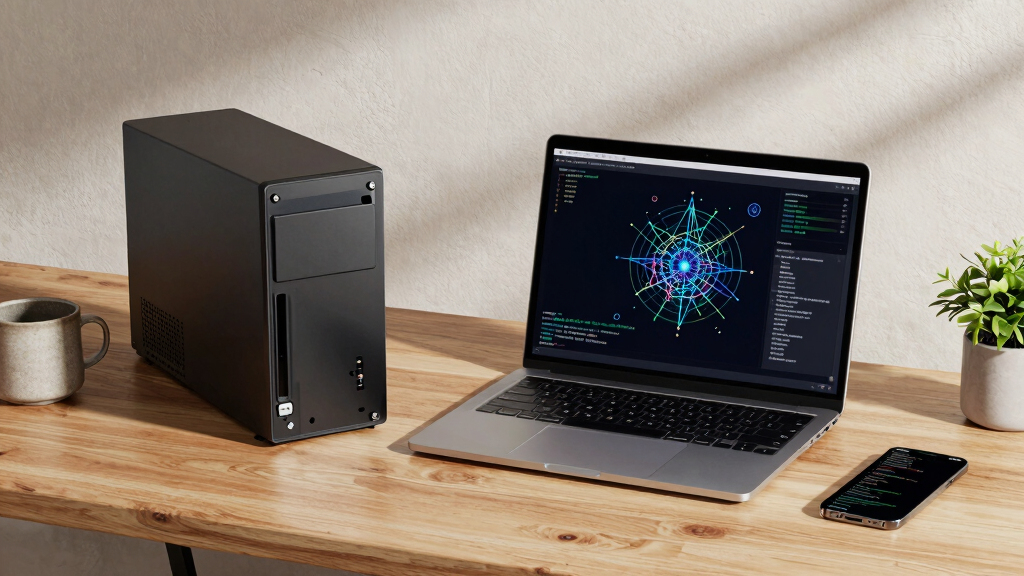

📊 Full opportunity report: The Real Cost Of A Local-Inference Rig In 2026 on ThorstenMeyerAI.com — validation score, market gap, and execution plan.

Get business pricing on tech for your team
- Business-only prices and quantity discounts
- Tax-exempt purchasing
- Multiple users, one account, clear invoices
TL;DR
In 2026, owning a local inference rig for large language models involves significant hardware costs, with VRAM capacity and GPU choices dictating affordability. Smart buyers prioritize VRAM-per-dollar over raw compute power, often opting for used or multi-GPU setups to balance cost and performance.
In 2026, the cost of building a local inference rig for large language models varies widely depending on VRAM capacity and hardware choices, with significant implications for AI practitioners seeking privacy and cost control. The most critical factor is VRAM, which determines whether a model can run at usable speeds, making hardware selection a nuanced balance of performance and expense.
The core constraint for local inference is the ‘VRAM cliff’: models that fit entirely within a GPU’s VRAM run at high speed, while those spilling into system RAM slow down drastically, often by a factor of 5 to 20. For example, a 70-billion-parameter model requires around 43GB of VRAM at FP16 precision, meaning a single 32GB GPU cannot run it natively—necessitating multi-GPU setups or aggressive quantization.
Cost-effective options include used GPUs like the RTX 3090, which offers 24GB of VRAM for approximately $600–850, providing a high VRAM-per-dollar ratio. These cards, often sold without warranty or as ex-mining hardware, can be pooled via NVLink to create larger VRAM pools, enabling the running of larger models at a fraction of the cost of flagship new cards like the RTX 5090, which costs around $2,000 and offers 32GB of VRAM.
Model size thresholds are clear: models up to 14B are easily run on budget cards, 26–32B models need a 24GB GPU, and 70B models typically require multiple GPUs or large memory systems. The key insight is that for inference, VRAM capacity and cost per gigabyte are more important than raw compute power, as inference is bandwidth-bound rather than compute-bound.
The real cost of a local-inference rig
Owning beats renting for steady AI work — so what does a local rig cost in 2026? The unintuitive, good news: the most expensive build is almost never the smartest one. It all comes down to one rule.
The difference is only whether the weights fit. LLM inference is memory-bandwidth-bound — VRAM capacity is the hard limit you build around. Compute specs are mostly noise.
The squeeze reframes the rig like everything else in this series: discipline beats maximalism. VRAM is exactly the memory under most pressure, so over-buying it is the 128GB-“to-be-safe” trap, only worse per gigabyte. Take the cheap, high-value step to 24GB (the gateway to the 30B class), reach for used 3090s and MoE models, and use quantization to climb a tier without buying silicon. Sized right, the rig pays for itself against the cloud’s ever-rising hidden bill. Next: Apple Silicon’s quiet memory advantage.
Impact of Hardware Choices on AI Deployment Costs in 2026
Understanding the true hardware costs for local inference rigs helps AI practitioners make cost-effective decisions, balancing performance and budget. The emphasis on VRAM capacity and value-oriented GPU choices enables more affordable local deployment of large models, reducing reliance on cloud APIs and enhancing privacy.
This shift could reshape the AI hardware market, favoring used or multi-GPU setups over the latest flagship cards, and making local inference more accessible for smaller teams and individual developers.
used NVIDIA RTX 3090 GPU for AI inference
As an affiliate, we earn on qualifying purchases.
As an affiliate, we earn on qualifying purchases.
2026 Hardware Landscape and Model Size Thresholds
As of early 2026, the AI hardware landscape is dominated by the importance of VRAM for inference. Models like the 70B Llama 3 require approximately 43GB of VRAM at FP16, pushing users toward multi-GPU configurations or aggressive quantization. The market sees a trend toward used GPUs like the RTX 3090, which offers high VRAM-per-dollar value, and multi-GPU setups using NVLink to pool VRAM for larger models.
Recent developments include the availability of more affordable, second-hand GPUs and the use of quantization techniques like Q4 to reduce memory needs with minimal quality loss. Meanwhile, flagship cards like the RTX 5090 are less cost-effective per VRAM dollar but provide the fastest inference speeds for models that fit entirely within their VRAM.
“For inference, VRAM capacity and cost per gigabyte outweigh raw compute power, making used GPUs and multi-GPU setups the most economical choice in 2026.”
— Thorsten Meyer
high VRAM graphics card for machine learning
As an affiliate, we earn on qualifying purchases.
As an affiliate, we earn on qualifying purchases.
Unresolved Questions About Future Hardware and Model Scaling
It remains unclear how rapidly new GPU models will enter the market with improved VRAM capacities and better price-performance ratios. Additionally, the long-term viability of multi-GPU pooling solutions like NVLink in consumer-grade hardware is uncertain, as newer architectures may phase out these features. The impact of ongoing advances in model quantization and offloading techniques on hardware costs is also still developing.
multi-GPU NVLink bridge for AI training
As an affiliate, we earn on qualifying purchases.
As an affiliate, we earn on qualifying purchases.
Next Steps for Building Cost-Effective Local Inference Systems
Practitioners should monitor GPU market trends, especially the availability of used hardware like the RTX 3090, and consider multi-GPU configurations to maximize VRAM at lower costs. Advances in quantization and system memory integration, such as Apple Silicon’s unified memory, could further reduce hardware barriers. Continued research into efficient model compression and offloading will shape future hardware strategies.
affordable large VRAM GPU for local inference
As an affiliate, we earn on qualifying purchases.
As an affiliate, we earn on qualifying purchases.
Key Questions
What is the most cost-effective GPU for local inference in 2026?
A used RTX 3090 offers the best VRAM-per-dollar ratio, costing around $600–850 with 24GB of VRAM, often outperforming newer flagship cards in value for inference tasks.
How does VRAM capacity influence model performance?
If a model fits entirely within VRAM, it runs at high speed; spilling into system RAM causes a drastic slowdown, making VRAM capacity the critical factor for efficient inference.
Are multi-GPU setups worth the investment?
Yes, pooling VRAM via NVLink or similar technologies allows running larger models at lower total hardware costs, making multi-GPU configurations a cost-effective solution for high-performance local inference.
Will newer GPU models improve the VRAM-per-dollar ratio?
It is uncertain; market trends suggest used GPUs like the RTX 3090 currently provide the best value, but future models may shift this balance depending on supply and architecture developments.
Can Macs or Apple Silicon hardware handle large models?
Yes, Apple Silicon’s unified memory allows effective VRAM of over 100GB, making Macs a viable option for large-model inference without dedicated GPUs, though with different performance trade-offs.
Source: ThorstenMeyerAI.com
Halloween Picks
halloween
As an affiliate, we earn on qualifying purchases.