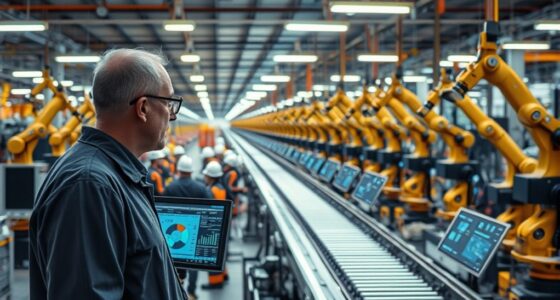
AI is transforming jobs by automating repetitive tasks and creating new roles in fields like data science, automation, and ethics. While some jobs may be displaced, many new opportunities emerge that require fresh skills. Success depends on how proactively you adapt through continuous learning and skill development. Embracing AI as a tool for growth can lead to exciting career shifts. If you want to understand how to navigate this shift effectively, there’s more to discover below.

Get business pricing on tech for your team
- Business-only prices and quantity discounts
- Tax-exempt purchasing
- Multiple users, one account, clear invoices
Key Takeaways
- AI automates routine tasks, potentially displacing some jobs but also creating new roles in emerging sectors.
- The net impact depends on workers’ ability to adapt through upskilling and continuous learning.
- New opportunities arise in fields like AI ethics, data science, and automation supervision.
- Roles requiring complex problem-solving, creativity, and emotional intelligence are less vulnerable to automation.
- Proactive skill development can help workers benefit from AI-driven industry transformations, potentially leading to more jobs overall.

Have you ever wondered how artificial intelligence is shaping the future of work? As AI continues to evolve, it’s clear that its impact on employment isn’t simply about replacing jobs but also transforming how work is done. One of the key aspects to consider is the automation potential AI brings to various industries. AI systems can perform repetitive, routine tasks more efficiently and accurately than humans, which means many roles in sectors like manufacturing, customer service, and data entry are at risk of being automated. This shift can lead to significant job displacement in certain areas, but it also opens up opportunities for new types of employment. The challenge lies in understanding the balance between these forces and preparing for them.
As you look at the automation potential, it’s essential to recognize that not all jobs are equally vulnerable. Jobs that rely heavily on routine tasks are more susceptible to automation, while roles that require complex problem-solving, creativity, and emotional intelligence tend to be safer. However, even in less vulnerable roles, AI can serve as a tool to augment human capabilities rather than replace them entirely. This means your skills will need to evolve, emphasizing areas where AI has difficulty replicating human nuance. The growing use of AI highlights a pressing issue: skill gaps. Many workers currently lack the expertise needed to operate, manage, or collaborate with AI-driven systems, creating a mismatch between available jobs and qualified candidates.
Addressing these skill gaps is essential if you want to remain relevant in an AI-influenced job market. Continuous learning and upskilling become necessary. You might need to acquire new technical skills, such as data analysis, machine learning, or programming, or develop soft skills like adaptability, critical thinking, and emotional intelligence. Companies are increasingly investing in training programs, but it’s also your responsibility to stay ahead by seeking out educational opportunities. The good news is that AI can also create new jobs in emerging sectors—roles that didn’t exist a decade ago, such as AI ethicists, data scientists, or automation supervisors. These positions often require specialized skills, and filling them can lead to career growth and increased job satisfaction.
Furthermore, understanding the role of wall organization systems and aesthetic solutions in home decor can help professionals in related fields adapt to evolving consumer preferences. Ultimately, the impact of AI on jobs depends on how proactively you respond. While the automation potential may threaten some roles, it also offers a chance to reinvent your career and develop new expertise. Recognizing skill gaps and committing to lifelong learning can help you navigate this transition successfully. Rather than fearing AI’s rise, embracing its potential to complement and enhance human work can lead to a future where technology and talent work hand in hand to create more opportunities, not fewer.
Frequently Asked Questions
How Do AI Advancements Impact Global Job Markets Differently?
AI advancements impact global job markets differently by influencing local economies through AI ethics and cultural adaptation. You might find that some regions benefit from new job opportunities, while others face disruption due to automation. Your understanding of AI ethics helps guarantee responsible deployment, and cultural adaptation ensures AI tools align with local needs. This dynamic shapes how industries evolve worldwide, affecting employment patterns uniquely across countries and communities.
What Industries Are Most Vulnerable to Ai-Driven Job Loss?
You should know that industries with high automation risk, like manufacturing, transportation, and retail, are most vulnerable to AI-driven job loss. These sectors often rely on routine tasks that AI can easily replace. However, industries with strong industry resilience, such as healthcare, creative arts, and education, tend to adapt better because they require complex human skills. Stay aware of these shifts to navigate potential employment changes effectively.
How Can Policy Shape Ai’s Effect on Employment?
You can shape AI’s impact on employment by advocating for strong regulatory frameworks that guarantee fair use and protect workers. Prioritize ethical considerations in AI development, encouraging transparency and accountability. Support policies that promote workforce retraining and job shift programs. By actively engaging with policymakers and tech companies, you help create an environment where AI benefits everyone, minimizing job losses and fostering new opportunities.
What Skills Will Be Most Valuable in an Ai-Driven Economy?
In an AI-driven economy, your most valuable skills will include AI ethics and human-AI collaboration. You’ll need to understand ethical considerations around AI, ensuring responsible use. Your ability to work alongside AI systems, leveraging their strengths while maintaining human judgment, will set you apart. Emphasizing creativity, emotional intelligence, and adaptability will help you thrive as technology reshapes the job landscape. Keep learning and stay flexible to stay ahead.
How Quickly Can AI Create New Job Opportunities?
AI can create new job opportunities surprisingly quickly, especially as automation speeds up. For example, when a manufacturing company adopted AI-driven robotics, new roles in maintenance, programming, and data analysis emerged within months. The job creation rate often lags behind automation speed initially, but as industries adapt, these new roles expand rapidly. Your ability to learn new skills can help you capitalize on these emerging opportunities swiftly.
Conclusion
In the end, embracing AI’s potential means you’ll find new opportunities even as some jobs change. Remember, every cloud has a silver lining—AI can create jobs, boost innovation, and open doors you hadn’t imagined. Stay adaptable and open-minded; those who embrace change thrive. While concerns are valid, the future isn’t set in stone. Like the saying goes, “The early bird catches the worm,” so get ready to seize the opportunities AI brings your way.
Evergreen bestsellers Picks
bestsellers
As an affiliate, we earn on qualifying purchases.