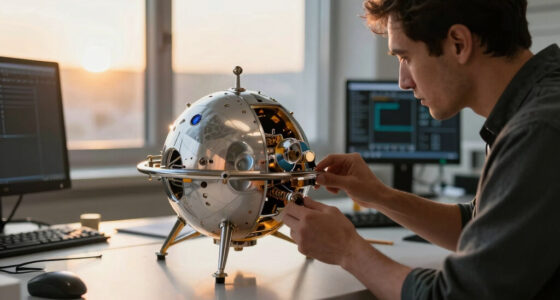

🔍 Read the full analysis: How Claude Is Uplifting Biomolecular Modeling – Anthropic on ThorstenMeyerAI.com

Get business pricing on tech for your team
- Business-only prices and quantity discounts
- Tax-exempt purchasing
- Multiple users, one account, clear invoices
TL;DR
Anthropic claims its Claude AI helps biomolecular researchers by streamlining tasks like coding, literature review, and data analysis. These applications could speed up drug discovery and biological research, though independent verification is pending.
Anthropic has announced that its Claude AI models are being actively used by researchers in biomolecular modeling, supporting tasks such as code writing, literature synthesis, and data interpretation. For more details, see How Claude Is Uplifting Biomolecular Modeling – Anthropic. This development highlights a growing trend of large language models integrating into scientific workflows to accelerate research processes, particularly in complex fields like structural biology and drug discovery.
The company’s account describes how researchers deploy Claude to generate and debug custom scripts for molecular dynamics simulations, reducing the time spent on coding and troubleshooting. This is part of a broader trend discussed in Anthropic Debuts Claude Docs, Raising Stakes For Microsoft. Additionally, Claude is used to digest large volumes of scientific literature and experimental data, helping scientists stay current amidst the rapid publication cycle in biology. Another application involves reasoning through complex molecular structures, binding sites, and sequence data via conversational interfaces, making these insights more accessible than traditional specialized tools.
According to Anthropic, these uses are part of a broader pattern where AI assistants support laboratory-adjacent tasks, not replace core scientific methods. The company emphasizes that Claude acts as an accelerating layer, helping researchers move faster through intermediate steps such as scripting, data wrangling, and literature review, thereby reducing the time between hypothesis and discovery. However, the account is based on Anthropic’s own descriptions, with limited independent verification or peer-reviewed evidence available at this stage. For updates on Claude’s reliability, see Anthropic Confirms Claude Is Down, Multiple Models Affected.
Potential Impact on Scientific Research Efficiency
If validated through independent studies, the integration of Claude into biomolecular workflows could significantly shorten research cycles in drug discovery, enzyme engineering, and fundamental biology. By automating and assisting with routine but time-consuming tasks, AI could enable scientists to focus more on experimental design and interpretation. The broader adoption of such tools might also influence industry practices, with pharmaceutical and biotech firms seeking to leverage AI for competitive advantage.
Moreover, this development signals a shift toward general-purpose AI models becoming integral to specialized scientific domains, expanding their role beyond traditional predictive tasks like protein structure prediction. The potential for AI to support complex reasoning and data synthesis in biology could transform how researchers approach problem-solving in the field.
As an affiliate, we earn on qualifying purchases.
Biomolecular Modeling and AI: Recent Developments
Biomolecular modeling has been revolutionized by machine learning, notably with the advent of systems like AlphaFold, which demonstrated that AI could predict protein structures with near-experimental accuracy. This breakthrough earned a Nobel Prize in Chemistry in 2024 and established AI as a core component in structural biology. However, AlphaFold and similar systems primarily focus on prediction tasks, leaving the surrounding workflows—such as scripting, data analysis, and literature review—to human researchers.
Anthropic’s approach differs by positioning Claude as a general-purpose assistant that complements existing predictive tools. Instead of competing with structure prediction models, Claude aims to streamline the ancillary tasks that support scientific discovery, potentially reducing bottlenecks and increasing productivity across the research pipeline.
molecular dynamics simulation tools
As an affiliate, we earn on qualifying purchases.
As an affiliate, we earn on qualifying purchases.
Limitations and Need for Independent Evidence
The claims about Claude’s utility in biomolecular modeling are primarily based on Anthropic’s own account, with no peer-reviewed studies or detailed benchmarks available. It remains unclear how the described workflows compare against traditional methods in terms of speed, accuracy, or error rates. The extent of adoption among different research groups and the generalizability of these applications are also not yet established. Independent verification, through peer-reviewed publications or third-party testing, is needed to substantiate the claimed benefits.
scientific literature review software
As an affiliate, we earn on qualifying purchases.
As an affiliate, we earn on qualifying purchases.
Monitoring Independent Studies and Adoption Trends
Future developments will include peer-reviewed research assessing AI-assisted productivity gains in biomolecular modeling. Watch for independent laboratories publishing detailed workflows and results involving Claude. Additionally, as Anthropic releases new versions of Claude with enhanced scientific capabilities, researchers and industry players will evaluate whether these tools deliver consistent, measurable benefits in real-world settings. Enterprise adoption in biotech and pharma could serve as a practical indicator of the technology’s impact outside vendor narratives.
protein structure visualization tools
As an affiliate, we earn on qualifying purchases.
As an affiliate, we earn on qualifying purchases.
Key Questions
How is Claude currently being used in biomolecular research?
According to Anthropic, Claude assists with code generation and debugging for simulation pipelines, synthesizes scientific literature, and helps interpret complex molecular data through conversational interfaces.
Has Claude been independently validated for scientific use?
No, the claims are based on Anthropic’s own descriptions. Independent verification through peer-reviewed studies or third-party testing is not yet available.
What are the potential benefits of AI in biomolecular modeling?
If effective, AI tools like Claude could shorten research cycles, improve data interpretation, and reduce routine workload, potentially accelerating drug discovery and biological understanding.
What are the limitations of current claims about Claude’s capabilities?
The main limitations are the lack of independent evidence, detailed benchmarks, and data on error rates or comparative efficiency. The extent of adoption among research labs remains unclear.
What is the next step for evaluating AI’s role in scientific research?
Independent peer-reviewed studies, detailed case reports, and broader adoption data will be critical for assessing Claude’s real-world impact and reliability in biomolecular workflows.
Primary source: Anthropic · via ThorstenMeyerAI.com
Fall Picks
fall essentials
As an affiliate, we earn on qualifying purchases.