

AI-powered student assessment tools promise to cut grading time in half while making feedback more personal — but the guides teaching you how to use them vary widely in depth and practicality. AI for Teachers: Assessment and Feedback earns my top spot because it tackles the full assessment workflow, from rubric design to automated feedback, while directly addressing teacher burnout. AI-Powered Assessment: Mastering Bloom’s Taxonomy with Generative LLMs stands out for educators who want assessments tied to cognitive rigor rather than generic quiz generation, and AI Assignments and Assessment for Teachers is the fastest path to working quizzes and grading systems. The core tradeoff in this category is depth versus speed: taxonomy-grounded frameworks take longer to master but produce better assessments long-term. Keep reading for the full breakdown of all twelve options.

Get business pricing on tech for your team
- Business-only prices and quantity discounts
- Tax-exempt purchasing
- Multiple users, one account, clear invoices
Key Takeaways
- Only three of the twelve books (the top three picks) treat assessment as their primary subject — the rest cover it as one chapter inside broader AI teaching guides, which means assessment depth varies dramatically across this lineup.
- Bloom’s Taxonomy integration was the single biggest differentiator: books that tied AI prompts to cognitive levels produced assessments measuring higher-order thinking, while generalist guides mostly generated recall-based quizzes.
- Prompt libraries are not equal. Books offering copy-and-paste assessment prompts with placeholders (student level, subject, rubric criteria) saved far more prep time than those giving vague prompt-writing principles.
- Burnout and workload framing matters more than it appears — the strongest pick pairs every assessment technique with a time-saved estimate, which helps skeptical teachers justify the learning curve.
- ChatGPT-focused guides age faster than tool-agnostic ones; books built around general AI workflows retained their value better than those tied to a specific model’s interface.
| AI for Teachers: Assessment and Feedback: Grade Smarter, Give Better Feedback, and End the Burnout Cycle |  | Best Overall | Format: Book (AI for Educators series) | Primary focus: Assessment and feedback | Secondary focus: Grading efficiency, teacher burnout | VIEW LATEST PRICE | See Our Full Breakdown |
| AI-Powered Assessment: Mastering Bloom’s Taxonomy with Generative LLMs |  | Best for Instructional Designers | Format: Course | Primary focus: AI-assisted assessment design | Framework: Bloom’s Taxonomy | VIEW LATEST PRICE | See Our Full Breakdown |
| The AI-Powered Teacher’s Playbook: 200 Ready-to-Use Prompts for Lesson Planning, Student Engagement, Assessment & Beyond |  | Best Value for Quick Wins | Format: Book (prompt collection) | Number of prompts: 200 | Primary focus: Ready-to-use AI prompts | VIEW LATEST PRICE | See Our Full Breakdown |
| AI Tools for Teachers: Boost Classroom Productivity, Save Time, and Enhance Student Engagement with Smart Technology |  | Best for Time-Strapped Generalists | Format: Book | Primary focus: Classroom productivity and time savings | Secondary focus: Student engagement | VIEW LATEST PRICE | See Our Full Breakdown |
| The AI-Powered Teacher: The Complete Guide to Smarter Lesson Planning, Personalized Learning, Student Engagement, Assessment, Prompt Engineering, and Future-Ready Teaching |  | Best Premium Deep-Dive | Format: Book (complete guide) | Primary focus: Whole-classroom AI integration | Topics covered: Lesson planning, personalized learning, engagement, assessment, prompt engineering | VIEW LATEST PRICE | See Our Full Breakdown |
| AI for Teachers: Practical AI Tools for Lesson Planning, Smart Grading, Classroom Productivity, Student Engagement, and Educational Leadership |  | Best for School Leaders | Format: Book (digital/print) | Primary Audience: Teachers and school leaders | Core Topics: Lesson planning, grading, classroom productivity, engagement, leadership | VIEW LATEST PRICE | See Our Full Breakdown |
| AI in the Classroom: The Educator’s Complete Guide to Transforming Student Learning with Artificial Intelligence |  | Best Big-Picture Introduction | Format: Book (digital/print) | Primary Audience: Classroom educators | Core Topics: AI integration strategy, student learning transformation | VIEW LATEST PRICE | See Our Full Breakdown |
| AI-Powered Teaching: The Practical Guide to ChatGPT and AI Tools for Educators |  | Best All-Round Teacher’s Toolkit | Format: Book (digital/print) | Primary Audience: K-12 and higher-ed teachers | Core Topics: ChatGPT integration, classroom engagement, workflow streamlining | VIEW LATEST PRICE | See Our Full Breakdown |
| AI Assignments and Assessment for Teachers: Create Quizzes, Tests, Feedback, and Grading Systems in Minutes Using ChatGPT | 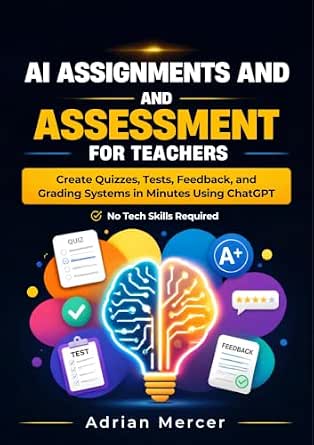 | Best for Assessment Workflows | Format: Book (digital/print) | Primary Audience: Teachers handling quiz, test, and grading workloads | Core Topics: Quiz creation, test generation, feedback, grading systems | VIEW LATEST PRICE | See Our Full Breakdown |
| ChatGPT for Teachers: The Complete Guide to AI-Powered Lesson Planning, Classroom Management, Student Engagement, Assessment, Prompt Engineering, and Time-Saving Teaching Strategies |  | Most Complete Single Volume | Format: Book (digital/print) | Primary Audience: Teachers at beginner-to-intermediate AI levels | Core Topics: Lesson planning, classroom management, engagement, assessment, prompt engineering | VIEW LATEST PRICE | See Our Full Breakdown |
| AI Powered Classroom: Tools to Save Time, Enhance Curriculum, and Boost Student Engagement |  | Best for Curriculum-Focused Teams | Format: Guide/printed resource | Primary focus: Curriculum enhancement and time savings | Secondary focus: Student engagement | VIEW LATEST PRICE | See Our Full Breakdown |
| ChatGPT & AI Tools for Teachers: Practical Strategies for Lesson Planning, Classroom Communication, Grading Support, and Student Engagement |  | Best for All-in-One Classroom Workflows | Format: Guide/printed resource | Primary focus: Practical AI strategies for teachers | Topics covered: Lesson planning, classroom communication, grading support, student engagement | VIEW LATEST PRICE | See Our Full Breakdown |
| AI-powered student assessment tool | Format | Primary focus | Skill Level Required |
|---|---|---|---|
| AI for Teachers: Assessment an | Book (AI for Educators series) | Assessment and feedback | — |
| AI-Powered Assessment: Masteri | Course | AI-assisted assessment design | — |
| The AI-Powered Teacher’s Playb | Book (prompt collection) | Ready-to-use AI prompts | — |
| AI Tools for Teachers: Boost C | Book | Classroom productivity and time savings | — |
| The AI-Powered Teacher: The Co | Book (complete guide) | Whole-classroom AI integration | — |
| AI for Teachers: Practical AI | Book (digital/print) | — | Some AI familiarity recommended |
| AI in the Classroom: The Educa | Book (digital/print) | — | Beginner-friendly |
| AI-Powered Teaching: The Pract | Book (digital/print) | — | Basic AI familiarity helpful |
| AI Assignments and Assessment | Book (digital/print) | — | None — designed for non-technical users |
| ChatGPT for Teachers: The Comp | Book (digital/print) | — | Familiarity with AI concepts recommended |
| AI Powered Classroom: Tools to | Guide/printed resource | Curriculum enhancement and time savings | Some familiarity with AI tools recommended |
| ChatGPT & AI Tools for Teacher | Guide/printed resource | Practical AI strategies for teachers | Basic AI familiarity helpful |
More Details on Our Top Picks
AI for Teachers: Assessment and Feedback: Grade Smarter, Give Better Feedback, and End the Burnout Cycle
Assessment and feedback is the hardest part of teaching to delegate, and this book earns the top spot because it refuses to wander from that single problem. Where The AI-Powered Teacher’s Playbook spreads itself across lesson planning, engagement, and everything else, this one stays locked on grading efficiency and feedback quality, which is exactly where AI delivers the biggest time savings. Compared with broader guides like The AI-Powered Teacher, it reads less like a survey of possibilities and more like a working manual for the marking pile. The burnout framing is also honest — it treats AI as a workload tool, not a gimmick. The tradeoff is that it assumes some comfort with AI concepts, so complete beginners may need a companion primer before the strategies click.
Pros:- Laser focus on assessment and feedback rather than general AI theory
- Practical tools aimed directly at reducing grading workload
- Addresses teacher burnout as a workload problem, not a mindset problem
- Part of a series that supports deeper follow-up learning
Cons:- Assumes prior familiarity with AI concepts and terminology
- No detailed technical breakdowns of the specific tools recommended
Best for: Classroom teachers drowning in grading who want AI workflows built specifically around assessment and feedback
Not ideal for: Educators with zero AI background who need a from-scratch introduction before applying assessment-specific strategies
- Format:Book (AI for Educators series)
- Primary focus:Assessment and feedback
- Secondary focus:Grading efficiency, teacher burnout
- Audience:K-12 and higher-ed classroom teachers
- Experience level required:Some AI familiarity recommended
- Scope:Narrow and deep — assessment only
Our verdict“If marking and feedback are eating your evenings, this is the most targeted resource in the lineup.”
AI-Powered Assessment: Mastering Bloom’s Taxonomy with Generative LLMs
This is the most pedagogically rigorous entry in the batch, and it’s aimed at a different reader than the rest. Rather than promising time savings like AI for Teachers: Assessment and Feedback, it tackles assessment design through Bloom’s Taxonomy, showing how generative LLMs can build questions that actually measure higher-order thinking. That makes it a better fit for instructional designers and curriculum leads than for teachers who just want faster quizzes — AI Assignments and Assessment for Teachers covers that speed-first need elsewhere in this roundup. The tradeoff is real: the content assumes you already know both Bloom’s framework and how LLMs behave, so it functions as an intermediate-to-advanced resource. Course length and structure details are thin, so buyers are trusting the framework, not a detailed syllabus.
Pros:- Grounds AI assessment in Bloom’s Taxonomy rather than generic quiz generation
- Teaches evaluation design, not just question creation
- Genuinely differentiator-level depth compared with generalist AI teaching books
Cons:- Requires working knowledge of both AI and Bloom’s Taxonomy
- No published course duration or detailed content outline
Best for: Instructional designers and curriculum specialists who want AI-built assessments aligned to learning objectives
Not ideal for: Time-pressed classroom teachers who need quick grading help without studying pedagogical theory
- Format:Course
- Primary focus:AI-assisted assessment design
- Framework:Bloom’s Taxonomy
- Technology covered:Generative large language models
- Audience:Instructional designers, curriculum developers
- Experience level required:Intermediate to advanced
- Scope:Assessment design theory and practice
Our verdict“Choose this only if you design assessments professionally and care about cognitive alignment, not just speed.”
The AI-Powered Teacher’s Playbook: 200 Ready-to-Use Prompts for Lesson Planning, Student Engagement, Assessment & Beyond
Two hundred copy-and-go prompts is the appeal here, and it’s a different value proposition than every other pick. Instead of teaching you why AI works — the approach of AI-Powered Assessment — this playbook hands you the finished inputs so you can get results tonight. Assessment prompts are included, but they sit alongside lesson planning and engagement material, so the assessment coverage is necessarily shallower than the dedicated AI for Teachers: Assessment and Feedback book. That breadth-for-depth trade is the whole decision: if you want immediate utility across every teaching task, this wins; if you want a systematic assessment workflow, it won’t go far enough. The lack of detail on individual prompts also means some will fit your subject and grade level better than others, so expect to adapt rather than paste blindly.
Pros:- 200 prompts means immediate, low-friction value with no learning curve
- Covers assessment, lesson planning, and engagement in one place
- Cheapest path to actually trying AI in daily teaching
Cons:- Assessment coverage is broad rather than deep
- Prompt usefulness varies by subject and grade level with no guidance on adaptation
Best for: Busy teachers who want ready-made AI prompts they can deploy immediately across multiple tasks
Not ideal for: Educators wanting a deep, systematic assessment strategy — the prompt format skims rather than digs
- Format:Book (prompt collection)
- Number of prompts:200
- Primary focus:Ready-to-use AI prompts
- Topics covered:Lesson planning, engagement, assessment
- Audience:Teachers at any experience level
- Setup required:Access to an AI chat tool
- Scope:Broad — many tasks, limited depth each
Our verdict“The fastest way to start using AI in your teaching this week, as long as you accept surface-level depth.”
AI Tools for Teachers: Boost Classroom Productivity, Save Time, and Enhance Student Engagement with Smart Technology
This one positions itself as a productivity-first overview — time savings and engagement ahead of pedagogy — which places it closer to AI Powered Classroom than to the assessment-heavy picks above. Compared with The AI-Powered Teacher’s Playbook, it favors explaining categories of tools over handing you literal prompts, so it suits teachers who want to understand the landscape before committing to workflows. Assessment appears as one productivity application among many rather than the centerpiece, which is why it ranks below the dedicated assessment titles in this roundup. The honest drawback is transparency: feature detail and user reviews are sparse, so you’re buying on the strength of the premise. For a teacher overwhelmed by options who wants a plain-language map of what AI can take off their plate, that premise still holds up reasonably well.
Pros:- Frames AI around teacher time savings rather than tech enthusiasm
- Accessible for teachers with no prior AI exposure
- Covers engagement alongside productivity in one read
Cons:- Little detail on specific tools or features
- No user reviews available to validate claims
- Assessment coverage is peripheral compared with dedicated titles
Best for: Overwhelmed generalist teachers who want a simple overview of AI’s time-saving possibilities before diving deeper
Not ideal for: Anyone evaluating specific tools or needing proven assessment workflows — detail is thin
- Format:Book
- Primary focus:Classroom productivity and time savings
- Secondary focus:Student engagement
- Audience:AI-curious teachers, beginners
- Experience level required:None — introductory
- Scope:Broad overview of AI tool categories
- Validation:No published user reviews
Our verdict“A reasonable first primer if you’re curious but uncommitted — just don’t expect assessment depth or tool specifics.”
The AI-Powered Teacher: The Complete Guide to Smarter Lesson Planning, Personalized Learning, Student Engagement, Assessment, Prompt Engineering, and Future-Ready Teaching
This is the encyclopedia option — the subtitle alone signals that it covers prompt engineering, personalized learning, assessment, and future trends under one cover. That breadth directly competes with ChatGPT for Teachers from elsewhere in this roundup, and it differentiates by including prompt engineering fundamentals, which most teacher-focused books skip entirely. Assessment gets a chapter-scale treatment rather than the book-length focus of AI for Teachers: Assessment and Feedback, so dedicated graders should still prefer that pick. Where this guide earns its place is as a single-volume reference for educators building long-term AI fluency rather than solving one problem. The costs are length and density — it reads closer to professional development material than a weekend read, and educators wanting quick wins will find The AI-Powered Teacher’s Playbook far less demanding.
Pros:- Most complete topical coverage in this batch, from prompt engineering to personalized learning
- Includes future-ready framing that keeps content relevant beyond current tools
- Doubles as an ongoing reference rather than a one-time read
Cons:- Dense and technical in stretches — a real time investment
- Assessment is one chapter among many, not a specialty
Best for: Educators committed to a long-term AI practice who want one thorough reference instead of five shallow books
Not ideal for: Teachers seeking quick, targeted fixes — the breadth makes it a slow, demanding read
- Format:Book (complete guide)
- Primary focus:Whole-classroom AI integration
- Topics covered:Lesson planning, personalized learning, engagement, assessment, prompt engineering
- Audience:Educators pursuing long-term AI fluency
- Experience level required:Beginner to intermediate, with patience
- Depth:Deep and wide — reference-style
- Special features:Prompt engineering and future-readiness sections
Our verdict“Buy this if you want to become fluent in AI-powered teaching overall, not if assessment is your only pain point.”
AI for Teachers: Practical AI Tools for Lesson Planning, Smart Grading, Classroom Productivity, Student Engagement, and Educational Leadership
Among a lineup dominated by classroom-level guides, this title stands apart because it extends beyond teaching mechanics into educational leadership. Where AI-Powered Teaching focuses narrowly on ChatGPT workflows, this book tackles the harder question: how a department head or principal actually drives AI adoption across a school. The leadership and integration strategies are what justify its place here — few competitors address change management at all.
The tradeoff is breadth. By covering planning, grading, engagement, and leadership, it sacrifices depth in each area; teachers who want a deep grading workflow will get more from AI Assignments and Assessment for Teachers. It also assumes some baseline comfort with AI vocabulary, so complete newcomers may feel a step behind.
Pros:- One of the few titles covering AI adoption strategy for administrators, not just classroom use
- Connects assessment and grading tools to school-wide productivity goals
- Balances teaching tactics with engagement and leadership guidance
- Useful as a shared reference point for staff-wide AI initiatives
Cons:- Broad scope means shallow coverage of any single topic like grading or feedback
- Assumes prior familiarity with AI concepts rather than teaching them from scratch
- Lacks specific technical walkthroughs or prompt examples
Best for: Principals, department heads, and instructional coaches responsible for rolling out AI tools across multiple classrooms or a whole school
Not ideal for: Individual teachers wanting step-by-step grading or quiz workflows — the broad scope means less hands-on depth per topic
- Format:Book (digital/print)
- Primary Audience:Teachers and school leaders
- Core Topics:Lesson planning, grading, classroom productivity, engagement, leadership
- AI Focus:General practical AI tools for education
- Skill Level Required:Some AI familiarity recommended
- Depth:Broad overview across multiple domains
Our verdict“This pick makes the most sense for school leaders who need a strategic framework for AI adoption rather than a single-classroom toolkit.”
AI in the Classroom: The Educator’s Complete Guide to Transforming Student Learning with Artificial Intelligence
This is the conceptual foundation pick of the roundup. Compared with ChatGPT for Teachers, which jumps straight into prompt engineering and daily workflows, this guide spends more time on the why: how AI reshapes student learning, what changes in an AI-driven classroom, and how teachers should reposition themselves. That framing makes it the right first read for someone who has heard the buzz but doesn’t yet grasp the landscape.
The drawback is the flip side of its strength. With little technical content or hands-on tooling, it won’t help you build a quiz or automate feedback tomorrow — for that, AI Assignments and Assessment for Teachers is the practical alternative. It also ships without a track record of reader feedback, so quality is harder to verify.
Pros:- Frames AI’s impact on student learning rather than just teacher convenience
- Approachable for educators with zero AI background
- Covers the full teaching context, not a single tool
- Good preparatory read before tackling tool-specific guides
Cons:- Lacks detailed technical or hands-on instructional content
- No verified reader reviews to signal quality
- Tool-agnostic approach means no copy-and-use prompts or templates
Best for: Teachers and student-teachers early in their AI journey who want conceptual grounding before touching any specific tool
Not ideal for: Time-pressed educators who need ready-to-run assessment workflows today — this is orientation, not a field manual
- Format:Book (digital/print)
- Primary Audience:Classroom educators
- Core Topics:AI integration strategy, student learning transformation
- AI Focus:General artificial intelligence in education
- Skill Level Required:Beginner-friendly
- Approach:Conceptual and strategic rather than tool-specific
Our verdict“Read this first if you want to understand what AI changes about learning — skip it if you need a working quiz generator this week.”
AI-Powered Teaching: The Practical Guide to ChatGPT and AI Tools for Educators
Positioned between the strategy-heavy AI in the Classroom and the single-purpose AI Assignments and Assessment for Teachers, this guide hits a practical middle ground: ChatGPT-centered workflows for real teaching tasks. Lesson prep, classroom engagement, and streamlined admin all get treatment, making it a sensible default for teachers who want one book rather than three.
Where it beats AI for Teachers is specificity — grounding guidance in ChatGPT gives readers something concrete to act on. Where it falls short is originality: the ChatGPT-for-teachers shelf is crowded, and it doesn’t distinguish its assessment content from what ChatGPT for Teachers offers with its own prompt-engineering chapters. Expect a solid generalist, not a specialist.
Pros:- Practical, task-oriented guidance rather than abstract theory
- Centered on ChatGPT, the most accessible AI tool for teachers
- Covers engagement and workflow efficiency alongside teaching craft
- Balanced scope suits most everyday classroom needs
Cons:- Overlaps heavily with competing ChatGPT guides without a clear differentiator
- Light on technical detail and specific prompt examples
- Assumes basic AI understanding from the start
Best for: Classroom teachers who want a single well-rounded ChatGPT guide covering planning, engagement, and daily workflow
Not ideal for: Specialists hunting for advanced prompt engineering or deep assessment design — dedicated titles cover those better
- Format:Book (digital/print)
- Primary Audience:K-12 and higher-ed teachers
- Core Topics:ChatGPT integration, classroom engagement, workflow streamlining
- AI Focus:ChatGPT and companion AI tools
- Skill Level Required:Basic AI familiarity helpful
- Approach:Practical, task-based strategies
Our verdict“A sensible one-book choice for generalist teachers who want actionable ChatGPT workflows without wading into niche guides.”
AI Assignments and Assessment for Teachers: Create Quizzes, Tests, Feedback, and Grading Systems in Minutes Using ChatGPT
This is the most tightly scoped book in the batch, and that focus is its whole value proposition. While AI-Powered Teaching spreads itself across planning, engagement, and management, this one stays locked on the assessment pipeline: quizzes, tests, feedback, and grading systems built in minutes. For teachers drowning in marking, that specificity translates directly into reclaimed evenings.
The no-tech-skills-required promise sets it apart from prompt-engineering-heavy rivals like ChatGPT for Teachers, which expects more comfort up front. The tradeoff: it’s ChatGPT-only, so educators exploring broader AI platforms get nothing here, and the narrow scope means it’s a supplement to — not a replacement for — a general teaching guide.
Pros:- Assessment-specific focus matches the biggest time sink in teaching
- Genuinely beginner-friendly with no technical background needed
- Promises results in minutes, not weeks of learning
- Covers the full loop: creation, feedback, and grading systems
Cons:- ChatGPT-only — no coverage of other AI assessment platforms
- Narrow scope makes it a one-trick addition to a teacher’s shelf
- Sparse published detail on the actual content inside
Best for: Teachers who spend hours weekly on quizzes, tests, and grading and want fast, no-technical-skill ChatGPT shortcuts
Not ideal for: Educators seeking a full AI-in-the-classroom guide — planning, engagement, and strategy topics are largely absent
- Format:Book (digital/print)
- Primary Audience:Teachers handling quiz, test, and grading workloads
- Core Topics:Quiz creation, test generation, feedback, grading systems
- AI Focus:ChatGPT exclusively
- Skill Level Required:None — designed for non-technical users
- Approach:Workflow-driven, output-focused
Our verdict“Buy this if grading and quiz creation are your pain point and you want the shortest path from prompt to finished test.”
ChatGPT for Teachers: The Complete Guide to AI-Powered Lesson Planning, Classroom Management, Student Engagement, Assessment, Prompt Engineering, and Time-Saving Teaching Strategies
Of everything in this roundup, this title claims the widest footprint: planning, classroom management, engagement, assessment, and prompt engineering in one package. Compared with AI-Powered Teaching, it adds explicit prompt-engineering instruction, which is the skill that actually determines output quality once the basics are learned. For a teacher buying one reference and nothing else, this is the most defensible single purchase.
The risk with any ‘complete guide’ is dilution. Its assessment chapters won’t match the focused depth of AI Assignments and Assessment for Teachers, and newcomers to AI may find the breadth overwhelming at first. Teachers already fluent in ChatGPT basics will also find early chapters slow going before the advanced material arrives.
Pros:- Widest topic coverage of any single book in this roundup
- Includes prompt engineering, a skill most competing guides skip
- Explicitly ties AI use to time savings teachers can measure
- Works as a long-term reference rather than a one-time read
Cons:- Breadth dilutes depth — assessment coverage trails dedicated titles
- Less accessible for teachers with no prior AI exposure
- Light on concrete worked examples despite the technical chapters
Best for: Teachers who want a single comprehensive reference spanning planning, assessment, and prompt engineering instead of buying multiple niche books
Not ideal for: AI-averse beginners who need gentle onboarding — the sheer scope can overwhelm — and specialists who’d benefit from a focused assessment-only title
- Format:Book (digital/print)
- Primary Audience:Teachers at beginner-to-intermediate AI levels
- Core Topics:Lesson planning, classroom management, engagement, assessment, prompt engineering
- AI Focus:ChatGPT and AI teaching tools
- Skill Level Required:Familiarity with AI concepts recommended
- Approach:Comprehensive reference with strategy and technique
- Scope:Broadest coverage in the roundup
Our verdict“The one-book library for teachers ready to go from AI novice to power user, provided they don’t need specialist depth in any single area.”
AI Powered Classroom: Tools to Save Time, Enhance Curriculum, and Boost Student Engagement
Most of the titles in this roundup lean on prompt lists or single-tool deep dives, but this one positions itself around curriculum development as a whole, which gives it a distinct role in the lineup. Where The AI-Powered Teacher’s Playbook hands you 200 ready-to-use prompts, this option works backward from bigger questions: how AI reshapes what you teach, not just how you write it. That breadth makes this pick better suited to department leads and instructional coaches who need a shared reference for redesigning units, not just quick wins on a Sunday night. The tradeoff is real, though. Compared with AI Assignments and Assessment for Teachers, which promises quiz and grading workflows in minutes, this one stays at a higher altitude and offers fewer copy-paste artifacts. Sparse feature documentation and the absence of reader reviews also mean you’re buying on faith rather than evidence.
Pros:- Frames AI around curriculum design rather than isolated tasks
- Strong emphasis on time savings for busy educators
- Addresses student engagement alongside planning
- Useful as a shared reference for teams adopting AI together
Cons:- Thin publicly available detail about its actual tools and structure
- No reader reviews to validate claims before purchase
- Assumes some baseline comfort with AI tools
Best for: Department heads, curriculum coordinators, and instructional coaches planning AI adoption across multiple classrooms
Not ideal for: Teachers who want immediate, copy-ready grading or quiz templates — the prompt-driven titles in this guide deliver faster day-one results
- Format:Guide/printed resource
- Primary focus:Curriculum enhancement and time savings
- Secondary focus:Student engagement
- Intended audience:K-12 and higher-ed educators
- Skill level required:Some familiarity with AI tools recommended
- Includes prompts/templates:Limited; concept-driven rather than prompt-driven
- Reader reviews:None available at time of writing
Our verdict“A reasonable choice for curriculum leaders who want a strategic lens on AI, but classroom teachers chasing ready-made prompts should look elsewhere in this roundup.”
ChatGPT & AI Tools for Teachers: Practical Strategies for Lesson Planning, Classroom Communication, Grading Support, and Student Engagement
What sets this title apart in a crowded field is its breadth across the daily teaching workflow — lesson planning, parent and student communication, grading support, and engagement all get covered under one cover. That’s a wider practical footprint than AI for Teachers: Assessment and Feedback, which narrows in on grading and feedback alone, and it avoids the prompt-dump feel of ChatGPT for Teachers: The Complete Guide by organizing chapters around real classroom tasks. For a teacher who wants one book instead of four, this is the pragmatic middle ground. The catch: breadth costs depth. If your single biggest pain point is assessment, the assessment-specific titles in this guide will go further, and the strategies here still assume you can navigate ChatGPT on your own. With no ratings or pricing visibility, you’re weighing structure over proven track record.
Pros:- Covers planning, communication, grading, and engagement in one volume
- Strategies are organized around everyday teaching tasks
- Practical rather than theoretical in orientation
- Reduces the need to buy multiple single-topic AI books
Cons:- Coverage of any one area is shallower than specialist titles
- No visible ratings or pricing data to gauge reader satisfaction
- Assumes prior familiarity with AI tools
Best for: Classroom teachers who want one resource covering planning, communication, and grading rather than buying a specialist book for each task
Not ideal for: Educators focused strictly on assessment and grading systems — a dedicated assessment title will cover that ground in more detail
- Format:Guide/printed resource
- Primary focus:Practical AI strategies for teachers
- Topics covered:Lesson planning, classroom communication, grading support, student engagement
- Core tool focus:ChatGPT and related AI tools
- Intended audience:K-12 and higher-ed teachers
- Skill level required:Basic AI familiarity helpful
- Reader reviews:None available at time of writing
Our verdict“The best single-book choice for teachers who want AI help across their whole workflow, though assessment-heavy users should pick a narrower title instead.”

How We Picked
I evaluated each title through one lens: how well it helps a teacher create, deliver, and grade student assessments with AI. That meant judging assessment specificity (is assessment the book’s core or an afterthought?), prompt quality (are the examples copy-ready with variables, or abstract advice?), pedagogical grounding (does the book connect AI output to rubrics, standards, or Bloom’s levels?), and usability for a time-poor teacher (can someone implement something useful within a week?).
The ranking logic follows directly from those criteria. Books that dedicate their entire structure to assessment sit above generalist AI teaching guides that compress assessment into a single chapter, no matter how polished those guides are otherwise. Within the generalist tier, I ranked books higher when their assessment content included concrete workflows — quiz generation, feedback templates, grading-system setup — rather than inspirational overviews. Where two books offered similar depth, the tiebreaker was practicality: copy-ready prompts beat prompt theory every time.
| AI-powered student assessment tool | Skill Level Required |
|---|---|
| AI for Teachers: Assessment an | — |
| AI-Powered Assessment: Masteri | — |
| The AI-Powered Teacher’s Playb | — |
| AI Tools for Teachers: Boost C | — |
| The AI-Powered Teacher: The Co | — |
| AI for Teachers: Practical AI | Some AI familiarity recommended |
| AI in the Classroom: The Educa | Beginner-friendly |
| AI-Powered Teaching: The Pract | Basic AI familiarity helpful |
| AI Assignments and Assessment | None — designed for non-technical users |
| ChatGPT for Teachers: The Comp | Familiarity with AI concepts recommended |
| AI Powered Classroom: Tools to | Some familiarity with AI tools recommended |
| ChatGPT & AI Tools for Teacher | Basic AI familiarity helpful |
Factors to Consider When Choosing AI-powered Student Assessment Tools
Choosing among AI-powered student assessment resources comes down to matching the book’s scope to your actual pain point. These are the factors that separated the worthwhile purchases from the shelf-fillers in this comparison.
Assessment Depth vs. Breadth of Coverage
The most common mistake teachers make here is buying a broad AI-in-education book when what they actually need is assessment depth. Generalist guides covering lesson planning, engagement, communication, and assessment in one volume spend perhaps forty pages on grading and feedback — useful for orientation, thin for implementation. Dedicated assessment books invert that ratio, walking through rubric creation, question design, feedback loops, and grading pipelines step by step. If assessment is your biggest time sink, the dedicated titles in this lineup justify themselves faster. If you’re adopting AI across your whole practice, the broader guides give better context, and you can supplement later. Decide which problem you’re solving before comparing page counts or price.
Pedagogical Grounding and Cognitive Rigor
AI can generate a multiple-choice quiz in seconds, but a quiz that only tests recall is not an improvement over what most teachers already have. The books worth paying more for are the ones that show you how to prompt for higher-order thinking — analysis, evaluation, synthesis — usually through Bloom’s Taxonomy or a similar framework. Without that grounding, you risk automating the weakest part of your assessment practice at scale. When comparing options, check whether the author explains why an assessment works, not just how to generate one. Cheaper, prompt-list-style books rarely cover this. It’s the difference between using AI as a shortcut and using it as an amplifier for good pedagogy.
Prompt Usability: Templates vs. Theory
There is a real split in this category between books that teach prompt-writing principles and books that hand you finished prompts with fill-in-the-blank variables. Templates get you grading faster, but principles make you adaptable when a prompt fails or your district changes tools. The strongest resources do both: a worked example followed by the reasoning behind it. A common disappointment is buying a 200-prompt book and finding half the prompts are too generic to survive contact with an actual classroom. Look for prompts that reference grade level, subject, rubric criteria, and response format explicitly. That specificity is what separates a usable library from padding.
Feedback and Grading Workflow Coverage
Quiz generation is the easy part; the real time drain is grading open responses and writing feedback. Yet many books in this space spend most of their assessment pages on question creation and barely touch feedback. Before buying, check the table of contents for feedback-specific chapters — tone control, differentiation for student reading levels, rubric-aligned comments, and how to keep a human voice in AI-drafted feedback. Also consider whether the book addresses grading consistency, since inconsistent application of rubrics is one of the biggest fairness complaints from students and parents. Books that treat feedback as an afterthought will leave your largest workload untouched.
Tool Dependence and Longevity
Books built entirely around one tool — typically ChatGPT — read smoothly today but date quickly as interfaces change and competitors emerge. Tool-agnostic books that teach workflows and prompt logic tend to hold value for multiple school years, which matters if you’re spending your own money. That said, tool-specific books have a place for absolute beginners who want exact click-by-click instructions and lower initial friction. The tradeoff is a shorter useful lifespan. My suggestion for most teachers: start with one tool-specific guide to get moving, then pick up a framework-driven book once you’re comfortable, so your skills survive the next platform shift.
Privacy, Policy, and Academic Integrity Awareness
A surprising number of these books barely mention student data privacy or academic integrity, both of which directly affect assessment design. If your district restricts what student work can be pasted into an AI tool, a book full of workflows that assume open data sharing will be frustrating to adapt. Stronger titles address anonymization, de-identification of student writing, and designing assessments that are AI-resistant — oral defenses, process-based grading, personalized contexts. These chapters are dull but they protect you. Treat their absence as a yellow flag, especially if you teach in a district with strict data policies or at a level where accreditation reviews assessment practices.
Frequently Asked Questions
Do I need a dedicated assessment book, or is a general AI-for-teachers guide enough?
It depends on how central assessment is to your pain. If grading and feedback consume most of your evenings, a dedicated assessment book will pay for itself within a semester because every chapter moves your workflow forward. Generalist guides work well when you’re new to AI and want one resource covering planning, engagement, and assessment together — but expect their assessment sections to run forty to sixty pages, enough for ideas, not full implementation. A reasonable path many teachers take is starting with a generalist guide, then adding a dedicated assessment title once they know which part of the workflow hurts most. What I’d avoid is buying three overlapping generalist books hoping one of them goes deep on grading — in this comparison, none of them did.
Are prompt-library books actually useful, or do the prompts fall apart in real classrooms?
The honest answer is that quality varies enormously, and the difference is specificity. Prompts with explicit placeholders — grade level, subject, number of questions, rubric criteria, difficulty spread — worked far better in this comparison than prompts giving vague instructions like ‘create a challenging quiz.’ The good news is that even mediocre prompt libraries teach you pattern recognition: after using twenty of them, most teachers start writing their own variations. If a book offers 200 prompts, expect maybe 60–80 to be genuinely useful for your subject and level, which is still a solid return for the price. The books to skip are those whose prompts read like they were generated by AI and never tested against a real curriculum.
Can these books help if my district bans sending student work to AI tools?
Partially, and this is where checking the table of contents before buying saves disappointment. The stronger titles in this lineup include guidance on anonymizing student writing, using AI to build feedback templates and rubrics rather than process raw student data, and generating example responses for comparison instead of uploading actual essays. That said, a district-wide ban doesn’t eliminate the value of these books — most assessment work (question design, rubric building, feedback phrasing, differentiation variants) never involves student data at all. What a ban does change is which workflows you can adopt, so prioritize books with privacy-aware chapters. Books that assume open data sharing will need constant adaptation on your part.
How do I keep AI-generated feedback from sounding robotic to students?
The best books in this comparison treat tone control as a prompting skill, not an afterthought. The techniques that work include feeding the AI examples of your own past comments so it mimics your voice, requiring specific evidence from the student’s work in every comment, and instructing it to vary sentence openers and length. Some titles also recommend a two-pass approach: AI drafts, teacher edits the first line and last line personally, which is where students read most attentively. The books to be wary of are those suggesting you send AI feedback unedited — students detect generic comments quickly, and trust in feedback erodes fast once they do. Used well, AI handles the structural scaffolding while you supply the personal judgment that makes feedback land.
Is it worth paying more for a framework-based book over a budget prompt collection?
Usually yes, if you’ll be teaching more than two or three years. Prompt collections deliver instant gratification but their value decays as your needs shift — once you want assessments aligned to specific standards, differentiated versions, or higher-order thinking tasks, template-only books run out of runway. Framework-based books cost more upfront and demand more reading time, but they teach you to diagnose why an assessment is weak and prompt your way to a fix, a skill that transfers across every AI tool you’ll ever use. The pragmatic middle path appears twice in this lineup: books that pair a framework with a starter prompt library. For teachers on a strict budget, one of those hybrids is the better single purchase than either extreme.
Conclusion
For best overall, AI for Teachers: Assessment and Feedback delivers the most complete assessment workflow with realistic attention to teacher workload and burnout — it’s the pick I’d hand most teachers. The best value choice is AI Assignments and Assessment for Teachers, which gets quizzes, tests, and grading systems running in minutes for a modest price. For depth and rigor, AI-Powered Assessment: Mastering Bloom’s Taxonomy with Generative LLMs is the premium pick, aimed at educators and instructional leads who want assessments measuring genuine higher-order thinking. Beginners should start with AI-Powered Teaching: The Practical Guide to ChatGPT and AI Tools for Educators, whose click-by-click approach lowers the entry barrier. If you want one book for your whole AI practice, The AI-Powered Teacher covers planning, personalization, and assessment in a single volume — just accept that its assessment coverage is broader than deeper. Match the book to your biggest bottleneck and you’ll get value from any of these picks.
Halloween Picks
halloween
As an affiliate, we earn on qualifying purchases.