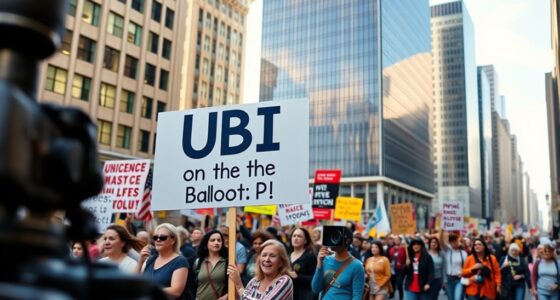
Implementing UBI can increase demand and potentially push prices higher initially. However, if managed well, it encourages economic activity, boosts spending, and supports growth without triggering significant inflation. Proper policy coordination, such as balancing supply and demand and promoting productivity, helps prevent prices from spiraling out of control. While concerns are valid, understanding how UBI interacts with the economy reveals ways to minimize inflation risks—you’ll see how all this fits together if you keep exploring.
Key Takeaways
- Small, targeted UBI transfers are less likely to cause inflation than large, broad payouts.
- Proper policy coordination and supply-side measures can mitigate inflation risks from UBI.
- Increased demand from UBI can stimulate growth without significantly raising prices if supply adjusts.
- UBI’s impact on prices depends on scale, implementation, and existing economic conditions.
- Combining UBI with productivity and growth strategies helps prevent inflationary pressures.

Universal Basic Income (UBI) is often discussed as a tool to reduce poverty and provide economic security, but many worry it could also trigger inflation. One common concern is that distributing regular cash transfers might lead to higher prices, especially if people start spending more without a corresponding increase in goods and services. However, it’s important to understand how UBI interacts with economic growth and inflation dynamics. When implemented thoughtfully, cash transfers can stimulate economic activity without necessarily causing runaway inflation. By putting more money into people’s hands, UBI can boost consumption, encouraging businesses to produce more, which in turn supports economic growth. This increased demand might push prices up initially, but if the economy responds by expanding capacity—through investment or innovation—prices can stabilize or even fall over time.
The key lies in how the additional income is used. If recipients use their cash transfer to buy goods and services, businesses may see higher sales, prompting them to hire more workers or invest in new equipment. This creates a positive cycle: increased demand leads to higher economic growth, which can absorb the extra spending without causing inflation to spiral out of control. In fact, some economists argue that UBI could help smooth out economic fluctuations by providing a steady base of income, reducing the need for reactive policy measures that often have inflationary side effects. Furthermore, the inflation risk depends on the scale of the cash transfer relative to the economy’s size. Smaller, targeted transfers are less likely to cause inflation than massive, universal payouts that notably boost aggregate demand.
It’s also worth noting that inflation isn’t solely driven by demand. Factors like supply chain disruptions, energy prices, and monetary policy play vital roles. If a country maintains a balanced approach, improves productivity, and manages monetary policy effectively, the inflationary impact of UBI can be minimal. Additionally, understanding the relationship between consumer spending and inflation helps clarify how UBI can be managed to prevent excessive price increases. Conversely, if UBI is accompanied by loose monetary policy or supply constraints, inflation could accelerate. Ultimately, whether UBI fuels inflation depends on how well policies are coordinated. When cash transfers are part of a broader strategy that promotes economic growth, enhances productivity, and manages demand, the risk of triggering inflation diminishes. Instead, UBI can serve as a catalyst for economic stability and growth, rather than a cause of rising prices.
As an affiliate, we earn on qualifying purchases.
Frequently Asked Questions
How Might UBI Affect Long-Term Economic Growth?
Universal Basic Income can boost your long-term economic growth by increasing consumer spending and reducing poverty. When people have a safety net, they’re more likely to invest in education, training, and entrepreneurship, which benefits the economy overall. While some worry about inflation, properly managed UBI can stimulate growth without causing instability. Ultimately, it encourages a more equitable and resilient economy, helping you and others thrive over time.
Could UBI Replace Traditional Welfare Programs Effectively?
You can see that universal basic income (UBI) could replace traditional welfare programs by providing a simple, universal social safety net. It streamlines support, reduces bureaucracy, and guarantees everyone has basic financial security. However, you’d need to take into account funding and potential impacts on work incentives. While UBI offers an effective safety net, it might not address all specific needs, so some targeted programs could still be necessary alongside it.
What Are the Environmental Impacts of Implementing UBI?
Implementing UBI can positively impact environmental sustainability by providing income that encourages eco-friendly choices. For example, with a guaranteed income, you might invest in renewable energy or reduce waste. This influences resource management by promoting responsible consumption. However, increased consumption could strain natural resources if not managed carefully. Overall, UBI can support environmental goals if paired with policies that promote sustainable practices and efficient resource use.
How Does UBI Influence Workforce Participation Rates?
You might find that UBI influences workforce participation rates by boosting workforce motivation, encouraging people to pursue jobs that match their skills and interests rather than just survival needs. It can lower unemployment rates by providing a safety net, making workers more willing to leave unstable jobs. However, some may reduce their working hours or withdraw from the workforce altogether, which could impact overall productivity and economic growth.
Are There Historical Examples of Similar Monetary Policies?
Yes, history shows examples of monetary policy aimed at inflation control, like the U.S. during the 1970s. The Federal Reserve increased interest rates to curb inflation, but it also slowed economic growth. Similarly, countries have used quantitative easing and other policies to manage inflation. You should recognize that these strategies can impact prices and economic activity, emphasizing the importance of careful monetary policy to balance growth and inflation control.
As an affiliate, we earn on qualifying purchases.
Conclusion
So, with free money flooding in, you might think prices will skyrocket overnight. But hey, who needs stable prices when you can enjoy the thrill of unpredictable inflation, right? Maybe, just maybe, a little extra cash won’t turn your wallet into a rollercoaster. Or will it? Either way, you’re all set for the wild ride of UBI and inflation—because what’s life without a little chaos in your economy?
economic growth simulation software
As an affiliate, we earn on qualifying purchases.
As an affiliate, we earn on qualifying purchases.
As an affiliate, we earn on qualifying purchases.