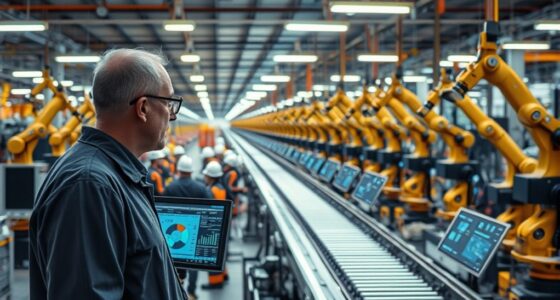
Techno-utopian promises suggest automation will free you from traditional work, creating a perfect, leisure-filled society. However, these ideas often overlook challenges like widespread job loss, economic instability, and societal shifts needed to redefine purpose beyond employment. While automation might reshape the future, staying prepared means understanding the realities behind these optimistic visions. If you’re curious about what’s truly at stake and how society plans to navigate this changeover, there’s more to explore below.
Key Takeaways
- Automation may displace many jobs, but societal adaptation and new roles could emerge, challenging the notion of a complete work end.
- Universal Basic Income (UBI) is proposed as a safety net, yet its practicality and effects on motivation remain debated.
- Redefining work beyond income—focusing on purpose, social connection, and creativity—is a key aspect of techno-utopian promises.
- Policy and societal shifts are necessary to manage economic transitions, but resistance and uncertainty may hinder progress.
- The future of work depends on proactive planning, balancing technological innovation with societal well-being and economic sustainability.

Have we reached the point where traditional work as we understand it is coming to an end? Many experts and futurists suggest that rapid technological advances are pushing us toward a future where jobs could become obsolete. But as exciting as that sounds, it also sparks a lot of anxiety, especially around automation fears. You might worry that robots and AI will take over not just manual labor but also skilled professions, leaving many people unemployed or underemployed. This uncertainty fuels debates about whether society is prepared to handle such sweeping changes. Some propose solutions like universal basic income (UBI), which could provide a safety net for those displaced by automation. UBI promises regular cash payments to everyone, regardless of employment status, aiming to reduce poverty and economic insecurity. But even with this idea floating around, it’s not a magic fix. Critics argue it could disincentivize work or strain public resources, raising questions about its practicality and sustainability.
You need to contemplate that these technological shifts aren’t happening in a vacuum. While automation fears dominate headlines, they also prompt a reevaluation of what work means in the first place. Is work solely about earning money, or does it serve other purposes like social connection, purpose, and identity? If machines take over most tasks, society might need to redefine these ideas altogether. Some envision a future where humans focus more on creative, emotional, or community-centered pursuits, but that shift requires significant cultural and economic adjustments. The promise of universal basic income offers a way to cushion this transition, but it’s not universally accepted or implemented yet. Countries experimenting with UBI show mixed results, and the debate continues about whether it can truly replace the income lost from traditional jobs.
You also have to think about how policies will evolve to address these challenges. Will governments ramp up social safety nets, or will they resist change out of fear of economic instability? The conversation around automation fears and universal basic income isn’t just about technology—it’s about how society chooses to adapt and support its people in a rapidly changing landscape. As you watch these developments unfold, it’s clear that the end of work as we know it isn’t just a sci-fi concept. It’s a real possibility that demands careful planning, open-mindedness, and a willingness to rethink what a meaningful life looks like in the age of machines.
universal basic income UBI kit
As an affiliate, we earn on qualifying purchases.
As an affiliate, we earn on qualifying purchases.
Frequently Asked Questions
How Will Income Inequality Be Affected by Automation?
Automation could widen income inequality if profits from tech advancements concentrate among the wealthy. You might see the rich getting richer while workers face job losses. To counter this, income redistribution policies and a strong social safety net can help make certain that benefits from automation are shared more equitably. Without these measures, the gap between high and low earners will likely grow, deepening economic divides.
What Policies Are Needed to Support Displaced Workers?
Think of supporting displaced workers as steering a ship through turbulent waters. You need targeted policies like reskilling initiatives to help them navigate new roles and strengthen social safety nets to catch those who falter. Investing in education and training guarantees workers aren’t left adrift, while robust safety nets provide stability during shift. Together, these policies create a steady course toward inclusive growth despite automation’s challenges.
Will Universal Basic Income Become a Standard Solution?
Universal basic income will likely become a standard solution as automation and AI threaten jobs, but you’ll need to address cybersecurity challenges and digital privacy concerns alongside it. Implementing UBI requires secure systems that protect personal data, ensuring trust in the program. While UBI offers a safety net, staying vigilant about digital privacy and cybersecurity is essential to prevent exploitation and maintain public confidence in this evolving economic support.
How Do Technological Advances Impact Global Economic Stability?
Technological advances markedly impact global economic stability by reshaping the labor market and driving innovation trends. You might see job shifts or disruptions as automation and AI replace traditional roles, but these same innovations can create new opportunities and boost productivity. Staying adaptable and investing in skills development helps you navigate these changes, ensuring economic stability remains resilient despite rapid technological progress.
Are There Environmental Consequences of Increased Automation?
You might think automation is a green light, but it’s a double-edged sword for the environment. Increased automation can boost energy consumption and expand ecological footprints if not managed with sustainable practices. While it can reduce waste and optimize resources, unchecked growth risks harming ecosystems. You should prioritize eco-friendly innovations and regulation to guarantee automation benefits the planet, not just profits, preventing environmental consequences from spiraling out of control.

The Last Job: AI will eliminate millions of jobs. What are people going to do?
As an affiliate, we earn on qualifying purchases.
As an affiliate, we earn on qualifying purchases.
Conclusion
Imagine sitting on your porch, watching robots quietly replace workers in the fields. It’s tempting to think technology will set us free from labor, but history shows promises often hide pitfalls. As automation accelerates, you might find yourself asking: will this new era bring more leisure or just new struggles? Stay aware of the fine print, because the future of work isn’t written yet—and it’s up to you to read the small print carefully.

IQ BUILDER | STEM Learning Toys | Creative Construction Engineering | Fun Educational Building Set for Boys & Girls Ages 3-10 | Top Blocks Game Kit
EMPOWER YOUR CHILD WITH THE SKILLS NEEDED FOR A BRIGHT AND SUCCESSFUL FUTURE ✮ IQ builder has created…
As an affiliate, we earn on qualifying purchases.
As an affiliate, we earn on qualifying purchases.
creativity and purpose development courses
As an affiliate, we earn on qualifying purchases.
As an affiliate, we earn on qualifying purchases.