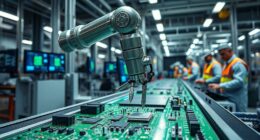

AI will transform many jobs, but it won’t take every single one. While up to 300 million roles could be displaced by 2030, around 170 million new jobs are expected to emerge, especially in healthcare, AI development, and tech sectors. Entry-level roles decline, but opportunities in skilled fields grow. Most roles will require new skills, making continuous learning essential. If you want to understand how this balance works across industries, keep exploring more insights.
Key Takeaways
- AI is expected to displace around 300 million jobs globally by 2030 but will also create approximately 170 million new roles.
- Net job gains, driven by industry shifts and new opportunities, offset most automation-related job losses.
- Many emerging roles in healthcare, AI development, and STEM require reskilling rather than replacement.
- Entry-level jobs are declining, but increased demand for AI skills and continuous learning support workforce adaptation.
- Regional and sector-specific impacts mean automation will reshape employment landscapes, not eliminate all jobs.
The Displacement vs. Creation Equation

The displacement vs. creation equation captures the complex impact of AI on jobs. You might think AI will wipe out most roles, but the reality is more nuanced. While 14% of workers have already faced job loss due to AI, automation has eliminated around 1.7 million manufacturing jobs since 2000. In 2025, AI-related tech job cuts average nearly 500 daily. Still, 90% of US companies are adopting AI, mainly automating tasks rather than just augmenting work. This shift is reshaping industries and requiring workers to retrain. Although 13.7% of US workers report losing jobs to robots, many new roles are emerging, especially in AI development and maintenance. AI job creation is projected to reach 20 to 50 million new roles globally by 2030, overall, the equation shows that while job displacement occurs, creation and transformation also happen, balancing the impact in the long run.
Projected Job Losses and Gains by 2030

By 2030, millions of jobs worldwide could be displaced due to AI, especially in routine roles like clerical work and manufacturing. However, new opportunities will also emerge in healthcare, STEM fields, and other sectors, offsetting some of the losses. You’ll need to stay adaptable, as AI reshapes industries and creates both challenges and growth avenues. The emergence of new industries and roles will help balance out employment shifts and ensure economic resilience. Understanding job market dynamics can help individuals better prepare for these changes.
Estimated Job Displacements
AI automation is expected to displace around 300 million jobs globally by 2030, but it will also create new opportunities. You’ll see significant shifts, especially in routine roles, with about 25% of tasks already robotized. Here’s what to expect:
- Up to 23% of jobs will change deeply by 2027, losing 83 million jobs but creating 69 million new ones.
- US jobs like bank tellers and cashiers could decline by 15% and 11%, respectively.
- Routine manufacturing jobs have already dropped by 1.7 million since 2000.
- Roles such as telemarketers and medical transcriptionists face notable reductions.
- Overall, many sectors will evolve, with AI reshaping tasks rather than wiping out jobs entirely, emphasizing the importance of reskilling and adaptation.
- Job displacement projections suggest that while many roles will be affected, the overall employment landscape will adapt through new roles and industries.
These shifts highlight the importance of reskilling and adaptation in the coming decade.
Emerging Job Opportunities
While automation will displace millions of jobs worldwide, it also opens doors to new opportunities driven by technological innovation. Emerging roles like AI Supervisors, Machine Learning Trainers, Data Ethicists, Human-AI Collaboration Experts, and AI Software Developers are on the rise. These positions require technical skills like programming, data analysis, and AI development, combined with soft skills such as critical thinking and adaptability. As shown below, the job market will shift, creating nearly 97 million new roles by 2025, despite an estimated displacement of 85 million jobs. Additionally, understanding projector technology can be crucial for professionals working in tech-driven fields.
The Impact on Entry-Level Opportunities

Are entry-level opportunities truly safe from the rapid advances of automation? Not quite. The job market for newcomers is shrinking—entry-level postings dropped 38% in 2023 and continued declining. Positions needing no experience declined 7–10%, while AI-related skills demand surged 30%, shifting expectations. You’ll notice:
- The unemployment rate for recent grads is rising faster than the national average.
- Wage growth for entry roles has slowed due to cautious hiring.
- New roles now demand skills like AI fluency and digital literacy.
- Soft skills like creativity are more valued than ever.
- Companies are offshoring many entry-level roles to lower-cost countries.
- Automation safety measures in manufacturing and other fields show a growing emphasis on human oversight and adaptability. Broader workforce shifts include shrinking university wage premiums and eroding pathways from campus to career. While automation reduces some roles, it also transforms others. Success depends on adapting your skills to meet evolving demands.
Sectors Most Affected and Emerging Fields

Certain sectors are facing more immediate disruption from automation than others, reshaping the job landscape in significant ways. White-collar fields like finance, law, and professional services are adopting generative AI quickly, automating routine tasks and boosting productivity. In manufacturing, up to 20 million jobs could be replaced globally by 2030 through robotics and AI, though not all losses stem solely from AI. Wall Street firms plan to replace around 200,000 roles within five years, with many executives forecasting 5–10% workforce reductions by 2030. Sectors such as IT and professional services show high AI integration, signaling where shifts will happen first. Meanwhile, traditional manufacturing, retail, and public sectors are less vulnerable, maintaining resilience due to the need for human judgment, hands-on skills, and regulatory constraints. Additionally, fostering a digital-friendly environment at home and in workplaces can help prepare workers for these ongoing technological changes.
Skills Shift and Workforce Adaptation

As AI changes the workplace, you’ll need to reskill for new roles and stay ahead of evolving demands. Continuous learning becomes essential as nearly 70% of jobs will require new skills by 2026. To keep pace, embracing ongoing training and adaptable mindsets is vital for your career resilience. Skills shortages and gaps are a significant risk, with 78% of survey respondents citing talent availability as a major concern. Additionally, understanding the risks in merchant services can help organizations better prepare for operational challenges amidst technological shifts.
Reskilling for New Roles
With rapid technological advancements transforming industries, reskilling has become essential for workers to stay relevant. You’ll need to adapt as job types become obsolete—about 44% of workers will need reskilling or upskilling within the next five years. Nearly 1.4 million workers will require retraining by 2026, and up to 70% of jobs are changing or disappearing. Focus on developing in-demand skills such as:
- AI literacy, expected to grow 340%
- Data analysis, with 280% growth
- Digital communication for remote work
- Creative problem-solving, rising 190%
- Emotional intelligence for leadership roles
Most organizations prioritize upskilling current staff—85% see it as more cost-effective than hiring new employees. Reskilling isn’t just necessary; it’s crucial for workforce resilience amid industry shifts. The skills gap crisis continues to widen as technology accelerates, making ongoing learning vital for career survival. Additionally, embracing continuous learning can help workers adapt more quickly to these evolving demands.
Continuous Learning Imperative
To keep pace with rapid industry changes driven by AI and digital innovation, continuous learning has become a vital strategy for workforce adaptation. You need to stay ahead by engaging in upskilling and reskilling, which are now central to workforce development worldwide. As AI adoption moves from experimental to systematic, organizations are deploying vocational and work-integrated learning approaches like apprenticeships to fill talent gaps efficiently. Skill stability improves as more workers participate in training; about half have recently upskilled or reskilled. Demand shifts away from manual skills toward analytical thinking, adaptability, and emerging tech like AI, cybersecurity, and data management. To remain relevant, you’ll need to embrace ongoing learning, develop core skills like resilience and creativity, and stay flexible in response to evolving job requirements. Incorporating essential oils into wellness routines can also support mental clarity and focus during periods of continuous learning.
Automation Trends and Industry Responses

Automation is rapidly transforming industries, prompting companies to adopt AI-driven solutions at an unprecedented pace. You’ll notice many organizations replacing roles with automation to cut costs and increase efficiency. Here’s what’s happening:
- About 30% of US companies have already replaced employees with AI tools, rising to 38% by 2025.
- Industries like manufacturing have lost 1.7 million jobs since 2000, and that trend continues.
- By 2025, AI could replace 85 million jobs worldwide, especially in retail and customer service.
- Roles like clerical, bank tellers, and cashiers are among the most vulnerable, with significant declines expected.
- Employers are shifting toward automation over augmentation, often lowering entry-level salaries and offshore jobs to compete globally.
- Workforce impacts are expected to be uneven across sectors, with some regions and professions experiencing more disruption than others.
These trends show a shift toward automation, but not the end of human employment.
The Role of Continuous Learning

As industries undergo rapid technological change, continuous learning has become essential for maintaining workforce relevance. You need ongoing practical skills development through corporate training, industry credentials, and employer partnerships to stay competitive. Online and professional education face challenges expanding microcredentials due to concerns about relevance and administrative hurdles, but diversifying programs for government, healthcare, and alumni learners helps sustain revenue. Nearly 70% of employee skills are acquired on the job, emphasizing the importance of workplace training, which 68% of employees prefer. Continuous learning boosts employee retention—94% say they’d stay longer if companies invested in their growth—and improves performance, with 60% linking their success to training. As automation advances, reskilling becomes vital, and personalized, AI-guided learning enhances skill development effectively. Incorporating spiritual practices like meditation into workplace wellness programs can also support mental clarity and emotional resilience, further contributing to employee development and adaptability.
Balancing Automation With Job Growth

How can we guarantee that automation drives job growth rather than just displacement? The key lies in strategic adaptation and reskilling. While automation may displace 92 million jobs by 2030, it’s expected to create 170 million new ones, resulting in a net gain of 78 million jobs globally. To assure positive outcomes, you should focus on:
- Investing in workforce training and reskilling programs
- Promoting industries with high AI job growth, like tech and healthcare
- Encouraging policies that support job transition efforts
- Supporting sectors where automation boosts employee satisfaction
- Fostering innovation to create new market opportunities and exfoliation benefits that can boost productivity and worker well-being.
Frequently Asked Questions
How Quickly Will New Ai-Related Jobs Actually Be Created?
You’re wondering how fast AI-related jobs will emerge. Based on recent data, job growth in AI fields is accelerating, with openings increasing by 25.2% from Q1 2024 to Q1 2025. New roles like Data Scientists and AI Engineers are appearing rapidly, and AI could create nearly 97 million jobs by 2025. However, it takes time for industries to adapt, so expect steady growth rather than instant change.
What Industries Are Most Likely to Benefit From AI Job Growth?
You’ll notice that healthcare, manufacturing, finance, and retail are the industries most likely to benefit from AI job growth. In healthcare, AI improves diagnostics and data security. Manufacturing sees a surge in roles like AI engineers and content creators. Finance uses AI for fraud detection and trading, while retail leverages AI for customer insights and logistics. These sectors actively adopt AI to boost efficiency, creating new roles and transforming existing ones.
Will AI Adoption Worsen Existing Social Inequalities?
Think of AI adoption as a rising tide—lifting some boats while leaving others stranded. You’ll notice high-income workers catching the wave, gaining productivity and wealth, while lower-wage workers are left battling rough waters. Without policy changes, this divide will deepen, widening existing inequalities. AI’s potential to level the playing field is limited, and unless we act, the gap between the haves and have-nots will only grow wider.
How Can Workers Prepare for Shifting Ai-Driven Job Requirements?
You can prepare for shifting AI-driven job requirements by continuously updating your skills, especially in AI literacy and data analysis. Embrace ongoing learning through online courses, workshops, and industry certifications. Stay adaptable and open to new roles, focusing on combining human judgment with AI tools. Networking and collaborating with industry peers will also help you identify emerging opportunities and build resilience in a rapidly evolving job market.
Are Government Policies Effective in Managing Ai-Related Job Displacement?
You might think government policies are perfect shields against AI upheaval, but they’re more like Swiss cheese—full of holes. While programs like TAA offer some support, they often fall short due to limited reach and bureaucratic delays. To truly manage displacement, you need policies that are flexible, industry-specific, and prioritize worker retraining. Without bipartisan support and sufficient funding, these efforts risk being more talk than action, leaving workers vulnerable.
Conclusion
You might be surprised to learn that, by 2030, only about 10% of jobs are expected to be displaced by AI, while millions more will be created or transformed. This means you won’t be left behind—adapting your skills through continuous learning is key. Embrace the change, and you’ll find new opportunities emerging in unexpected fields. Remember, technology reshapes work, but it also opens doors you might not have considered before.