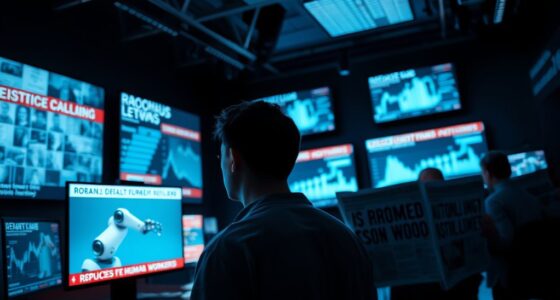
AI boosts efficiency and sparks new ideas, but it can also reduce originality and weaken your problem-solving skills over time. Relying too much on AI may lead to homogenized outputs and less diverse cultural expressions. While it can help accelerate creativity, long-term dependence risks diminishing your unique voice and artistic diversity. If you want to understand how to balance AI’s benefits with preserving true creativity, explore what comes next.
Key Takeaways
- AI can both enhance and homogenize creativity, increasing productivity but risking reduced originality and cultural diversity.
- Reliance on AI may weaken critical thinking and diminish long-term creative capacity.
- While AI sparks new ideas and automates tasks, overdependence can lead to similar outputs and loss of unique voices.
- Maintaining human oversight and setting clear boundaries help preserve authentic creativity amidst AI use.
- Ethical and regulatory measures are essential to prevent biases, misuse, and ensure AI supports rather than replaces human ingenuity.

CyberLink PhotoDirector 2026 | Generative AI Photo Editor for Windows | AI Tools, Layer Editing, Photo Retouching, Creative Effects & Design | Box with Download Code
AI Object Removal with Object Detection – Clean up photos fast with AI that detects and removes distractions…
As an affiliate, we earn on qualifying purchases.
As an affiliate, we earn on qualifying purchases.
The Rise of AI in Creative Workflows
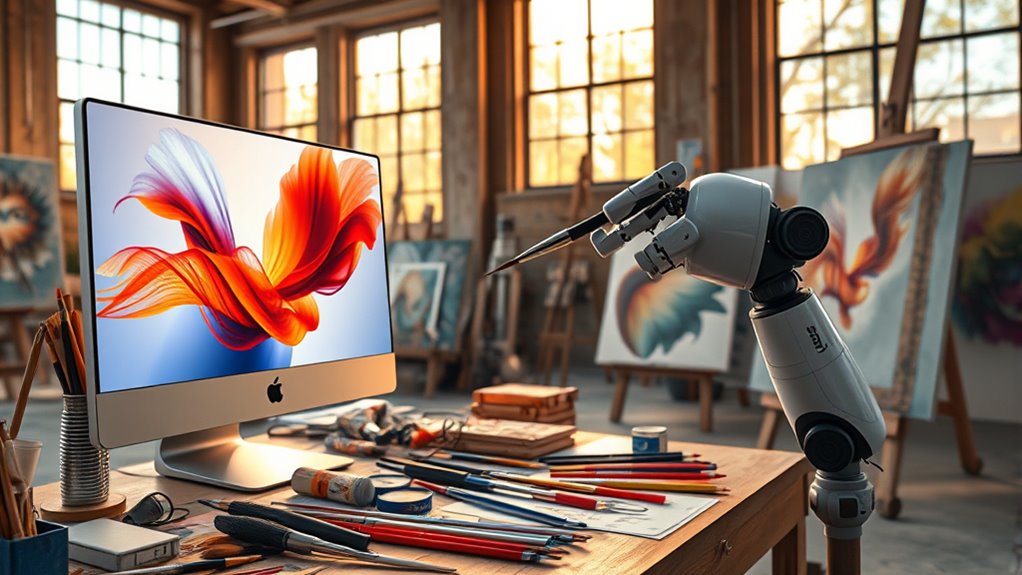
The rise of AI in creative workflows reflects a rapidly expanding market driven by innovative tools that enhance productivity and inspire new artistic possibilities. You’re witnessing a surge in AI adoption, with the creative AI economy projected to grow over 30% annually through 2029, reaching $12.6 billion. AI video creation alone is expected to jump from $614.8 million in 2024 to $2.56 billion by 2032, while AI image generation could increase from $8.7 billion to $60.8 billion by 2030. Specialized AI tools for image editing are also expanding, nearly tripling in value by 2034. Platforms like Stable Diffusion, NVIDIA Canvas, and AI upscaling tools help you generate, remix, and refine visuals rapidly, transforming how you approach design and visualization. The overall market for generative AI in creative industries is expected to expand from $1.7 billion in 2022 to over $21 billion by 2032, highlighting the significant investment and interest in this technological shift. As these tools become more sophisticated, they are also pushing the boundaries of human creativity, prompting discussions about AI and originality and its impact on traditional artistic processes.

AI Video Creation Made Simple: How to Create Cinematic Videos, Ads, and Stories with Sora AI, Veo, and AI Video Tools
As an affiliate, we earn on qualifying purchases.
As an affiliate, we earn on qualifying purchases.
Efficiency Gains and Time Savings With AI Tools

AI tools substantially boost your productivity by saving time on routine tasks. On average, generative AI users save about 2.2 hours weekly, which is 5.4% of their work hours. Nearly 21% of workers save four hours or more per week, with daily users saving even more—over four hours weekly. This results in a 1.4% reduction in total work hours across all employees. Industries like law report that 61% of firms see increased efficiency, with some legal professionals saving up to 11 hours weekly. Additionally, the role of personal growth in adapting to new technologies emphasizes the importance of continuous learning and skill development.

Generative AI Art: A Beginner’s Guide to 10x Your Output with Smart Text Prompts (Midjourney, DALL-E, Craiyon) (Learn AI & Text Prompt Engineering Series)
As an affiliate, we earn on qualifying purchases.
As an affiliate, we earn on qualifying purchases.
The Diminishing Number of Original Ideas
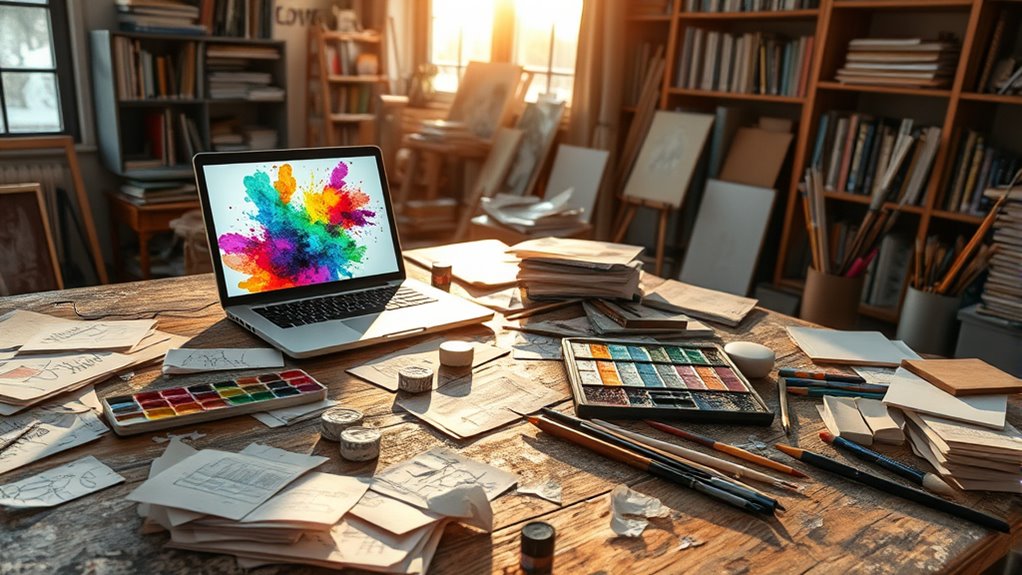
You might notice that the number of truly original ideas is shrinking, with many innovations becoming more similar or derivative. Despite increased patenting, measures of novelty and originality show a clear decline over time. This trend suggests that creativity is becoming more homogenized, raising questions about the future of innovation. In the realm of sound design, techniques for creating sound effects are increasingly relying on digital manipulation and synthesis, which can lead to a convergence of auditory styles.
Reduced Idea Generation
Has the rise of AI truly led to a decline in human-led idea generation? Evidence suggests it has. AI automation cuts human effort from about 50% to under 16%, shifting focus from creating to evaluating ideas. High-ability researchers nearly double their output, but lower performers see little change. AI’s ability to generate more creative, novel ideas often surpasses human ideas, especially when refining concepts. This reduces the number of original ideas humans produce. For example:
| Human Idea Count | AI-Generated Ideas | Originality Level |
|---|---|---|
| High | Many | Less distinctive |
| Moderate | Fewer | Slight decline |
| Low | Minimal | Significant drop |
This trend indicates that, as AI dominates idea generation, human originality diminishes, leading to fewer truly novel concepts. AI’s impact on idea quantity and originality further compounds this decline by encouraging reliance on AI outputs rather than original human thought. Additionally, the reliance on automation risks stifling the development of unique perspectives and innovative thinking.
Homogenization of Creativity
Does increased exposure to AI-generated ideas truly foster greater diversity in collective creativity? While AI broadens the range of ideas at the group level, it often leads to homogenized individual outputs. You might notice that AI-assisted creations—whether stories, art, or music—tend to converge in style and content, despite higher ratings for creativity and quality. This suggests that, although AI fuels cultural evolution rapidly, it also narrows the variety of truly original ideas. Over time, reliance on AI can diminish your capacity for independent thinking and reduce the diversity of innovative perspectives. Even after stopping AI use, this homogenizing effect can persist, potentially stunting long-term creative growth and leading to a collective creativity that’s more uniform and less inventive. Additionally, the vetted products for effectiveness and safety highlight how reliance on external tools can influence individual originality and safety considerations in creative pursuits.

AI for UX Designers: Using Artificial Intelligence to Supercharge Your Workflow and Build AI-Powered Products
As an affiliate, we earn on qualifying purchases.
As an affiliate, we earn on qualifying purchases.
Cognitive Decline and Reduced Problem-Solving Skills
Relying heavily on AI for tasks like writing and problem-solving can weaken your brain’s connectivity and memory retention. When you overdepend on AI, your neural engagement drops, making your brain less active. Consider this:
- Your brain activity, measured by EEG, is lowest when you rely solely on AI.
- After stopping AI use, cognitive decline persists, showing lasting effects.
- Increased copy-paste behavior suggests you’re doing less mental effort.
- Over time, AI users tend to trust AI more, reducing critical thinking.
– neuroscientific research indicates that reduced brain activity correlates with decreased cognitive flexibility, which can hinder your ability to adapt to new challenges. These habits diminish your problem-solving skills, making it harder to think critically on your own. Additionally, engaging in diverse mental exercises can help maintain neural pathways and boost cognitive resilience, counteracting some of the negative effects of AI dependence. While AI makes tasks easier, it can also weaken your cognitive resilience, especially if you don’t challenge yourself regularly.
Long-Term Effects of AI Dependency on Creativity

Long-term dependence on AI can considerably hinder your ability to develop a distinctive creative voice and original thinking skills. Relying heavily on AI tools in academia or creative tasks may cause you to bypass essential processes that foster imagination and innovation. When you use AI for routine work like writing or problem-solving, you miss out on practicing personal expression and critical thinking, which are crucial for originality. Over time, this dependence can weaken your capacity to generate novel ideas independently, leading to less unique creative outputs. While AI-generated content can broaden collective idea diversity, it doesn’t necessarily enhance your individual creativity. Excessive reliance risks diminishing your motivation to develop ideas on your own, ultimately impairing your long-term ability to think creatively and produce original work. AI’s role in education also influences how individuals develop their creative skills, often shifting focus from personal development to technological convenience. As AI becomes more integrated into creative processes, the importance of cultivating human ingenuity remains essential to maintain originality and personal expression.
AI as an Enabler Versus a Replacement for Human Creativity

AI acts as a powerful tool that enhances human creativity by automating technical tasks and expanding creative possibilities. However, relying too much on AI risks leading to homogenized outputs and diminishing unique artistic voices. Striking the right balance between AI support and human input is key to ensuring technology empowers rather than replaces genuine creativity. AI processes vast data, recognizes patterns, and generates variations quickly, which can boost innovation when used thoughtfully. Additionally, understanding the capabilities of AI in creative fields can help artists and creators leverage technology more effectively.
Enhancing Creative Collaboration
While some worry that AI might replace human creativity, evidence shows it often acts as a powerful enabler rather than a substitute. You can leverage AI to boost collaboration in several ways:
- It helps generate ideas during brainstorming, sparking new directions.
- AI handles repetitive tasks, freeing you to focus on strategic and innovative work.
- In content creation, AI supports authentic voices and emotional nuances, enhancing originality.
- Combining human ingenuity with AI’s computational power expands your creative possibilities and fosters innovation.
- Self-awareness in understanding AI’s role can help you better integrate technology without losing your unique creative voice.
This partnership isn’t about replacing you but amplifying your creative potential, enabling more dynamic and impactful collaborations. Understanding how to harness AI effectively can transform your workflows into more innovative and efficient processes.
Risks of Creative Homogenization
Although AI can boost collective creativity by rapidly generating diverse ideas, it also poses a risk of homogenization. When you rely heavily on AI suggestions, your outputs often become similar to others’, reducing overall idea diversity across groups. AI’s tendency to generate popular or dominant patterns leads creators to converge on similar themes and styles, limiting innovative variation. This standardization can stifle cultural evolution by narrowing the range of distinct contributions. While AI accelerates idea exchange at the group level, it may inadvertently undermine unique perspectives. If you depend too much on AI, your creative process might shift from original exploration to replicating common patterns, risking a loss of authentic diversity. Additionally, the standardization of ideas caused by AI can diminish the richness of cultural and artistic diversity over time. Ultimately, balancing AI’s facilitation with human originality is essential to prevent creative sameness.
Balancing AI and Human Input
Balancing AI assistance with human input is key to ensuring that creativity remains vibrant and authentic. You need to use AI as a partner, not a crutch, to maximize its benefits while maintaining your unique voice. Consider these strategies:
- Train yourself to critically evaluate AI suggestions instead of accepting them blindly. Generative AI challenges traditional notions of creativity by analyzing patterns and producing works, so maintaining a critical perspective helps preserve originality.
- Use AI as a brainstorming partner or drafting aid, keeping the final decision in your hands.
- Stay aware of AI’s limitations in generating truly novel ideas; curate and build on its outputs.
- Keep practicing manual creative processes to preserve your independent thinking skills.
Ethical Considerations in AI-Driven Creative Industries
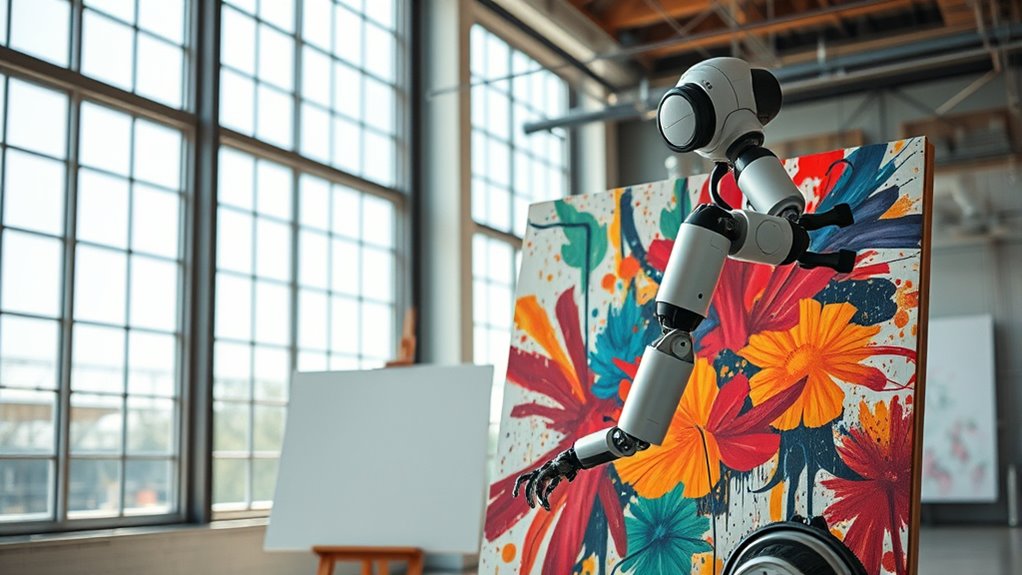
How do we guarantee that AI-driven creativity remains fair and transparent in a rapidly evolving landscape? First, we need clear rules on intellectual property, addressing ownership of AI-generated works and ensuring original creators are fairly compensated. Transparency is vital; creators and audiences must know when AI contributes to content, requiring explicit labeling. Without regulation, AI’s misuse could deceive audiences or infringe on rights, especially as legal frameworks lag behind technological developments. Ethical guidelines should promote diverse training data to prevent biases and harmful stereotypes. Accountability and explainability in AI decision-making build trust, while oversight helps avoid unethical practices. The impact of AI on intellectual property rights remains a complex legal challenge, requiring ongoing policy development. Balancing innovation with responsibility ensures AI enhances creativity without undermining fairness, authenticity, or artists’ rights.
Impact on Cultural Norms and Artistic Diversity
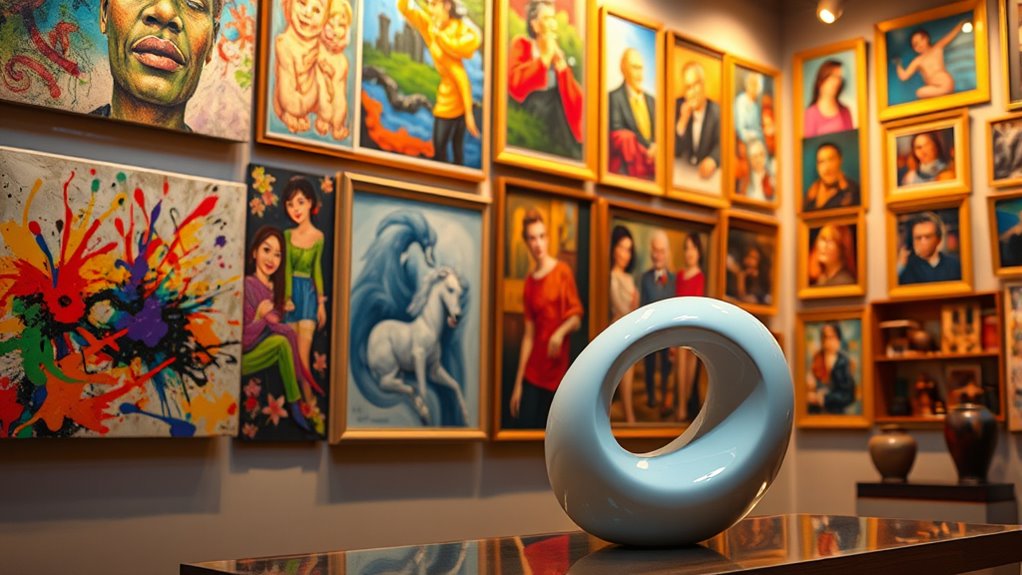
AI has the power to reshape cultural norms and influence artistic diversity in profound ways. It can democratize creation but also reinforce biases, impacting societal perceptions. Consider these points:
- AI-generated art often amplifies historical biases, underrepresenting women and minorities, which can slow cultural progress. Bias amplification Further, the datasets used to train AI models frequently lack sufficient diversity, leading to skewed representations that do not reflect the full spectrum of human experience.
- Like traditional media, AI outputs tend to mirror existing stereotypes, potentially reinforcing rather than challenging them.
- As AI content spreads online, it shapes ideas about beauty, identity, and norms, influencing societal perceptions.
- The homogenizing effect of social media algorithms can promote viral, sensational AI art, narrowing aesthetic diversity and reinforcing dominant norms.
Strategies for Balancing AI Assistance and Human Ingenuity
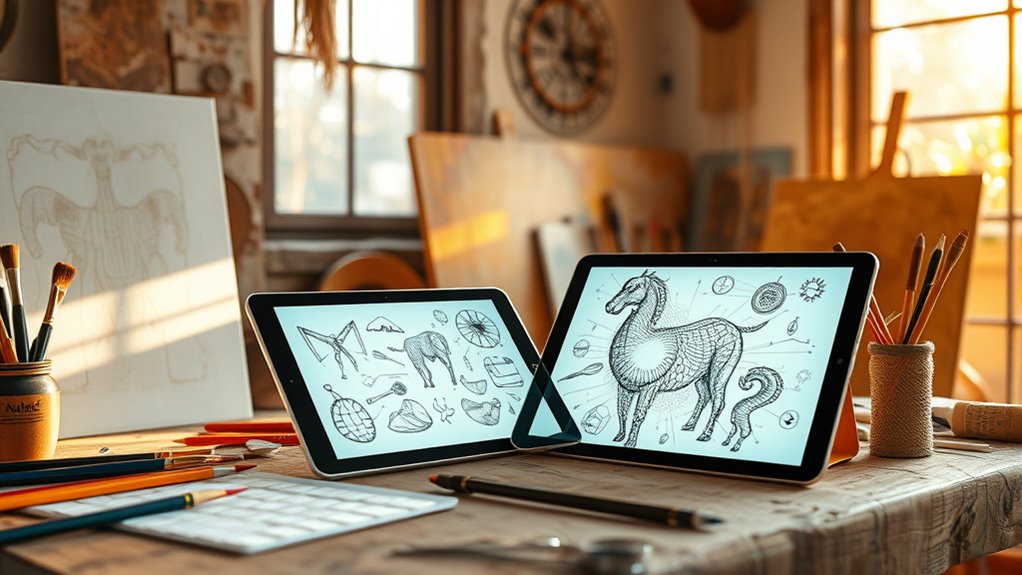
To effectively balance AI assistance with human ingenuity, you need to establish clear creative boundaries that prioritize your artistic vision. By setting strict guidelines and maintaining final decision-making authority, you preserve your unique voice while leveraging AI’s strengths. Cultivating independent thinking guarantees your creativity remains authentic, even as you incorporate AI tools into your workflow. Moreover, understanding that AI’s role is to support and enhance rather than dominate your creative process ensures a harmonious collaboration.
Cultivating Independent Thinking
Balancing AI assistance with human ingenuity requires actively cultivating independent thinking skills. To do this, you should focus on developing habits that challenge and refine your judgment. Here are four strategies:
- Question AI suggestions critically, asking if they align with your vision or if they need modification.
- Seek diverse perspectives to expand your understanding and avoid echo chambers created by AI filters.
- Experiment with new ideas, even if they seem unconventional, to foster originality.
- Regularly review and refine AI-generated content to ensure it reflects your unique voice and creativity.
Setting Creative Boundaries
Establishing clear boundaries between human creativity and AI assistance helps keep your work authentic and emotionally resonant. Define AI’s role as a tool for technical tasks, like research or generating variations, while humans lead the conceptual and emotional aspects. Use AI suggestions as inspiration, refining them with your judgment. Develop workflows that allow AI to accelerate exploration but reject its final decisions without your approval. Regularly evaluate whether AI supports your creative integrity and emotional depth. Implement guardrails such as keyword filtering and precise prompt engineering to maintain relevance and quality. Clearly distinguish tasks suited for AI from those needing human intuition, ensuring your creativity remains genuine and culturally sensitive. This balance preserves your unique voice amid technological assistance.
| AI Assistance Role | Human Creative Leadership |
|---|---|
| Technical, repetitive tasks | Conceptual, emotional depth |
| Variations and drafts | Final decision-making |
| Inspiration | Ownership of vision |
| Data analysis | Cultural and ethical considerations |
| Workflow acceleration | Originality and intuition |
Future Directions for AI and Creative Potential
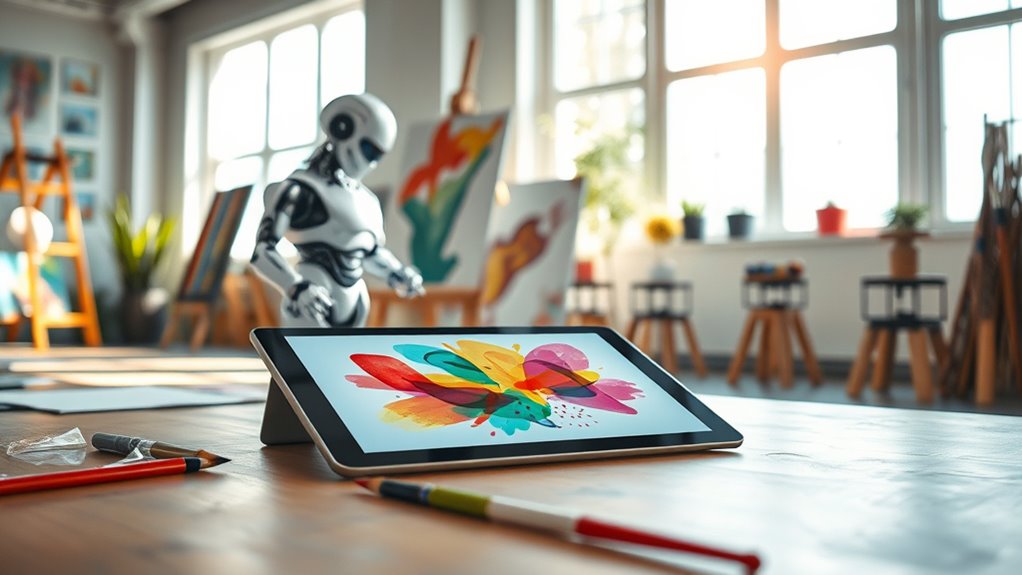
Future directions for AI and creative potential point toward deeper collaboration and more dynamic applications. You’ll see AI becoming a true partner in creative fields, with tools like Midjourney and DALL·E enhancing your ideas in art, music, and writing. Real-time applications will transform experiences through instant translation, video generation, and interactive gaming, powered by edge computing and 6G. Organizations will focus on custom models trained on proprietary data to meet sector-specific needs, especially in regulated fields. Open-source frameworks like Hugging Face will democratize access, enabling global creators to innovate faster. You’ll also encounter ongoing debates about authorship and originality, as human and machine contributions blur, shaping the future of creative AI collaboration. Generative AI models like GANs and large language models are rapidly advancing, opening new horizons for innovative content creation and immersive experiences.
Frequently Asked Questions
How Can Creatives Maintain Originality Amid Ai-Generated Content?
You can maintain originality by engaging deeply in problem-solving without overrelying on AI. Use AI primarily for support tasks like research or ideation, but keep core creative decisions human-driven. Diversify your influences beyond AI-generated content and collaborate with others to spark fresh ideas. Regularly challenge yourself with new stimuli and practice creative skills intentionally, ensuring your work remains authentic and distinct, even as you incorporate AI tools thoughtfully.
What Training Methods Best Support Independent Thinking Alongside AI Tools?
You should focus on training methods that balance AI use with developing your independent thinking skills. Use AI as a guide, not a crutch, and challenge yourself with complex problems that require creative solutions. Practice critical evaluation of AI outputs, reflect on your reasoning process, and engage in collaborative learning. These strategies help you harness AI’s benefits while maintaining originality, analytical skills, and the ability to think independently.
How Does AI Reliance Influence Artistic Diversity Across Cultures?
You might think AI boosts artistic diversity, but it often reflects biases from its training data, limiting cultural representation. This reliance can reinforce stereotypes and reduce variety, creating a homogenized aesthetic. While AI lowers barriers for creators, it also risks narrowing cultural voices if not carefully managed. To truly enhance diversity, you need to diversify training datasets and promote inclusive practices, ensuring AI expands, rather than constrains, global creative expression.
Can AI Be Designed to Enhance, Not Hinder, Human Creative Skills?
You can design AI to enhance your creative skills by focusing on tools that support idea generation and exploration. AI helps you overcome blocks, expand your options, and collaborate in new ways. By filtering and refining AI outputs, you maintain your artistic judgment. When AI acts as a partner rather than a replacement, it boosts your productivity and innovation, making your creative process more dynamic and fulfilling.
What Policies Are Needed to Safeguard Ethical Use of AI in Art?
You need policies that establish clear legal ownership and attribution for AI-generated art, ensuring transparency about AI’s role. Implement ethical standards that promote responsible data use, respect original creators, and prevent bias. Support human creativity by safeguarding traditional art forms and encouraging collaborations. Maintain ongoing oversight with monitoring systems and accountability measures, so AI use aligns with ethical norms, copyright laws, and cultural values, ultimately fostering trustworthy and respectful integration of AI in the arts.
Conclusion
As you navigate this brave new world, remember that AI is like a double-edged lightsaber—capable of great creation but also potential destruction. Embrace its efficiency, but don’t let it dull your unique spark. Keep your artistic galaxy vibrant by balancing technology with your innate ingenuity. With mindful use, you can avoid becoming a modern-day Sisyphus, forever relying on machines and losing sight of your true creative power.