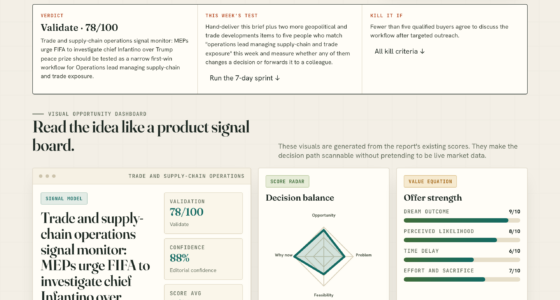

📊 Full opportunity report: The Critical Challenge Of AI Black Boxes For Allied Nations on ThorstenMeyerAI.com — validation score, market gap, and execution plan.

Get business pricing on tech for your team
- Business-only prices and quantity discounts
- Tax-exempt purchasing
- Multiple users, one account, clear invoices
TL;DR
NATO is increasingly worried about AI systems’ black boxes, which limit transparency and control, threatening both military and civilian infrastructure. The challenge raises questions about supply chain security and strategic dependencies.
NATO is confronting a growing challenge over the opacity of artificial intelligence systems used in military and civilian infrastructure. Official sources warn that the increasing reliance on AI black boxes—systems whose internal decision-making processes are inaccessible—could pose significant security risks, especially if these systems are compromised or manipulated by adversaries. This issue has become urgent as NATO’s operational environment becomes more interconnected and reliant on AI-driven technology.
Recent discussions within NATO highlight concerns that many AI systems integral to military logistics, communications, and civilian infrastructure are proprietary and opaque, making oversight and control difficult. Officials acknowledge that these black boxes could be exploited by hostile actors to disrupt critical functions, from transportation networks to satellite communications.
While NATO does not have definitive evidence of active sabotage, experts warn that dependency on uninspectable AI components increases strategic vulnerabilities. The challenge is compounded by global supply chains, where components and software may originate from or pass through countries with adversarial interests. The alliance is exploring ways to verify, inspect, and control AI systems more effectively, but technical and diplomatic hurdles remain.
Some NATO members are calling for stricter standards and transparency requirements for AI procurement, emphasizing the importance of maintaining sovereignty over critical systems. Discussions also focus on whether existing regulations are sufficient to prevent adversaries from embedding malicious code or backdoors in AI tools used in defense and civilian sectors.
Friendly fire at alliance scale: what Chinese equipment in NATO networks actually means
Yesterday: Ukraine may have turned a Russian unit’s identification layer against its own jet. Today’s question doesn’t require that to be true. It requires only that the concept be plausible — and then asks what it means when NATO’s own identification layer is built on equipment from a country whose law compels its companies to cooperate with intelligence on demand.
Any Chinese entity — any company, any employee, anywhere — must assist national intelligence work when asked. No carve-out for foreign deployments. No judicial review. No refusal option. When Beijing asks Huawei for access, Huawei must provide it. The law doesn’t distinguish between Shenzhen and Stuttgart. It doesn’t distinguish between civilian and NATO. This is not theoretical. It is operational law.
Requires no reconnaissance. The companies manufactured and installed the equipment. They have the source code, firmware, manufacturing tolerances, and update pipeline — the reconnaissance was completed before the adversary was even identified as one. A stronger position than what InformNapalm claims Ukraine achieved.
The question isn’t whether China will use this access. It’s whether NATO can afford to assume it won’t. Three things follow. Replacement is genuinely hard — banning without building the supply chain produces capability gaps, not security. The identification layer is where the exposure is sharpest — a Chinese motor is a supply-chain risk; a Chinese sensor or processor in an IFF system is an identification-layer risk, the same class the BARS Moscow story made visible. And the open-weight argument applies here — but stops short: open weights give you visibility into the classification model; they don’t give you visibility into the silicon it runs on. NATO has thirty-two members, each with its own procurement history. Together they’ve built an identification layer with distributed, unaudited, legally-accessible dependencies on a potential adversary. BARS Moscow required weeks of reconnaissance. The reconnaissance for NATO’s version was completed in the factory.
Implications of AI Black Boxes for NATO’s Security
This issue matters because AI black boxes could allow hostile nations or non-state actors to manipulate or disable critical infrastructure, risking both military effectiveness and civilian safety. The dependency on opaque AI systems creates a strategic vulnerability that could be exploited during conflict or crisis, undermining NATO’s operational readiness and resilience. Ensuring transparency and control over AI components is thus becoming a key element of modern defense planning and supply chain security.
As an affiliate, we earn on qualifying purchases.
Growing Dependence on AI in Military and Civil Sectors
NATO’s increasing reliance on AI spans a broad spectrum of operations, from autonomous vehicles and surveillance drones to logistics management and cyber defense. The trend reflects a broader shift in modern warfare and infrastructure management, where AI-driven systems are integral to efficiency and decision-making.
However, this dependence introduces vulnerabilities similar to those seen in telecommunications and critical infrastructure, where supply chain risks and proprietary systems have already caused security concerns. The 2023 European and UK decisions to restrict Chinese-made 5G equipment exemplify how dependency on foreign technology can become a strategic liability, prompting NATO to reassess its approach to AI procurement and oversight.
Historically, the challenge has been detecting malicious intent or embedded vulnerabilities in hardware and software, but AI systems’ black boxes complicate this further by obscuring internal processes and decision pathways. This situation is prompting a re-evaluation of supply chain security, inspection protocols, and international cooperation on AI standards.
“Dependency on proprietary AI components creates leverage for adversaries, especially if those systems are embedded deep within critical infrastructure.”
— Cybersecurity expert
As an affiliate, we earn on qualifying purchases.
Unclear Scope of AI System Vulnerabilities
It remains uncertain how widespread the use of uninspectable AI systems is across NATO’s infrastructure and what specific vulnerabilities have been exploited or could be exploited in future conflicts. Details about the origins of AI components and the effectiveness of current inspection methods are still emerging. Additionally, whether adversaries have already compromised some systems through supply chain manipulation is not yet confirmed.
AI supply chain security solutions
As an affiliate, we earn on qualifying purchases.
As an affiliate, we earn on qualifying purchases.
NATO’s Strategies for AI Transparency and Control
NATO is expected to initiate new standards for AI procurement, emphasizing transparency, inspection, and control measures. The alliance is also exploring international cooperation to establish AI security protocols and supply chain verification processes. Further assessments are likely to identify specific vulnerabilities and develop mitigation strategies, with some members pushing for tighter regulations on foreign AI components.
In the coming months, NATO may also conduct drills or exercises focused on AI system resilience, aiming to prepare for potential adversarial disruptions. The alliance’s ability to adapt to these technological challenges will be critical to maintaining operational security and strategic advantage.
As an affiliate, we earn on qualifying purchases.
Key Questions
Why are AI black boxes a security concern for NATO?
Because their internal decision-making processes are inaccessible, black boxes make it difficult to verify, inspect, or control AI systems, creating vulnerabilities that adversaries could exploit to disrupt critical infrastructure or military operations.
Are all AI systems used by NATO opaque or untrustworthy?
No, not all systems are black boxes. The concern is about those with proprietary or undisclosed internal processes, which pose higher risks because of the difficulty in verifying their security and integrity.
What measures is NATO considering to address this challenge?
NATO is exploring stricter procurement standards, international cooperation on AI security protocols, and enhanced inspection and control mechanisms to ensure that AI systems are trustworthy and controllable.
Could adversaries already be exploiting AI vulnerabilities?
It is not yet confirmed whether adversaries have exploited AI system vulnerabilities, but the risk remains high given the strategic importance of AI and the complexity of supply chains involved.
How does this issue compare to previous supply chain security concerns?
Similar to past concerns over foreign-made telecommunications equipment, AI black boxes represent a new frontier where dependency on opaque technology can undermine sovereignty and operational security if not properly managed.
Source: ThorstenMeyerAI.com
Fall Picks
fall essentials
As an affiliate, we earn on qualifying purchases.