

TL;DR
Nvidia announced Rubin HPC at SC26 on November 16, describing it as a GPU for scientific, engineering and analytics simulations with more than 50,000 CUDA cores. The company expects it in 2028, but has not released performance benchmarks, memory specifications, power figures or pricing.
Nvidia announced Rubin HPC at the SC26 supercomputing conference in Chicago on November 16, saying the GPU will have more than 50,000 CUDA cores and target simulation and data processing for science, engineering and analytics. The chip is expected in 2028, but Nvidia has not yet published benchmarks or several specifications needed to assess its performance and cost.

Get business pricing on tech for your team
- Business-only prices and quantity discounts
- Tax-exempt purchasing
- Multiple users, one account, clear invoices
The announcement appeared in a Nvidia blog post by Dan Ernst, senior director of supercomputing products. Nvidia describes Rubin HPC as a new GPU in its Vera Rubin platform. The company said it has “a record number of CUDA cores — more than 50,000 on a single GPU,” without giving an exact count. Nvidia also cited a sparse data acceleration capability intended to keep the cores supplied with data, and seventh-generation NVLink connections between GPUs.
Nvidia frames the chip around workloads in which software repeatedly processes large datasets to produce simulation results. It says these uses include scientific and engineering work and analytics, with examples such as climate modeling, genomic analysis and financial risk. The company also connects the GPU to AI agents that generate candidate materials, molecules or designs for testing through simulation. Nvidia argues that faster simulations could shorten the cycle of proposing an idea, testing it and refining it; that is the company’s rationale, not a measured result for Rubin HPC.
The company has not released an exact core count or explained how the sparse data feature works. Its announcement also gives no FP64 performance, memory capacity or bandwidth, power figures, price, named systems or independent benchmarks. Those omissions mean the core count alone cannot establish how fast the GPU will run scientific applications or what it will cost to deploy.
Simulation Speed Shapes Research Cycles
Simulation lets researchers and engineers test models and designs computationally before committing to laboratory experiments, physical prototypes or other costly work. If Rubin HPC delivers the speed Nvidia is aiming for, it could help teams run more tests or complete them sooner, including when AI systems generate many candidates for evaluation. The potential relevance is in the simulation workflow, not just the headline number of cores.
Core counts are only one part of a GPU’s capabilities. Scientific computing often depends on numerical precision, memory, data movement and application-specific performance. Without those figures or independent results, it is not possible to tell whether Rubin HPC will improve the workloads Nvidia highlights, how large any improvement might be, or whether the system will be economical for research organizations.
Products Worth Considering

LG 27GS60QC-B Ultragear 27-inch Curved Gaming Monitor (QHD, 180Hz, 1ms, 1000R)

DJI Osmo 360 Motorcycle Handlebar POV Combo

Logitech MX Keys S Combo Wireless Keyboard and Mouse, Graphite
As an affiliate, we earn on qualifying purchases.
How Rubin HPC Fits Nvidia’s Platform
Rubin HPC is presented as a specialized addition to the Vera Rubin platform, which Nvidia associates with high-performance computing and AI. Nvidia’s announcement contrasts a design that scales data movement alongside compute with an approach focused on increasing compute alone. The seventh-generation NVLink reference points to GPU-to-GPU connectivity as another part of the design, though Nvidia has not provided connection speeds or other implementation details in the announcement.
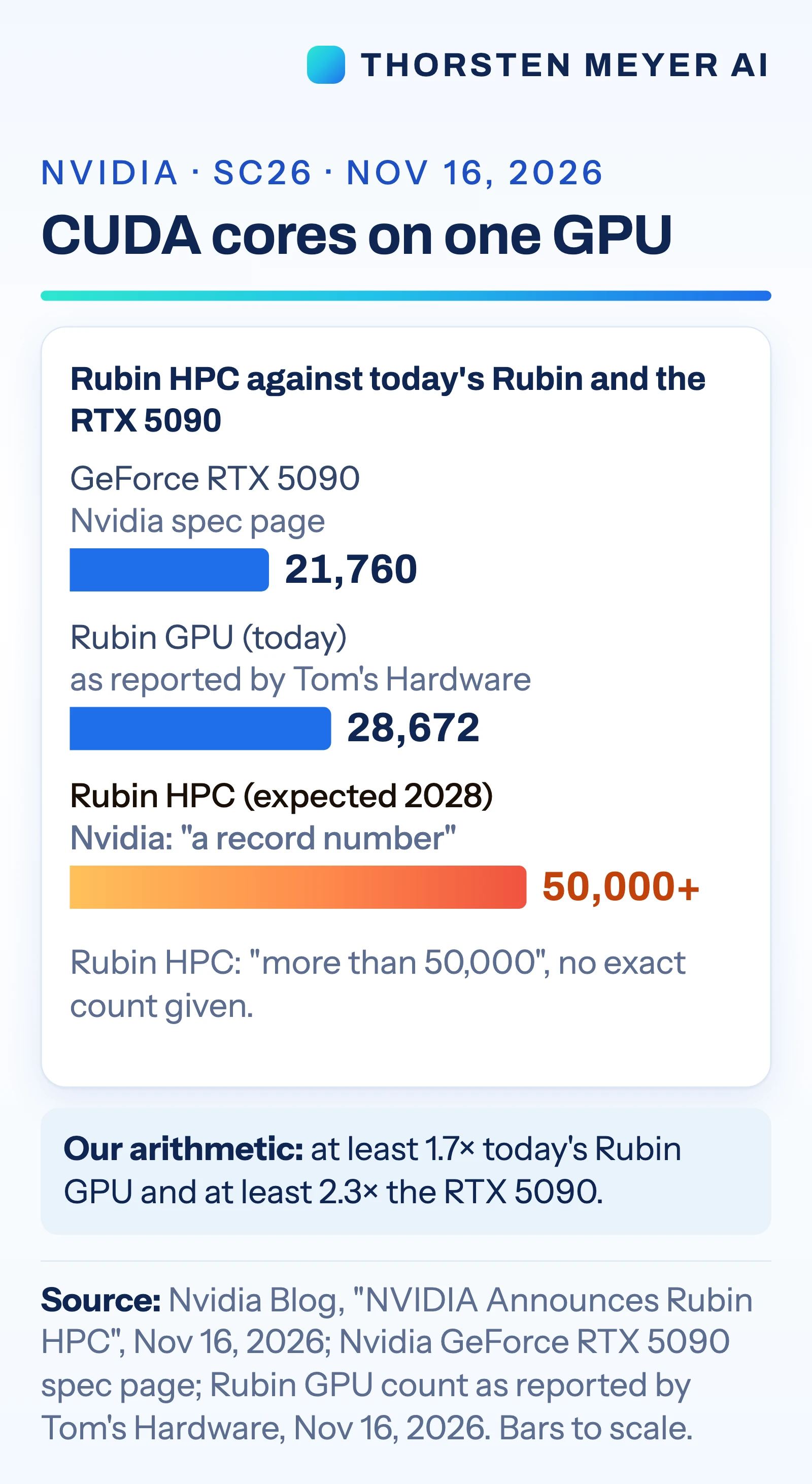
The announced core count is substantially above figures reported for other Nvidia GPUs, but comparisons need qualification. Tom’s Hardware reported that Nvidia’s current Rubin GPU has 28,672 CUDA cores, citing a configuration with 224 streaming multiprocessors; Nvidia has confirmed the 224-SM figure in a technical blog. Nvidia lists 21,760 cores for the GeForce RTX 5090. Since Rubin HPC’s total is stated only as “more than 50,000,” it would have at least 1.7 times the reported current Rubin count and at least 2.3 times the RTX 5090 count. These are core-count comparisons, not measures of overall performance.
Tom’s Hardware suggested the figure might imply a configuration similar to a four-die Rubin Ultra GPU, while also reporting that Nvidia had not disclosed the chip’s physical layout. That remains an outside inference. The announcement itself does not confirm the number of dies or describe the GPU’s architecture in detail.
““A record number of CUDA cores — more than 50,000 on a single GPU.””
— Nvidia
Key Specifications Still Missing
Nvidia has not disclosed Rubin HPC’s exact core count, FP64 performance, memory size or bandwidth, power consumption, price, system configurations or availability within the 2028 window. It has also not described how sparse data acceleration works or confirmed the GPU’s physical layout. No independent benchmarks are available in the announcement, so real-world performance and comparisons with other GPUs remain unknown.
The broad workload descriptions do not establish which applications will benefit most, or how much. Nvidia’s claims about faster simulation and shorter research cycles should be treated as the company’s expected benefits until systems are available and results can be assessed.
Details Expected Before 2028
Nvidia says Rubin HPC is expected to be available in 2028. Further announcements may clarify its architecture, precision performance, memory, power requirements, pricing and the systems that will use it. Those details, followed by independent benchmarks on scientific and engineering applications, will show how the GPU performs beyond its advertised core count.
For now, the confirmed development is Nvidia’s announcement of a planned GPU and its broad design claims. The company has not announced specific customer deployments or provided a release schedule more precise than the 2028 expectation.
Key Questions
What is Nvidia Rubin HPC?
Rubin HPC is a GPU Nvidia announced for simulation and data processing in science, engineering and analytics. Nvidia says it is part of the Vera Rubin platform.
How many CUDA cores will Rubin HPC have?
Nvidia says the GPU will have more than 50,000 CUDA cores but has not given an exact number.
When is Rubin HPC expected to be available?
Nvidia says Rubin HPC is expected in 2028. It has not provided a more specific release date.
Does the core count show how fast Rubin HPC will be?
No. Core count alone does not establish application performance. Nvidia has not published benchmarks, FP64 figures, memory specifications or power data for Rubin HPC.
Has Nvidia confirmed Rubin HPC’s chip layout or price?
No. The announcement did not disclose the physical chip layout or pricing. A suggestion that it may use a multi-die design is an outside inference, not a confirmed Nvidia specification.
Source: Thorsten Meyer AI