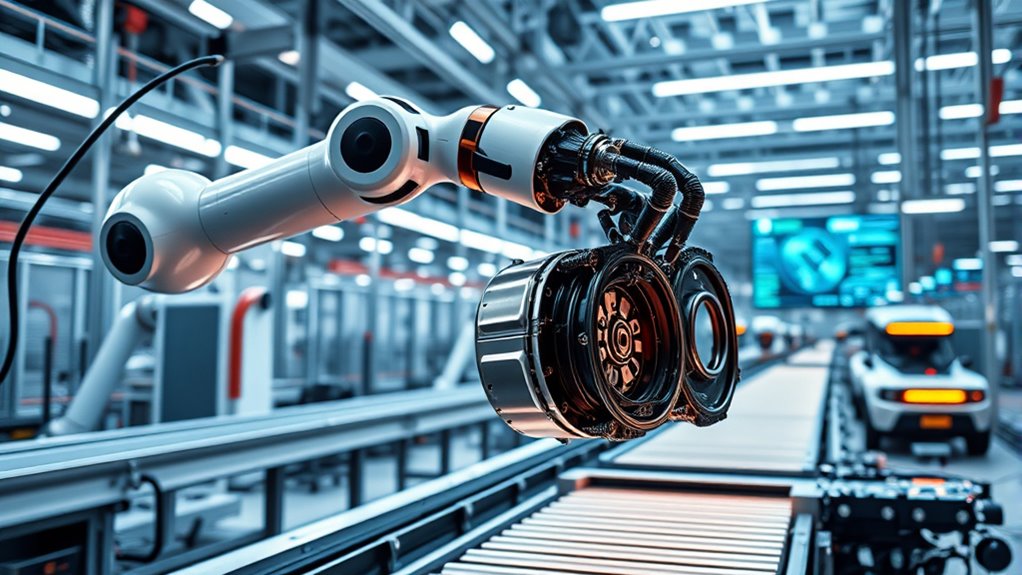

Autonomous assembly systems powered by AI are revolutionizing the automotive industry by enabling faster, more precise, and safer manufacturing processes. These systems use advanced robotics, real-time safety protocols, and continuous calibration to guarantee high quality while minimizing errors. As AI improves safety and efficiency, you’ll see cars assembled more quickly and reliably. If you want to uncover how these innovations are shaping the future of automotive production, there’s more to explore below.
Key Takeaways
- AI-powered autonomous assembly systems enhance automotive manufacturing by increasing speed, precision, and overall efficiency.
- Advanced AI safety protocols ensure robots operate reliably alongside humans, minimizing accidents and downtime.
- Robotic calibration maintains high accuracy in tasks like welding and inspection, reducing defects and rework costs.
- Integration of AI safety and calibration enables continuous improvement, ensuring consistent quality and safety standards.
- These technological advancements are transforming automotive production into a faster, safer, and more innovative industry.

Have you ever wondered how factories are revolutionizing manufacturing? It’s thanks to autonomous assembly systems powered by AI that the automotive industry is experiencing a significant transformation. These systems are designed to work with incredible precision, speed, and efficiency, enabling automakers to produce vehicles faster and with higher quality than ever before. At the core of this technological leap are innovations in AI safety and robotic calibration, which ensure that machines operate smoothly and reliably, minimizing errors and maximizing safety.
AI safety is a critical concern in autonomous assembly lines. When robots work alongside humans or handle complex tasks, safety protocols must be in place to prevent accidents and ensure consistent performance. Advanced AI algorithms monitor the robots’ actions in real-time, detecting anomalies or potential hazards before they cause issues. This proactive approach minimizes downtime and protects workers, making the entire manufacturing process safer and more predictable. Furthermore, AI safety involves rigorous testing and continuous learning, so the systems adapt to new conditions without compromising safety standards. This focus on safety ensures that autonomous assembly remains a reliable backbone of automotive production.
AI safety ensures autonomous assembly lines operate reliably, adapt to new conditions, and prevent accidents for a safer manufacturing environment.
Robotic calibration plays a crucial role in maintaining the high standards required in autonomous assembly. Calibration involves fine-tuning robots to perform tasks with pinpoint accuracy—whether it’s welding, assembly, or quality inspection. Without precise calibration, even small misalignments can lead to defective parts or assembly errors, which can be costly and time-consuming to fix. Automated calibration systems now use AI to constantly monitor and adjust robotic movements, ensuring peak performance throughout the production cycle. This ongoing calibration process allows robots to adapt to slight shifts in their environment, wear and tear, or variations in materials, thereby maintaining consistent quality. Additionally, robotic calibration enhances flexibility, letting manufacturers quickly reconfigure assembly lines for new models or updates without extensive downtime. Incorporating high-precision technology further optimizes the calibration process, ensuring even greater accuracy and efficiency.
Together, AI safety and robotic calibration form the backbone of autonomous assembly in the automotive industry. They enable robots to operate at high speeds without sacrificing accuracy or safety, streamlining production while maintaining strict quality standards. As AI continues to advance, these systems become even more sophisticated, capable of learning from their environment and improving over time. This ongoing evolution means that your future car might be assembled by highly intelligent robots that work seamlessly, safely, and efficiently. Autonomous assembly isn’t just a technological upgrade; it’s a fundamental shift that is shaping the future of automotive manufacturing, making it faster, safer, and more innovative than ever before.
Frequently Asked Questions
How Does AI Ensure Quality Control in Autonomous Assembly?
You can rely on AI to guarantee quality control in autonomous assembly by continuously monitoring sensor calibration, which keeps the robots precise and accurate. AI also predicts maintenance needs through data analysis, preventing equipment failures that could compromise quality. This proactive approach minimizes errors, maintains high standards, and ensures a smooth, efficient manufacturing process, giving you confidence that every vehicle meets strict quality requirements.
What Are the Safety Concerns With Ai-Driven Assembly Lines?
You should be aware that AI-driven assembly lines pose safety concerns like cybersecurity vulnerabilities, which hackers could exploit to cause accidents or sabotage production. Additionally, ethical decision-making becomes critical when AI must choose between safety and efficiency, potentially risking human lives. Addressing these issues involves robust cybersecurity measures and clear ethical guidelines to guarantee safe, reliable, and responsible automation in the automotive industry.
How Do AI Systems Adapt to New Vehicle Models?
You’ll find that AI systems adapt to new vehicle models quickly—over 85% of manufacturers report seamless integration. They do this by analyzing real-time diagnostics and machine learning algorithms, allowing the system to recognize new components and adjust assembly processes. This flexibility supports vehicle customization, ensuring that AI-driven assembly lines stay efficient and accurate even as models evolve, reducing downtime and keeping production lines ahead of market demands.
What Is the Impact of Autonomous Assembly on Factory Employment?
You might notice that autonomous assembly impacts the labor market by shifting job demands and reducing traditional assembly line roles. As AI takes over repetitive tasks, you’ll need to develop new skill requirements, such as managing and maintaining automated systems. While some jobs may decline, new opportunities emerge for skilled workers, emphasizing the importance of continuous learning. Overall, it reshapes employment, urging you to adapt to evolving skill needs in the industry.
How Cost-Effective Is AI Implementation in Automotive Manufacturing?
You’ll find AI implementation in automotive manufacturing highly cost-effective over time, despite initial investment costs. It offers significant cost savings through increased efficiency, reduced waste, and faster production cycles. While the upfront costs can be substantial, the long-term benefits outweigh these, leading to lower operational expenses. With proper planning, AI can boost your factory’s productivity and competitiveness, making it a smart investment for the future of automotive manufacturing.
Conclusion
Embrace the future of automotive manufacturing where automation accelerates progress, innovation fuels efficiency, and AI drives precision. As autonomous assembly transforms production lines, you’ll witness faster builds, safer workplaces, and higher quality vehicles. With each technological leap, you’ll experience increased productivity, reduced costs, and a more sustainable industry. The road ahead is paved with possibilities—where human ingenuity partners with artificial intelligence, and every step forward leads to a smarter, safer, and more innovative automotive world.