

Get business pricing on tech for your team
- Business-only prices and quantity discounts
- Tax-exempt purchasing
- Multiple users, one account, clear invoices
Executive Summary
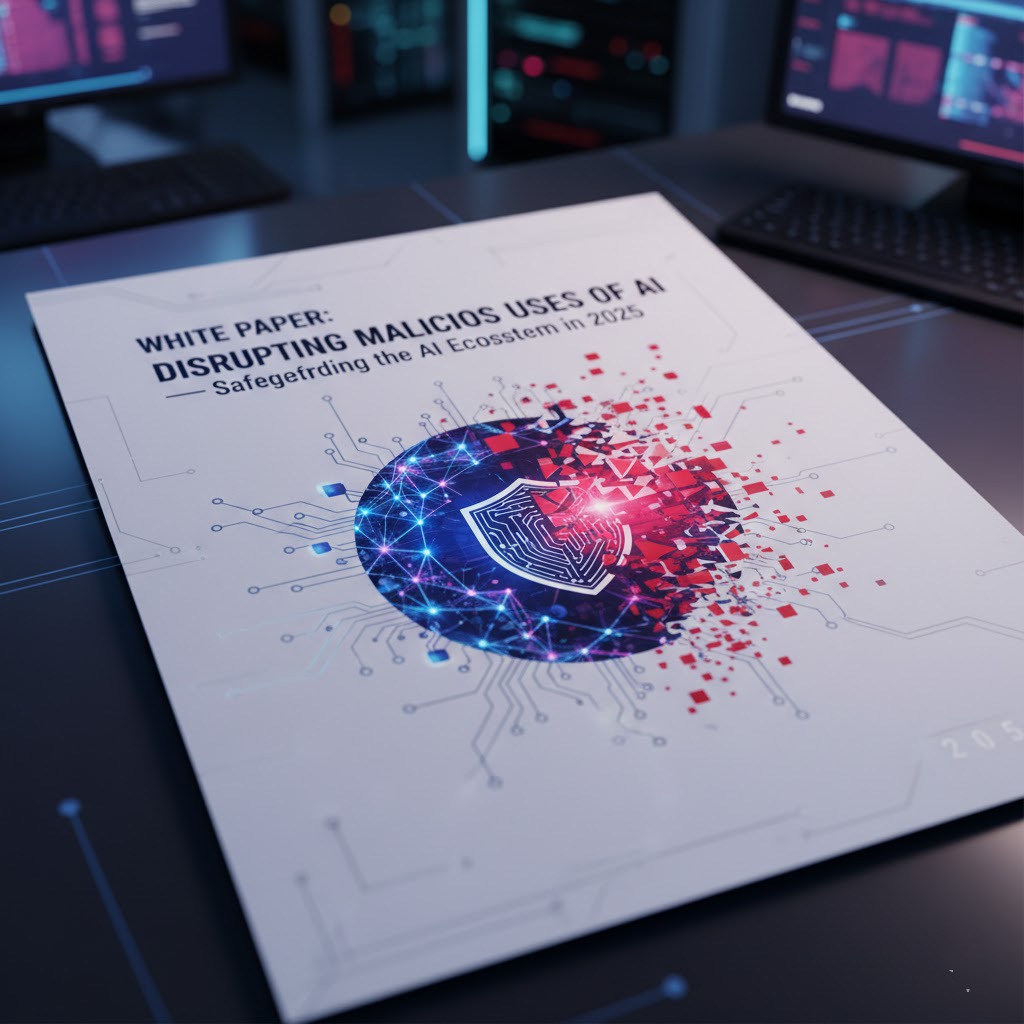
The acceleration of AI deployment has transformed productivity and innovation across industries, yet it has simultaneously lowered the barriers for malicious actors. In its October 2025 Threat Report, OpenAI documents the largest coordinated crackdown to date against state-affiliated and criminal groups abusing AI tools for surveillance, misinformation, and cyber exploitation.
This white paper examines OpenAI’s disruption operations, key threat vectors, ethical and geopolitical implications, and strategic recommendations for policymakers and enterprises building resilient AI systems.
As an affiliate, we earn on qualifying purchases.
1. Introduction: The Dual-Use Nature of AI
Artificial intelligence amplifies both capability and consequence. The same models that generate helpful text, code, and data analysis can be co-opted for:
- Large-scale misinformation campaigns
- Automated phishing and social engineering
- Surveillance and human rights violations
- Rapid malware prototyping
OpenAI’s latest findings underscore that malicious use is not theoretical — it is systemic and evolving.
cybersecurity threat monitoring tools
As an affiliate, we earn on qualifying purchases.
As an affiliate, we earn on qualifying purchases.
2. Overview of OpenAI’s 2025 Threat Disruption Program
Since its first Global Affairs Threat Report (February 2024), OpenAI has implemented a layered response combining detection, account termination, and collaboration with cybersecurity partners.
Key October 2025 Findings
- 40+ malicious networks disrupted globally
- China-linked entities used ChatGPT to propose and test surveillance algorithms, including “High-Risk Uyghur-Related Inflow Warning Models”
- Russian-language groups exploited GPT models for debugging and obfuscating malware
- Iranian and North Korean threat actors employed models for phishing and reconnaissance
- No evidence that generative models created new offensive capabilities — rather, they optimized existing attack workflows
As an affiliate, we earn on qualifying purchases.
3. Anatomy of the Threat: Case Studies
| Actor | Region | Objective | AI Misuse Pattern |
|---|---|---|---|
| Charcoal Typhoon | China | Data collection and phishing | Script generation, translation, and automation of spear-phishing |
| Crimson Sandstorm | Iran | Cyber-espionage | Code snippets for malware and obfuscation |
| Emerald Sleet | North Korea | Reconnaissance in defense and space | Querying satellite and radar research |
| Forest Blizzard | Russia | Technical reconnaissance | Drafting scripts for protocol analysis |
These activities reveal that large language models are now embedded in the early reconnaissance and tooling stages of cyber operations — not yet direct attack execution, but close.
As an affiliate, we earn on qualifying purchases.
4. OpenAI’s Defensive Framework
4.1 Technical Controls
- Continuous monitoring of high-risk usage patterns
- API-level detection for bulk automation and scraping
- Rapid account suspension pipelines
- Content classifiers for identifying surveillance or exploit requests
4.2 Human and Institutional Collaboration
- Partnership with Microsoft Threat Intelligence for attribution
- Coordination with law enforcement on state-sponsored activity
- Transparent reporting via Global Affairs blog and annual threat summaries
4.3 Ethical Safeguards
- Policy to restrict sensitive military, surveillance, and biometric applications
- Reinforcement of “safe-harbor” reporting for security researchers
- Ongoing model audits to test abuse pathways
5. Geopolitical Implications
The October 2025 findings coincide with rising digital authoritarianism and hybrid warfare tactics.
- AI as a surveillance multiplier: State actors using generative AI for linguistic and sentiment analysis of minority populations.
- Information warfare 2.0: AI-assisted propaganda targeting social platforms at scale.
- Cyber-industrial convergence: Criminal actors outsourcing AI-generated components for exploit development.
The report therefore marks a strategic inflection point — AI providers are now active participants in global cyber defense.
6. The Road Ahead: From Detection to Deterrence
OpenAI’s approach signals a shift from reactive moderation to proactive containment. However, sustained security requires cross-sector mechanisms.
6.1 Recommendations for AI Providers
- Implement Model Abuse Intelligence Sharing (MAIS) consortiums.
- Introduce traceable inference logging for high-risk queries.
- Adopt standardized “AI risk ratings” similar to CVSS for vulnerabilities.
- Expand red-team programs with geopolitical expertise.
6.2 Recommendations for Enterprises
- Integrate AI usage monitoring within SOC workflows.
- Enforce strict least-privilege policies for LLM access.
- Vet third-party plugins and extensions for prompt-injection risks.
- Develop internal “Responsible AI” playbooks aligned with NIST AI RMF.
6.3 Recommendations for Policymakers
- Create AI Abuse Coordination Centers under cyber agencies.
- Define international norms for AI accountability in cyber operations.
- Support transparent incident disclosure frameworks.
7. Conclusion: Toward a Secure AI Civilization
The 2025 OpenAI threat report is a milestone in global AI governance. It acknowledges that preventing malicious use is not simply about banning bad actors, but about engineering structural resilience into every layer of the AI stack.
From model alignment and telemetry to cross-border policy collaboration, the security of AI now defines the stability of the digital world.
Appendix
Primary Source: OpenAI Global Affairs — Disrupting Malicious Uses of AI (October 2025).
Supplementary Sources: Reuters, Engadget, Microsoft Threat Intelligence Briefs.
Fall Picks
fall essentials
As an affiliate, we earn on qualifying purchases.