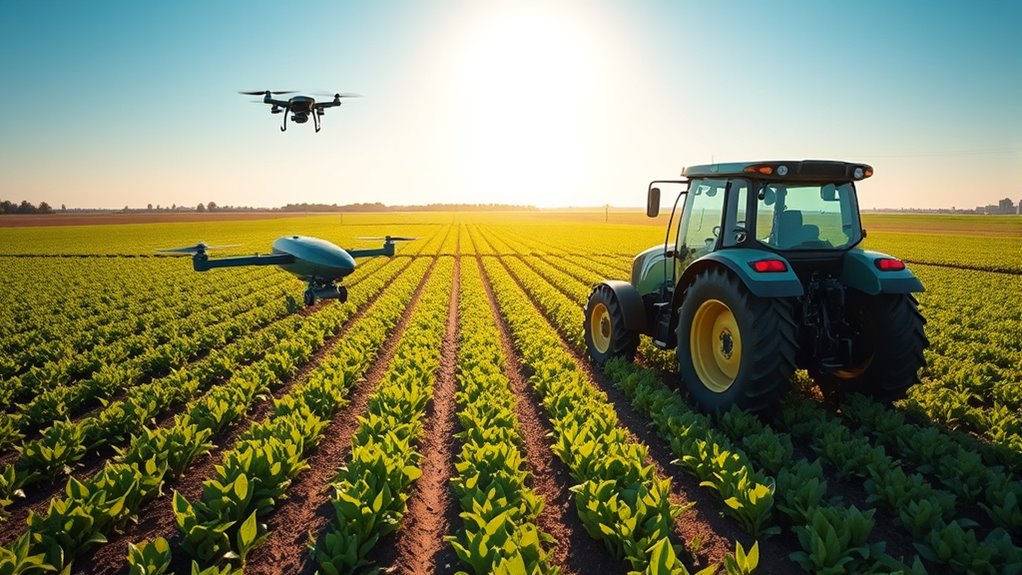

Precision farming leverages AI and advanced data tools to transform agriculture, boosting productivity and sustainability. You can use GPS-guided equipment, sensors, and data analytics to monitor soil health, optimize crop rotation, and reduce waste. This approach helps you make smarter decisions, improve soil vitality, and guarantee better yields over the long term. By embracing these innovations, you’re leading a new agricultural revolution—stay tuned to discover how further technological advances can benefit your farm.

Get business pricing on tech for your team
- Business-only prices and quantity discounts
- Tax-exempt purchasing
- Multiple users, one account, clear invoices
Key Takeaways
- AI-driven precision farming enhances planting accuracy, optimizing seed placement and timing for higher yields.
- Real-time soil monitoring using sensors guides targeted fertilizer and water application, reducing waste.
- Data analytics and GPS tools improve crop rotation planning, boosting soil health and pest management.
- Digital farm management systems support data-driven decisions, increasing efficiency and resilience to climate changes.
- Overall, AI and technology promote sustainable, profitable agriculture by optimizing resource use and conserving the environment.

Have you ever wondered how technology is transforming agriculture? It’s changing the way we plant, tend, and harvest crops, making farming more efficient and sustainable than ever before. With precision farming, you can leverage advanced tools like GPS-guided equipment, sensors, and data analytics to enhance every aspect of your farm. One key area where this innovation shines is in maintaining soil health. Healthy soil is the foundation of productive farming, and precision agriculture helps you monitor soil conditions in real-time. Sensors placed throughout your fields can detect moisture levels, nutrient content, and pH, giving you detailed insights into what your soil needs. This targeted approach allows you to apply fertilizers and water precisely where they’re needed, reducing waste and preventing soil degradation. By maintaining ideal soil health, you ensure your land remains productive for years to come, avoiding the pitfalls of overuse or neglect.
Precision farming uses sensors and data analytics to optimize soil health and boost sustainable productivity.
Crop rotation is another essential practice that benefits immensely from precision technology. Traditionally, crop rotation requires careful planning to reduce pest buildup and improve soil fertility. Now, with the help of data analytics and GPS mapping, you can plan your rotations more effectively. You can analyze historical crop yields, soil composition, and pest outbreaks to determine the best sequence of crops for each section of your farm. This precision approach helps break pest and disease cycles, naturally managing them without excessive chemical use. It also optimizes soil nutrients, preventing depletion and encouraging natural regeneration. Additionally, the use of contrast ratio in projectors can help visualize detailed images of soil conditions, aiding in more accurate assessments and decision-making. By integrating crop rotation strategies with real-time soil data, you can tailor your planting schedules and crop choices to maximize yield and sustainability.
Furthermore, precision farming tools enable you to track and record all these practices, creating a detailed farm management system. This digital record-keeping helps you make smarter decisions over time, identify patterns, and adapt your strategies based on concrete data. It’s a move away from guesswork and intuition toward science-backed farming. The impact on soil health and crop rotation is profound; you’re not only boosting productivity but also caring for the land that sustains you. As a result, your farm becomes more resilient to climate fluctuations and market pressures, ensuring long-term success.
In essence, precision farming empowers you to work smarter, not harder. By focusing on soil health through targeted interventions and optimizing crop rotation plans with data-driven insights, you create a more sustainable and profitable agricultural system. It’s a revolution that puts technology at the heart of farming, helping you grow better crops while safeguarding the environment for future generations.
As an affiliate, we earn on qualifying purchases.
Frequently Asked Questions
How Does AI Improve Crop Yield Predictions?
AI improves crop yield predictions by using machine learning algorithms that analyze vast amounts of data, including weather, soil conditions, and crop health. You can rely on advanced crop modeling to forecast yields more accurately, enabling better decision-making. This technology helps you optimize planting schedules, resource allocation, and management practices, ultimately increasing productivity and reducing waste. AI’s predictive power gives you a competitive edge in modern agriculture.
What Are the Costs of Implementing AI in Farms?
Think of AI as planting a seed that grows into future savings. You’ll face initial costs like equipment, software, and training, which require a thorough cost analysis. While investments may seem high, you must weigh the economic feasibility—the potential for increased yields and reduced waste. Over time, these costs can pay off, turning your farm into a well-oiled machine, ready for smarter, more sustainable growth.
How Do Farmers Adapt to New AI Technologies?
You adapt to new AI technologies by participating in farmer training programs that teach you how to operate and maintain the systems effectively. You also develop tech adoption strategies, such as starting with small pilot projects to build confidence and gradually expanding usage. Staying informed about advancements and collaborating with technology providers helps you integrate AI smoothly into your farming practices, ultimately increasing productivity and sustainability.
What Are the Environmental Impacts of Precision Farming?
You might think precision farming harms the environment, but it actually promotes sustainable practices and biodiversity conservation. By precisely applying inputs, you reduce waste and pollution, helping ecosystems thrive. Ironically, relying on advanced AI tech can lead to healthier soils, cleaner water, and diverse habitats. So, instead of harming, this approach helps you care for the planet, making agriculture more eco-friendly while boosting productivity.
How Does AI Address Small-Scale Farmers’ Needs?
AI helps address small-scale farmers’ needs by offering affordable solutions tailored to their unique challenges. It provides precise data on soil health, crop health, and weather, enabling you to optimize resources and improve yields. AI-driven tools are often cost-effective and easy to use, making advanced technology accessible. By streamlining decision-making and reducing waste, AI empowers you to overcome small-scale challenges and boost your farm’s productivity sustainably.
soil moisture sensors for farming
As an affiliate, we earn on qualifying purchases.
As an affiliate, we earn on qualifying purchases.
Conclusion
As you embrace precision farming, you’ll see how AI transforms agriculture into a smarter, more efficient practice. By tailoring your approach to each field’s unique needs, you can boost yields and reduce waste. Many experts believe this technology revolutionizes farming, making it more sustainable and profitable. So, trust in AI’s potential and stay open to this new era—your farm’s future depends on these innovative changes, bringing both success and environmental benefits.
precision agriculture data analytics tools
As an affiliate, we earn on qualifying purchases.
As an affiliate, we earn on qualifying purchases.
As an affiliate, we earn on qualifying purchases.
Fall Picks
fall essentials
As an affiliate, we earn on qualifying purchases.