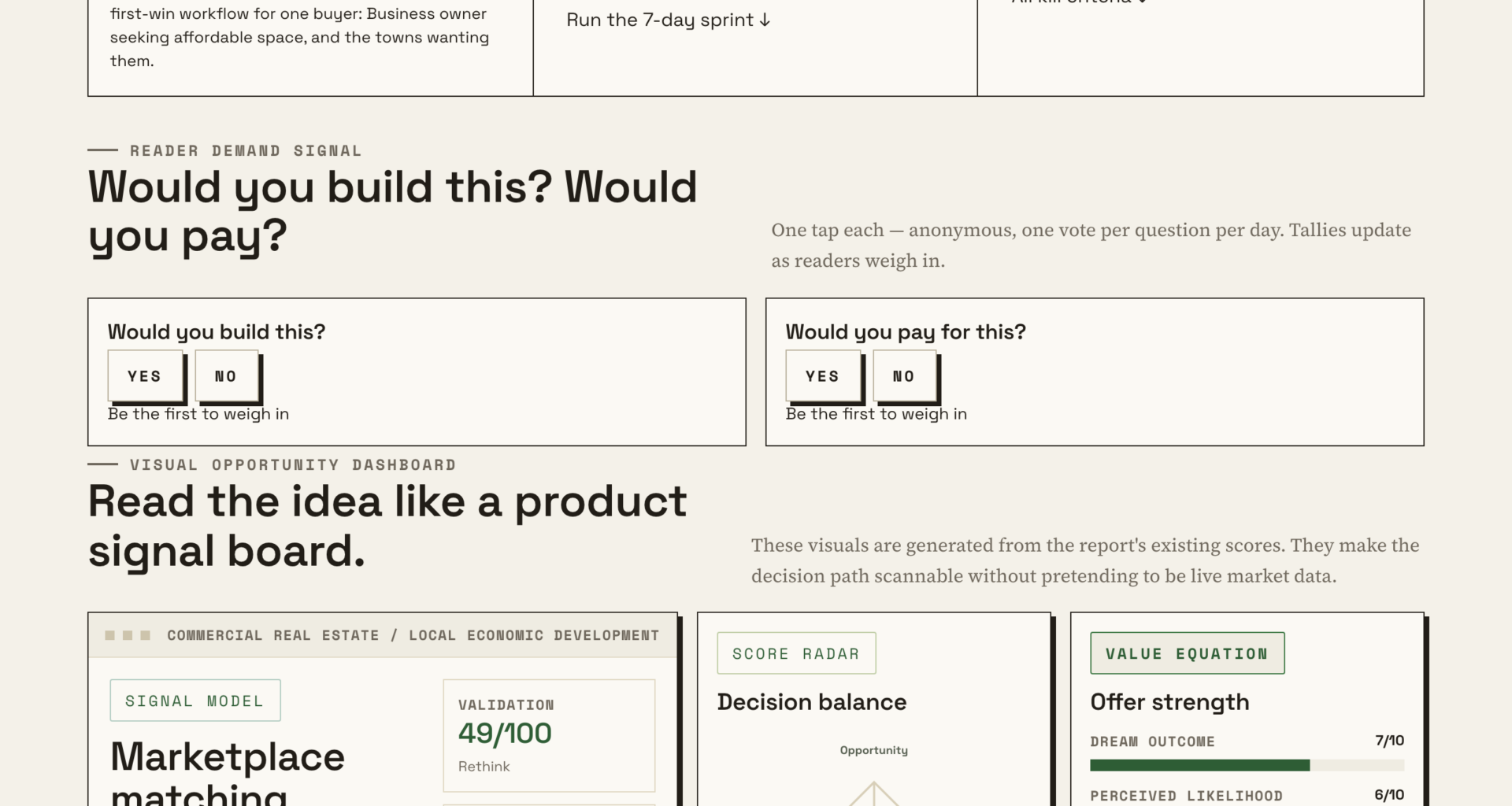
📊 Full opportunity report: What Happens When Businesses Meet Vacant Small-Town Storefronts? on IdeaNavigator AI — validation score, market gap, and execution plan.

Get tech for your team delivered free — and shop member deals
- Fast, free delivery on millions of items
- Access to Prime Big Deal Days deals on October 6–7
- Prime Video, Amazon Music and more included
TL;DR
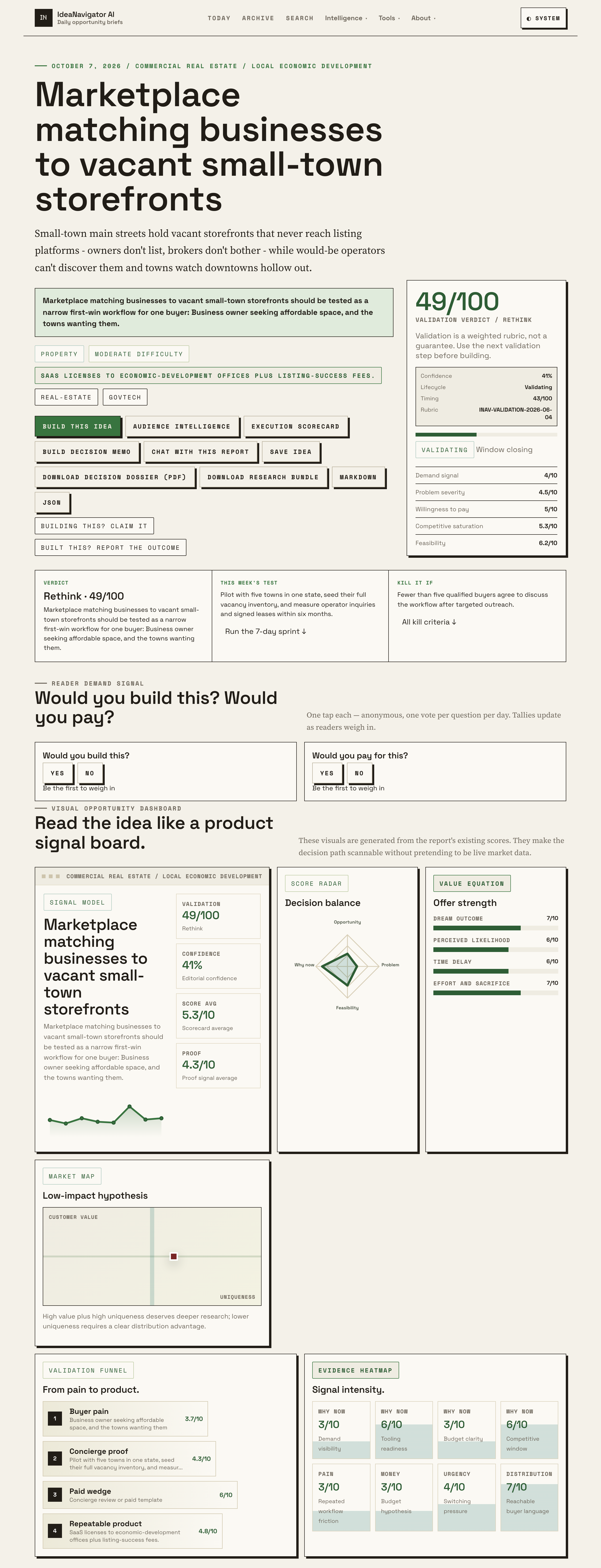
IdeaNavigator AI has outlined a marketplace concept to connect businesses seeking affordable commercial space with vacant storefronts in small towns. The proposal recommends testing the service with five towns in one state and tracking inquiries and signed leases over six months; no pilot or results are reported yet.
IdeaNavigator AI has proposed a marketplace to match business operators with vacant storefronts in small towns, routing interested businesses to local economic-development offices and any available incentives. The concept is framed as an early-stage business opportunity, not as a launched service: its suggested first test is a five-town pilot that would track operator inquiries and signed leases over six months.
The proposal describes a visibility problem: some storefronts on small-town main streets are vacant but are not listed on commercial property platforms. Owners may not advertise the spaces, while brokers may have little reason to market them. As a result, operators looking for affordable locations may not know the properties exist, and towns can have difficulty connecting available space with potential tenants.
The proposed minimum product would let towns and property owners post photos, floor area, rent and incentive programs. Prospective operators could browse listings using information about each town and foot-traffic data. When a business expresses interest, the marketplace would refer the match to the local development office, with relevant grants attached where available.
The business model outlined by IdeaNavigator AI combines software licenses for economic-development offices with fees tied to successful listings. The proposal recommends seeding the complete vacancy inventory in five towns in one state, then measuring inquiries and signed leases within six months. It does not identify a participating state, towns, property owners, grant programs or operators.
A Route From Empty Space to Tenants
If tested and adopted, a shared listing service could make overlooked commercial properties easier for prospective operators to find and give town development offices a more direct role in connecting businesses with landlords. Attaching incentive information to a listing could also make local support easier to discover, although the proposal does not specify which grants would qualify or how eligibility would be determined.
For business owners, the potential value is access to spaces that may not appear in standard searches. For towns, a consistent inventory could help staff see which properties are available and whether inquiries lead to leases. Those are proposed benefits, not demonstrated outcomes: the concept has no reported pilot data, and no evidence is provided that the marketplace would produce leases or reduce vacancies.
small town commercial property listings
As an affiliate, we earn on qualifying purchases.
As an affiliate, we earn on qualifying purchases.
How the Proposed Matching Works
The idea responds to a mismatch between available commercial space and businesses seeking locations. According to IdeaNavigator AI’s proposal, storefront owners may not list vacant units, and brokers may not pursue them, leaving potential tenants without a reliable way to discover the properties. The suggested marketplace would gather listings in one place rather than rely on each owner to reach operators independently.
The proposal also points to renewed small-town commercial interest associated with remote-work migration and says economic-development offices have grant funding for this kind of matching. Those points are part of the opportunity case presented by IdeaNavigator AI; no supporting figures, named grant programs or local examples are supplied. The recommended initial step is limited in scope: test the service in five towns in one state before judging it by inquiries and completed leases.
As an affiliate, we earn on qualifying purchases.
Pilot Details and Results Remain Unknown
No marketplace launch, town partnership or pilot timetable is reported. The proposal does not name a state or identify who would gather and verify the listings, maintain rent and availability details, or supply foot-traffic data. It also does not say how the service would handle owner consent, listing updates, grant eligibility or referrals that do not lead to a lease.
The proposal’s claims about remote-work interest and available grant money are not accompanied by figures or named programs. There are also no reported costs, customer commitments, revenue results or evidence that local offices would pay for licenses. Until a pilot is conducted, it remains unclear whether a marketplace can generate enough accurate listings and qualified operator interest to produce signed leases.
business incentives for small towns
As an affiliate, we earn on qualifying purchases.
As an affiliate, we earn on qualifying purchases.
A Five-Town Test Is Proposed
The next step described is to recruit five towns in one state, compile their storefront vacancy inventories and make listings available to prospective operators. The test would track inquiries and signed leases over a six-month period. No launch date or participating towns have been announced, so it is not clear when, or whether, that validation effort will begin.
If a pilot proceeds, its results could show whether owners participate, whether businesses use the listings and whether referrals to development offices translate into leases. Until those measures are available, the marketplace remains a proposed approach to a local property-discovery problem rather than an established service with proven results.
Source: IdeaNavigator AI
As an affiliate, we earn on qualifying purchases.
Key Questions
What is the proposed marketplace?
It is a concept for listing vacant small-town storefronts and connecting interested business operators with property owners and local economic-development offices.
Has the marketplace launched?
No launch is reported. IdeaNavigator AI presents it as an opportunity to test, with a five-town pilot suggested as the first step.
What information would listings include?
The proposed listings would include photos, storefront size, rent and information about available incentive programs. Operators could also browse by town profile and foot-traffic data.
How would the service make money?
The outlined model combines software licenses sold to economic-development offices with fees tied to successful listings. No pricing or revenue results are provided.
How would the idea be tested?
The proposal recommends adding the full vacancy inventory for five towns in one state, then measuring operator inquiries and signed leases over six months. No towns or start date have been named.
Source: IdeaNavigator AI
Halloween Picks
halloween
As an affiliate, we earn on qualifying purchases.