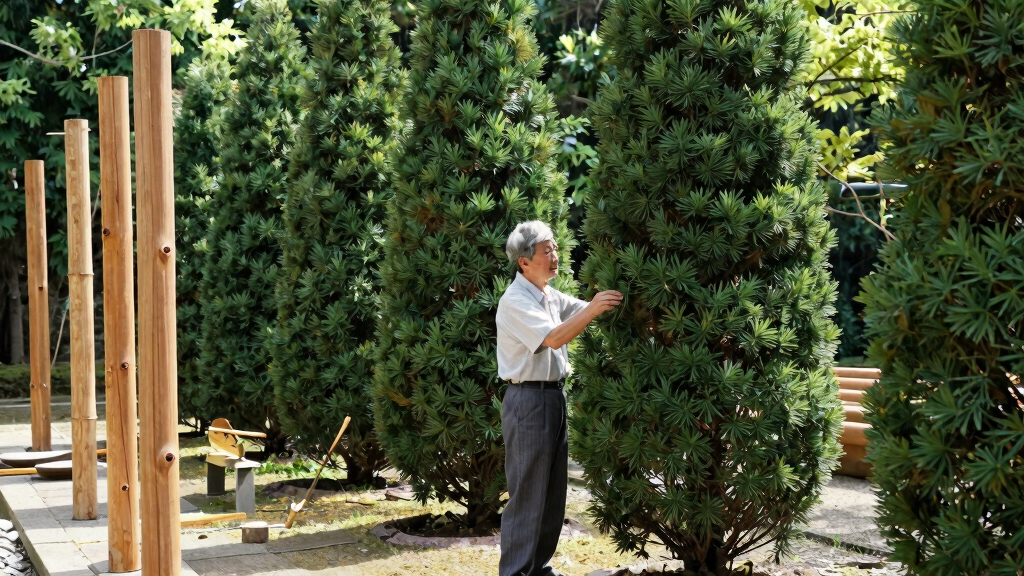

TL;DR
Daisugi is a centuries-old Japanese technique that involves growing trees out of existing trees to produce straight, dense timber. It originated in Kyoto in the 15th century and remains relevant for sustainable forestry and traditional architecture.
Daisugi is a traditional Japanese forestry technique that involves growing new trees out of existing trees to produce perfectly straight, dense timber. This method, developed in the 15th century, is still recognized for its durability and aesthetic quality, making it relevant for modern sustainable architecture and forestry practices.
Originating in Kyoto, daisugi was developed as a solution to land shortages and timber scarcity during the 15th century. The technique involves training and pruning trees to grow outward from a central trunk, creating a ‘bonsai’ of trees that produce high-quality timber known as taruki. This timber is prized for being straight, flexible, and strong—up to 200% denser than standard cedar—making it ideal for roofing and architectural elements in traditional Japanese buildings.
Historical records suggest that daisugi was employed by Kyoto’s tea masters and architects, notably during the 16th century, to meet the demand for perfect timber for tea houses and noble residences. The method not only optimized land use but also prevented deforestation by maximizing the yield from fewer trees. Today, the technique is still admired for its craftsmanship and sustainability, with some modern forestry experts considering its principles for eco-friendly timber production.
Cultural and Sustainable Impact of Daisugi in Modern Forestry
The significance of daisugi extends beyond its historical craftsmanship; it offers a model for sustainable forestry by reducing deforestation and optimizing land use. Its ability to produce high-quality, straight timber with less environmental impact makes it relevant for contemporary eco-conscious building practices. Additionally, the technique embodies Japan’s cultural heritage, linking traditional craftsmanship with modern sustainability goals.
Japanese straight timber for traditional architecture
As an affiliate, we earn on qualifying purchases.
As an affiliate, we earn on qualifying purchases.
Historical Development and Revival of Daisugi Techniques
Developed in the 15th century in Kyoto, daisugi emerged as a response to timber shortages and land constraints. Its use was documented in relation to tea house architecture and noble residences, where the demand for perfectly straight, durable timber was high. The technique involves pruning and training trees to grow outward, creating a ‘bonsai’ of trees that yield superior timber. Although less common today, daisugi has experienced renewed interest as a sustainable forestry method and a cultural heritage practice.
“The daisugi technique can prevent deforestation and produce timber that is 140% as flexible and 200% as dense as standard cedar.”
— an anonymous researcher
daisugi technique wood crafting tools
As an affiliate, we earn on qualifying purchases.
As an affiliate, we earn on qualifying purchases.
Current Adoption and Modern Reinterpretation of Daisugi
It is not yet clear how widely daisugi is being adopted in contemporary forestry or architecture outside of traditional contexts. While some experts see potential for modern sustainable practices, there is limited data on its commercial viability or integration into current forestry systems. Further research is needed to assess its practical application today.
sustainable cedar timber for roofing
As an affiliate, we earn on qualifying purchases.
As an affiliate, we earn on qualifying purchases.
Future Prospects for Daisugi in Sustainable Building
Researchers and environmental advocates are exploring ways to revive daisugi as a sustainable forestry technique. Future developments may include integrating daisugi principles into modern eco-friendly construction and forestry management, supported by technological innovations in pruning and tree training. Additionally, cultural preservation efforts could promote its use as part of Japan’s heritage in sustainable architecture.
bonsai style tree pruning tools
As an affiliate, we earn on qualifying purchases.
As an affiliate, we earn on qualifying purchases.
Key Questions
What exactly is daisugi?
Daisugi is an ancient Japanese method of growing trees out of existing trees to produce straight, dense timber used in traditional architecture.
How does daisugi differ from regular forestry?
Unlike conventional forestry, daisugi involves training and pruning trees to grow outward from a central trunk, creating a ‘bonsai’ of trees that yields superior timber with less land use and environmental impact.
Is daisugi still practiced today?
While historically prominent, daisugi is less common today but is experiencing renewed interest as a sustainable and cultural heritage technique.
What are the environmental benefits of daisugi?
The technique can reduce deforestation, optimize land use, and produce high-quality timber with less environmental impact.
Can daisugi be applied outside Japan?
Currently, its application is mostly traditional and localized, but there is potential for adaptation in global sustainable forestry practices.
Source: Hacker News