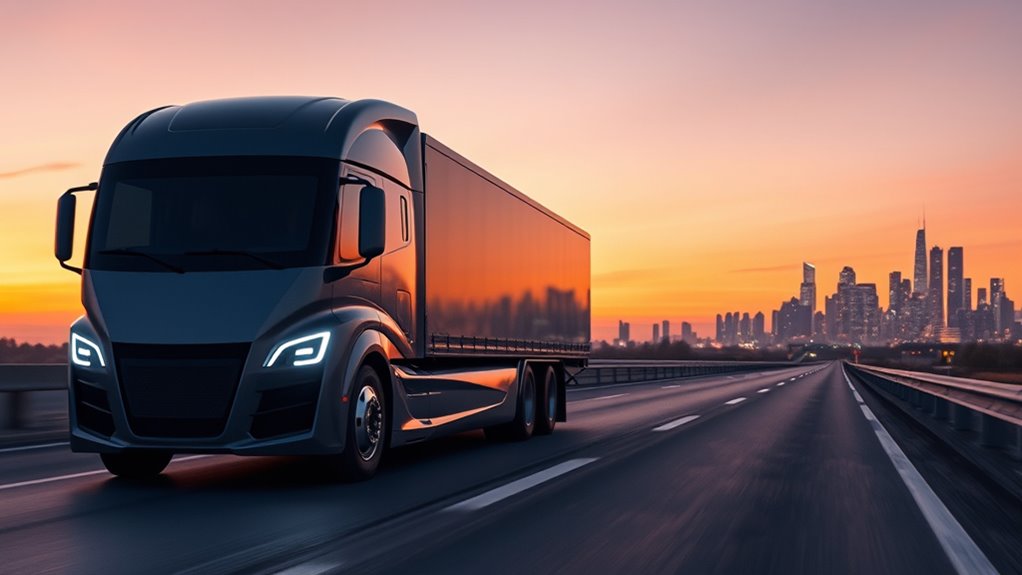

Autonomous trucks are transforming long-haul freight by offering safer, more efficient, and around-the-clock operations, which could drastically reduce driver shortages and costs. They’re changing industry dynamics, with key use cases like hub-to-hub routes, port automation, and highway corridors. While regulatory hurdles and infrastructure upgrades pose challenges, industry leaders are actively testing and deploying these vehicles. If you want to understand how these changes could reshape the freight industry entirely, there’s more to explore.
Key Takeaways
- Autonomous trucks are expected to significantly reduce long-haul trucking jobs, potentially eliminating 1.3 to 2.3 million positions over decades.
- Full autonomy on hub-to-hub routes is projected by 2027, enabling continuous, 24/7 transportation and operational efficiency.
- Industry shifts may lead to decreased costs and increased fleet utilization, transforming traditional trucking business models.
- Regulatory, infrastructure, and cross-border challenges could delay widespread autonomous long-haul adoption.
- While automation may reduce driver roles, new jobs in fleet management and technology oversight are likely to emerge.
Top picks for "autonomou vehicl long"
Open Amazon search results for this keyword.
As an affiliate, we earn on qualifying purchases.
The Rise of Autonomous Trucking: Market Drivers and Trends
The rise of autonomous trucking is driven by a combination of market needs and technological advancements that are reshaping the freight industry. You’ll notice the market is growing rapidly, projected to reach $1.74 billion in 2025 and $7.42 billion by 2034, with a 17.49% CAGR. This surge reflects increasing adoption of autonomous tech, as industry shifts from trials to early commercial deployment. Key drivers include driver shortages, rising labor costs, and the demand for safer, more efficient transport. Advances in sensors, AI, and vehicle communications enhance safety and reliability. Governments are supporting infrastructure and regulatory frameworks, encouraging adoption. Major players—OEMs, logistics firms, and tech companies—are investing heavily, recognizing autonomous trucking as a way to boost competitiveness and meet evolving supply chain demands.
Key Use Cases Transforming the Freight Industry

Autonomous trucks are revolutionizing the freight industry through targeted use cases that enhance efficiency and reduce costs. In hub-to-hub operations, they streamline logistics by cutting down on human intervention during long hauls, saving on labor and transportation expenses. These trucks can operate continuously, improving delivery times and customer satisfaction, especially within geofenced areas where conditions are controlled. Companies like Kodiak Robotics and Aurora Innovation are leading this shift. In port automation, autonomous trucks automate container handling, boosting efficiency and lowering operational costs at ports like Singapore’s Tuas Port. They also facilitate seamless freight transfer from ships to warehouses through integrated highway corridors. Across mining and agriculture, they optimize resource movement, reduce labor, and improve safety. Additionally, the integration of high-precision projector technology in logistics hubs can enhance real-time monitoring and navigation of autonomous vehicles, further transforming freight logistics across multiple industries.
Technological Breakthroughs Accelerating Adoption
Advances in AI and automation are driving rapid progress in autonomous trucking technology, making fully driverless operations increasingly feasible. Modern trucks now feature advanced driver assistance systems like automatic emergency braking, lane-keeping, and adaptive cruise control, all powered by AI-driven sensors such as LiDAR, radar, and high-resolution cameras. These sensors enable trucks to perceive their environment with high accuracy, even in complex conditions like urban traffic and bad weather. These sensors use AI-powered computer vision and sensor fusion techniques to accurately interpret surroundings. Integration of AI optimizes routes, fuel efficiency, and fleet management through predictive maintenance and logistics planning. Industry leaders like Navio, Tesla, Waymo, and Volvo are actively testing and deploying autonomous trucks, with trials covering thousands of miles and challenging scenarios. These technological breakthroughs are accelerating adoption, pushing autonomous trucks closer to commercial reality.
Infrastructure Developments Supporting Autonomous Vehicles
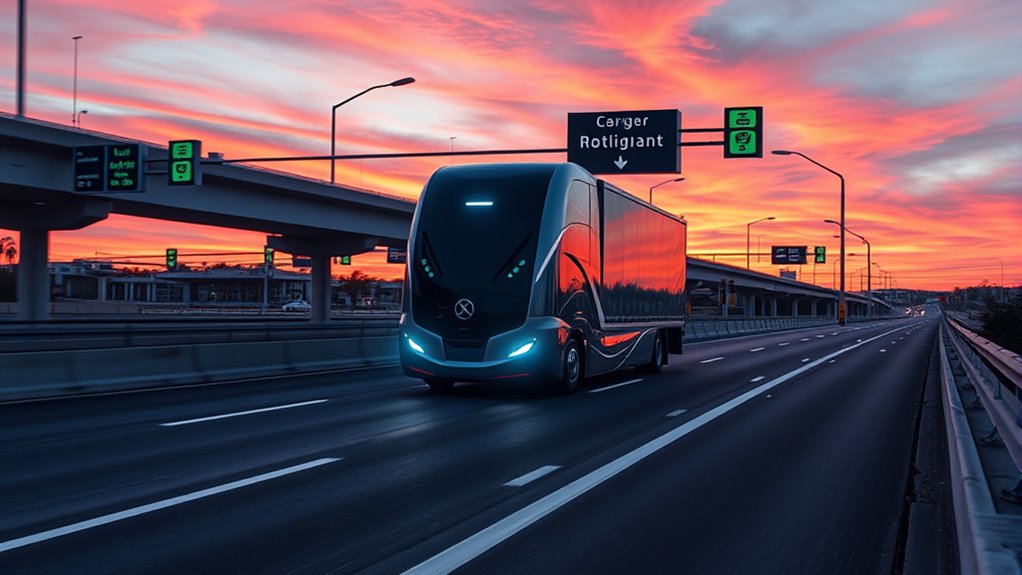
Smart road networks, enhanced with embedded sensors, enable real-time data exchange that improves safety and traffic flow for autonomous trucks. The deployment of 5G and advanced sensor integration provides the low latency and high bandwidth needed for reliable vehicle-to-infrastructure communication. These infrastructure upgrades are vital for supporting the efficiency and safety of long-haul autonomous trucking operations.
Smart Road Networks Enhancement
Enhancing road infrastructure is essential for supporting autonomous vehicles, as it provides the foundation for safe and efficient operation. Smart road networks incorporate sensors like LiDAR, weather sensors, and inductive loop sensors to monitor traffic, road conditions, and environmental factors. Adaptive traffic signals use AI and real-time data to optimize flow and reduce congestion. Wireless IoT integration enables vehicle-to-infrastructure (V2I) communication, ensuring seamless data exchange. You’ll see intelligent signage and markings that offer visual cues for AVs, improving navigation. Data analytics help predict maintenance needs and manage traffic more effectively. Integrating traffic management systems can further enhance coordination and responsiveness of autonomous vehicle operations.
5G and Sensor Integration
Infrastructure development for autonomous vehicles increasingly relies on sensor integration to improve safety and decision-making. Infrastructure-based sensors like LiDAR light-poles provide a “bird’s-eye” view of intersections and complex environments, reducing blind spots. By fusing data from multiple sensor points, AVs gain more robust perception and safer decision-making. Shared sensor data lowers the need for every vehicle to carry expensive sensors, easing adoption barriers. Intersections, where accidents are common, become safer with real-time hazard detection and communication. V2I systems enable direct data exchange between AVs and traffic infrastructure, optimizing flow and safety. However, limited standardized deployment hampers full integration. Limited widespread adoption of sensor systems also slows progress toward fully connected infrastructure, highlighting the need for broader implementation strategies. Additionally, ongoing research focuses on sensor calibration techniques to ensure data accuracy across diverse sensor networks. Here’s a snapshot:
| Infrastructure Sensors | V2I Communication |
|---|---|
| LiDAR light-poles | Real-time data exchange |
| Overlapping sensor data | Dynamic traffic control |
| Hazard detection | Weather adaptation |
| Traffic flow improvement | Interoperability challenges |
Economic Benefits and Operational Efficiency Gains
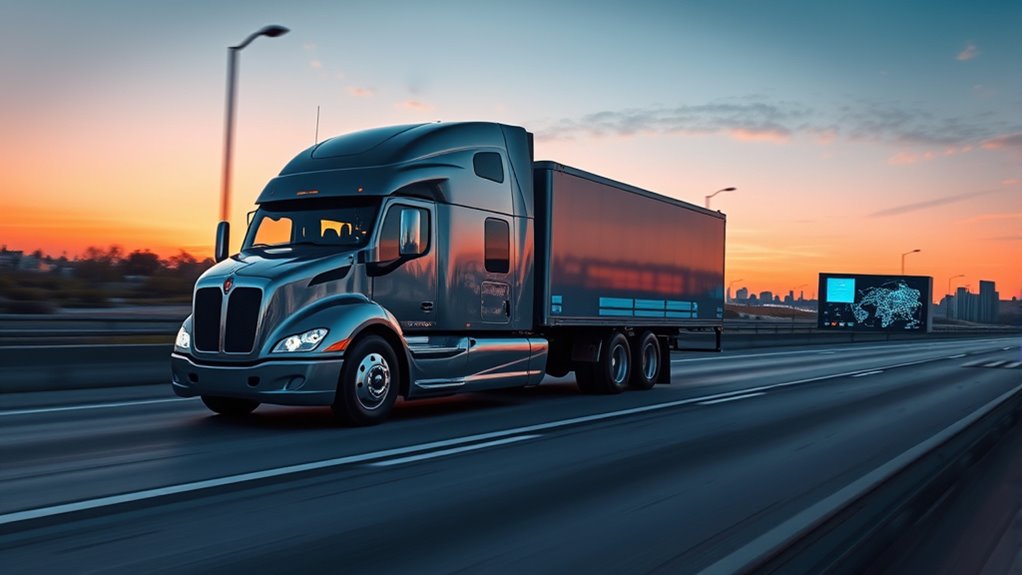
Autonomous vehicles are transforming long-haul trucking by delivering significant economic benefits and operational efficiency gains. You’ll see major cost savings from reduced labor expenses—up to $70 billion annually in the U.S.—and increased fleet utilization as trucks operate longer hours without drivers. Fuel efficiency improves by at least 5%, with some studies showing reductions of 10%, saving the industry billions each year. Additionally, autonomous trucks boost productivity by enabling near 24/7 operation, minimizing downtime, and optimizing routes. You can also expect lower maintenance costs due to less aggressive driving and predictive repairs. Insurance premiums may decrease as safety improves, cutting costs related to accidents. Overall, these advances position autonomous trucking as a game-changer for economic growth and operational excellence in the industry.
Regional Adoption Patterns and Market Shares

How are different regions progressing in adopting autonomous trucking technologies? North America leads the way, driven by government support, a strong manufacturing base, and high logistics demand. States like Michigan, Arizona, and California are testing and deploying these trucks, and the market is expected to grow rapidly, with North America having the highest CAGR. Additionally, the presence of established industry infrastructure accelerates adoption and deployment. Europe faces regulatory hurdles and infrastructure complexity, slowing adoption despite cost benefits. Still, its market has growth potential if regulations align with U.S. patterns. China’s adoption lags due to higher upfront costs and lower TCO benefits, but government influence could boost growth. Globally, the U.S. is set to hold a significant market share by 2035, solidifying its leadership in autonomous trucking deployment. Furthermore, Asia Pacific’s market share is expanding rapidly, owing to increasing technological investments and infrastructure development.
Challenges Facing Autonomous Long-Haul Deployment
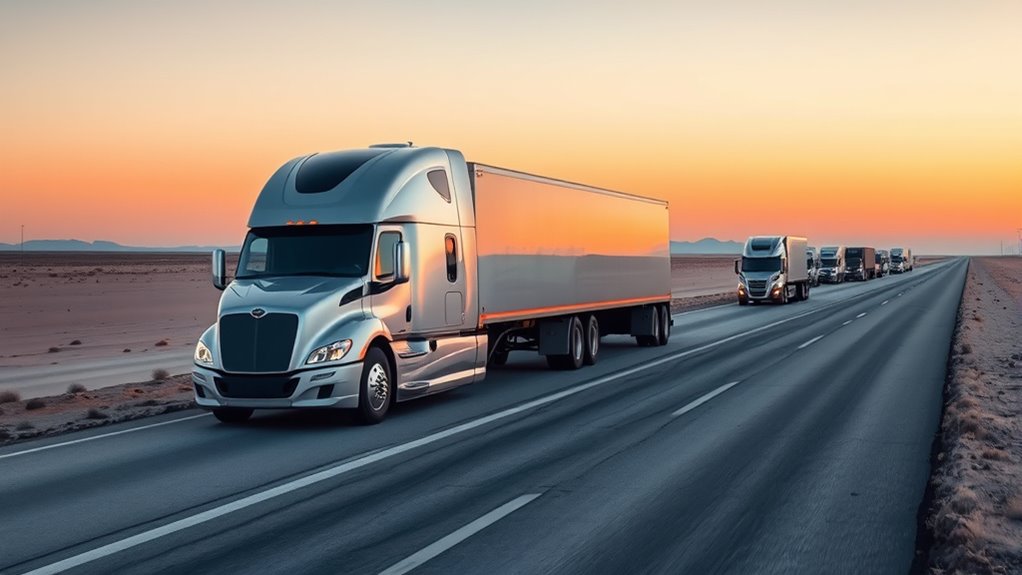
While regional adoption patterns shape the market landscape, deploying autonomous long-haul trucks faces a range of significant challenges. Technologically, advancements are needed in sensor accuracy, weather resilience, and communication systems like 5G to guarantee safety and reliability. Infrastructure gaps, such as insufficient roads, charging stations, and intelligent traffic signals, hinder widespread deployment. Operational hurdles include developing systems for automatic refueling, steering through weigh stations, and integrating with existing supply chains. Additionally, substantial investments are required to upgrade roads and telecommunication networks. Implementing renewable energy solutions for powering autonomous vehicles could also help reduce environmental impact and operational costs.
Regulatory Frameworks and International Coordination
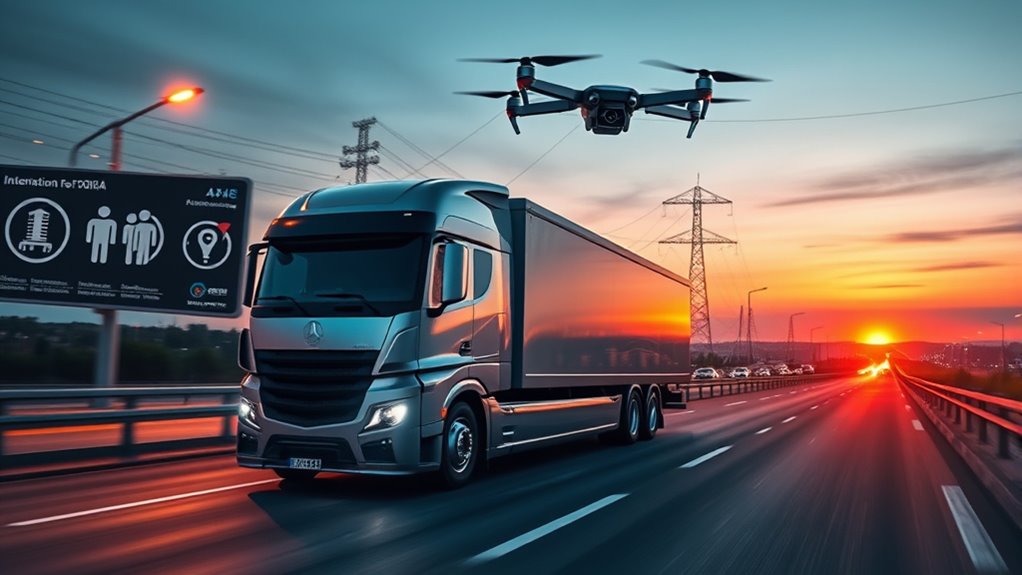
You’ll need to take into account how cross-border regulation challenges can complicate the deployment of autonomous trucks worldwide. Harmonizing international standards is essential to ensure seamless operation and safety across different regions. Understanding the regulatory approval processes in various countries helps you navigate the complexities of global deployment. Regulatory coordination between nations is crucial for facilitating the widespread adoption of autonomous trucking technology. Additionally, establishing consistent safety standards for home furnishings and vehicle safety can support international trust in autonomous systems.
Cross-border Regulation Challenges
Cross-border regulation challenges considerably hinder the widespread adoption of autonomous trucks in international freight transport. Different countries have varying rules for vehicle approval, safety standards, and driver credentials, creating a complex maze for operators. This fragmentation leads to delays, increased costs, and limited operational scope. Key issues include:
- Inconsistent inspection and certification processes across borders
- Divergent safety and cybersecurity standards
- Infrastructure gaps, such as communication networks and charging stations. Additionally, the lack of standardized regulatory frameworks complicates cross-border logistics further.
Without harmonized regulations, autonomous trucks face significant barriers to seamless cross-border movement. Limited international dialogue and cooperation further slow progress, making it difficult for logistics companies to plan and scale operations effectively. Addressing these challenges requires stronger coordination among regulators, industry stakeholders, and governments to develop compatible standards and streamline approval procedures. International standards and agreements may influence domestic policies and facilitate smoother cross-border operations.
Harmonizing International Standards
Efforts to harmonize international standards aim to address the regulatory fragmentation that hampers the deployment of autonomous trucks across borders. You’re working toward creating a unified framework that prevents conflicting regulations, reduces certification redundancies, and accelerates global deployment. The UNECE’s WP.29 plays a central role, developing guidance and draft standards that promote regulatory coherence. International agreements from 1958 and 1998 help align approaches, whether through type approval or self-certification. Industry organizations like ISO and SAE provide common standards for automation levels, safety, and V2X communication, fostering interoperability. While progress is steady, gaps remain in standardizing functional architectures and cybersecurity protocols. Harmonization efforts are essential to mitigate safety disparities across regions and ensure consistent safety performance worldwide. Achieving global consensus is essential to enable cross-border testing, certification, and deployment of autonomous trucks, ensuring safety and efficiency worldwide. Recognizing the importance of international standards in achieving interoperability, ongoing coordination among stakeholders is crucial to closing these gaps.
Regulatory Approval Processes
Regulatory approval processes for autonomous heavy-duty trucks are evolving rapidly at the state and federal levels, shaping how these vehicles gain access to public roads. States like California are updating regulations to permit testing and deployment, requiring DMV-approved permits and enhanced safety reporting. They also incorporate legislative changes, such as AB 1777, to improve interaction protocols with first responders and enforce stricter compliance. You’ll notice some key aspects:
- California’s open public comment period (April 25–June 9, 2025) for heavy-duty truck regulations.
- Variations across states, with some permitting autonomous trucks without human oversight, while others demand presence or permits.
- Federal regulators mainly respond to exemption requests, lacking a broad, extensive framework for autonomous truck approval.
- California’s proposed regulations aim to align with existing testing practices in other states, which could facilitate a more unified regulatory environment for autonomous trucking nationwide.
- The regulatory frameworks are being shaped by ongoing discussions among industry stakeholders, policymakers, and safety advocates to create consistent standards.
These overlapping, evolving processes influence how quickly autonomous trucking advances nationwide.
Impact on Employment and Industry Dynamics

Autonomous vehicles are poised to considerably reshape employment within the trucking industry, with projections indicating the loss of 1.3 to 2.3 million jobs in the next three decades. The trucking sector, especially highway drivers, faces significant disruption, with Goldman Sachs estimating 300,000 US truck driving jobs lost annually due to automation. Rural and logistics-heavy regions like Memphis, Riverside, and Indianapolis are most vulnerable, with over 3.5% of their labor force in driving roles. Industry costs will drop—by up to 30% in long-haul trucking—shifting focus from driver wages to technology investments. While some jobs will persist, roles will evolve toward fleet management and technical oversight. This shift may cause regional unemployment spikes and demand major retraining efforts, fundamentally altering industry dynamics. The pace of technological adoption and employers’ retraining strategies will largely determine how quickly and extensively these job impacts materialize. Additionally, understanding the cost savings associated with automation can help industry stakeholders plan for future economic shifts.
Future Outlook: Opportunities and Remaining Obstacles

Advancements in technology are propelling autonomous trucks toward widespread deployment, with full autonomy on hub-to-hub routes expected by 2027 and broader adoption by 2030-2035. These innovations open significant opportunities, such as reducing costs, increasing efficiency, and enabling 24/7 operations. However, several obstacles remain:
- Regulatory frameworks are still evolving, causing delays and uncertainty.
- Ensuring safety and cybersecurity in complex environments poses ongoing challenges.
- Infrastructure upgrades, like V2X communication systems, require substantial investment and coordination.
- Additionally, ongoing technological development and the need for comprehensive testing are essential to address safety concerns and build public trust.
Despite these hurdles, industry leaders are actively testing and expanding autonomous trucking in select regions. As technology matures and regulations develop, autonomous trucks could revolutionize logistics, but addressing remaining challenges is essential for realizing their full potential.
Frequently Asked Questions
How Will Autonomous Trucks Impact Long-Haul Trucking Jobs Long-Term?
You might wonder how technological advances will change long-haul trucking jobs over time. As automation progresses, you could see significant job reductions—potentially over 90% of highway trucking—though the impact will be gradual. While some drivers may lose their jobs, others could shift into new roles, benefiting from lower costs, better safety, and improved work conditions. Overall, long-term job impacts will depend on how quickly and widely automation is adopted.
What Are the Safety Concerns Specific to Autonomous Long-Haul Routes?
You should consider that autonomous long-haul routes face safety concerns like sensor limitations in bad weather, which can reduce visibility and detection accuracy. Unexpected scenarios or complex environments may cause system failures despite machine learning improvements. Connectivity issues and cybersecurity threats pose risks, while unpredictable human interactions and poorly maintained infrastructure can increase accident chances. These factors make ensuring safety on long routes a significant challenge that requires ongoing technological and regulatory solutions.
How Do Autonomous Trucks Handle Complex Urban Environments?
You see, maneuvering complex urban environments requires autonomous trucks to use advanced sensors like lidar, radar, and cameras to perceive surroundings accurately. They rely on inertial navigation systems when GPS signals are blocked and integrate real-time traffic and weather data to adapt routes. These trucks also employ AI-powered route planning, redundancy in safety systems, and simulation testing to handle urban challenges safely and efficiently.
What Legal Liabilities Exist if an Autonomous Truck Causes an Accident?
You should know that if an autonomous truck causes an accident, liability could fall on various parties. This includes software developers for AI errors, manufacturers for hardware defects, fleet operators for poor monitoring or maintenance, and cybersecurity firms if hacking is involved. Liability depends on factors like vehicle automation level, state laws, and how the accident happened. Investigations often involve analyzing vehicle data, maintenance records, and expert opinions.
How Might Autonomous Trucking Influence Global Supply Chain Resilience?
This question hits at a game-changer in logistics. Autonomous trucking boosts global supply chain resilience by making deliveries faster, more predictable, and less prone to human error. You’ll see fewer disruptions from driver shortages or labor strikes, and increased capacity enables quicker responses to demand spikes. Overall, autonomous tech can turn your supply chain into an unstoppable force, ensuring consistent, reliable delivery even amidst global uncertainties.
Conclusion
As autonomous trucks steer us into the future, they’re like a double-edged sword—offering incredible efficiency while cutting through traditional jobs. Embrace the potential, but stay aware of the hurdles still on the horizon. If you navigate wisely, this technological revolution could transform your industry, turning long-haul trucking from a solitary journey into a symphony of innovation. The road ahead is clear, but only if you’re ready to steer with foresight.