

Autonomous agents go beyond simple chatbots by performing complex, independent tasks that enhance decision-making and workflow efficiency. They can automate routine activities, support real-time data analysis, and collaborate seamlessly across departments, transforming how work gets done. As these systems evolve, they’ll shape new roles, restructure organizations, and improve productivity. To understand how these agents will impact your industry and job, explore the insights ahead.

Get business pricing on tech for your team
- Business-only prices and quantity discounts
- Tax-exempt purchasing
- Multiple users, one account, clear invoices
Key Takeaways
- Autonomous agents can independently perform complex tasks, enhancing efficiency beyond simple chatbot interactions in various industries.
- They enable real-time data analysis and adaptive decision-making, transforming how organizations operate and innovate.
- Multiagent collaboration allows scalable, resilient systems that handle large datasets and complex workflows effectively.
- Future work involves integrating environmental sensing, continuous learning, and sustainability principles into autonomous systems.
- These agents are poised to redefine roles, automate routine tasks, and support strategic initiatives across the future workplace.
autonomous AI agents for business
As an affiliate, we earn on qualifying purchases.
As an affiliate, we earn on qualifying purchases.
Defining Autonomous Agents and Their Evolution
Autonomous agents are AI systems that perform tasks independently, without needing human intervention. You’ll find they can handle complex tasks by sensing their environment and making decisions on their own. They actively interact with their surroundings to achieve specific objectives, adapting as needed. They are increasingly used in applications like logistics and inventory management, where autonomy can greatly improve operational efficiency. Over time, autonomous agents have evolved profoundly, starting from early concepts in the 1990s to more sophisticated systems capable of operating in dynamic environments. Today’s agents are goal-oriented, mimicking human decision processes and demonstrating remarkable adaptability. Thanks to ongoing AI advancements, these systems are becoming more capable, enabling them to act independently and manage complex, real-world tasks efficiently. Continuous learning allows autonomous agents to improve their performance over time, making them increasingly effective in various applications. As research continues, innovations in environment sensing and real-time data processing are further expanding their potential. Furthermore, advancements in adaptability enable autonomous agents to better respond to unpredictable changes in their environment. Incorporating learning algorithms enhances their ability to optimize decisions through experience, reflecting a significant progression in AI capabilities. Additionally, the integration of sound healing science principles is being explored to improve interface design and user interaction in some adaptive systems.
As an affiliate, we earn on qualifying purchases.
Transforming Workplace Operations With AI Agents

How are AI agents revolutionizing workplace operations? They handle routine tasks like scheduling, logistics, and data processing, freeing your team to focus on strategic work. Multiagent systems coordinate workflows, assign tasks, and validate outputs, ensuring seamless operations. These agents enable real-time data analysis, speeding up decision-making and improving efficiency. In customer service, AI manages inquiries and support tickets without human intervention. In manufacturing, they optimize supply chains and predict maintenance needs. Healthcare benefits from AI scheduling and diagnostics support, while finance uses them for transaction automation and fraud detection. E-commerce platforms personalize recommendations and manage inventory. This rapid adoption boosts scalability and personalization, transforming how you work. As AI agents become business essentials, they’re reshaping operations across industries, making processes faster, more efficient, and less resource-intensive. AI’s transformative potential is driven by advances in multimodal capabilities, reasoning, and autonomous decision-making. Additionally, integrating industry-specific knowledge enhances the accuracy and reliability of AI-driven workflows, further solidifying their role in future workplace innovations. Furthermore, incorporating insights from biodiversity conservation can improve the sustainability of AI deployment by promoting environmentally responsible practices. For example, understanding the layout of Water Parks can inspire the development of AI systems optimized for complex spatial environments, improving navigation and safety features. Incorporating automotive tuning techniques can also inspire innovative approaches to optimizing AI system performance and resilience in dynamic environments. For example, adopting innovative unique and wicked planters design principles can inspire new ways of creating adaptable and sustainable AI hardware structures.
As an affiliate, we earn on qualifying purchases.
Enhancing Decision-Making Through Autonomous Systems

Autonomous systems leverage data-driven insights to improve decision-making accuracy and speed across industries. They continuously analyze large datasets, adjusting their actions in real time to optimize outcomes. By executing workflows automatically, these systems free you from routine tasks and enhance overall efficiency. Additionally, integrating vetted product reviews ensures that the tools and costumes used in these systems or for related applications meet quality and safety standards. Incorporating Pimple Patch technology into health-related autonomous solutions can also boost their reliability and user trust. Moreover, advancements in predictive analytics enable these systems to forecast future trends and adapt proactively. For instance, selecting the right dog beds for Golden Retrievers can improve comfort and support, demonstrating how tailored solutions enhance system effectiveness and user satisfaction. Incorporating regular maintenance and quality checks further ensures optimal performance and longevity of autonomous systems.
Data-Driven Insights
The rise of data-driven insights is transforming decision-making processes across industries, empowering organizations to make smarter, faster choices. You can leverage real-time data to enhance operational efficiency, reduce risks, and align decisions with strategic goals. As more companies adopt data-driven approaches—77% prioritize them—you gain a competitive edge, with 6% higher profitability and 5% increased productivity. AI tools are increasingly assisting or replacing content creators, streamlining analysis and insights. To deepen your understanding, consider how:
- Advanced analytics support faster, more accurate decisions across environments, enabling predictive analytics to forecast trends and outcomes more precisely. Additionally, the development of AI-powered tools is further accelerating these capabilities, allowing for even more nuanced insights.
- AI integration drives innovation and operational risk reduction.
- Real-time data empowers proactive strategies and customer experience improvements.
- Data volume growth is fueling the development of sophisticated systems that can process and analyze vast datasets rapidly.
- Understanding data ecosystems is essential for managing the complex flow of information that supports these advanced systems.
- The integration of angel number knowledge can also offer unique perspectives on strategic decision-making and relationship management in organizational contexts.
- Additionally, insights from Mazda tuning demonstrate how targeted modifications can optimize vehicle performance, which parallels the importance of precise adjustments in data systems to enhance overall outcomes.
These developments help you stay agile, competitive, and prepared for future technological shifts.
Autonomous Workflow Execution
By automating routine and time-consuming tasks, AI-driven workflows enable your organization to operate more efficiently and respond swiftly to changing conditions. Autonomous systems handle repetitive activities, freeing your team to focus on strategic initiatives. They execute workflows independently, reducing the need for constant oversight and allowing for near real-time adjustments based on new data. These agents seamlessly integrate across platforms like email, ERP, and procurement, ensuring smooth operations. They guide users through complex procedures, minimizing errors and improving compliance. With high accuracy, they process vast amounts of data with fewer mistakes and fewer manual interventions. By accelerating task completion, autonomous workflows shorten delivery times, optimize resource use, and support continuous improvement, empowering your organization to adapt and grow more effectively. Autonomous AI systems can also learn from ongoing operations, becoming smarter and more efficient over time. Additionally, understanding supermarket hours today can help optimize supply chain and staffing decisions, indirectly benefiting your operational efficiency.
multiagent collaboration systems
As an affiliate, we earn on qualifying purchases.
As an affiliate, we earn on qualifying purchases.
Revolutionizing Learning and Development With AI
AI is transforming learning and development by offering personalized experiences that adapt to each learner’s needs. It also streamlines training processes, making them more efficient and tailored to individual skills. As these technologies evolve, they’ll reshape how you acquire knowledge and develop new competencies. The global AI market is projected to reach $1.81 trillion by 2030, further accelerating innovation in educational tools and methods.
Personalized Learning Experiences
Have you noticed how personalized learning experiences are transforming education and training? AI-powered platforms analyze your performance and adapt content to suit your unique learning style. This shift makes learning more efficient, engaging, and relevant. The market for these solutions is booming, valued at USD 6.5 billion in 2024 and projected to hit USD 208.2 billion by 2034, driven by wider accessibility and innovative applications. Institutions are increasingly adopting AI, with 57% of higher ed institutions prioritizing it in 2025. Personalized learning boosts engagement by providing real-time feedback, interactive content, and gamification, which motivate learners across all age groups. As AI advances, expect more modular micro-learning, immersive AR/VR experiences, and predictive tools to enhance individual educational journeys.
Streamlined Training Processes
Streamlined training processes are revolutionizing learning and development by automating routine tasks and delivering content more efficiently. AI-powered platforms optimize content speed, reducing training time, and dynamically update modules with minimal human effort to keep materials current. AI agents assign training based on roles, skill gaps, and compliance needs, simplifying onboarding and upskilling. Automated scheduling and reminders ensure consistent participation and completion rates. Seamless integration with HR systems minimizes administrative burdens, allowing smoother data flow. These systems analyze vast training data to identify patterns, monitor engagement, and predict learner drop-offs, enabling proactive interventions. Automated assessments and instant feedback accelerate skill development, while AI-driven interactivity, gamification, and virtual mentors boost engagement. Overall, AI empowers scalable, continuously improving training programs tailored to diverse, global workforces.
The Power of Multiagent Collaboration in Business
Multiagent collaboration substantially enhances business operations by enabling systems to work together seamlessly and efficiently. By executing tasks simultaneously, multiple agents speed up problem-solving and handle large datasets beyond single-agent limits. This reduces bottlenecks and allows for easy scalability—adding agents supports growing workloads.
Moreover, collective intelligence and diverse perspectives foster innovation and better decision-making. Agents adapt quickly to changing environments, managing complex tasks collaboratively. They continuously learn from outcomes, improving strategies over time. The system’s robustness ensures resilience; if one agent fails, others compensate, maintaining stability and performance.
- Handle complex, large-scale challenges with ease
- Enable real-time, informed decisions
- Support business growth through scalable architectures
Emerging Trends and the 2025 AI Landscape

What are the key trends shaping the AI landscape as we approach 2025? The AI market is booming, valued at around $391 billion, with projections to grow fivefold in five years, at a CAGR of 35.9%. The US alone accounts for nearly $74 billion, with companies increasing AI investments—92% plan to boost spending over the next three years. Generative AI attracted $33.9 billion in global private investments, and enterprise adoption is accelerating, with 72% of executives using it weekly. Workforce demand is surging, with nearly 100 million jobs expected in AI roles by year’s end, transforming job skills and roles. Additionally, AI is expanding beyond chatbots into cross-industry applications, reshaping operations, creativity, and competitive advantage. The ecosystem is evolving into interconnected systems, demanding continuous adaptation.
Role-Specific AI Agents and Industry Applications

Role-specific AI agents are transforming various industries by automating specialized tasks and enhancing operational efficiency. In customer service, they autonomously handle inquiries, suggest responses, and plan follow-ups, reducing manual workload and improving customer outcomes. For example, Salesforce’s Agentforce integrates AI to automate complex workflows like product launches and marketing. In manufacturing, AI agents analyze machine data to predict failures, schedule maintenance, and optimize production processes, preventing downtime. In supply chain management, they forecast demand, manage inventory, and detect disruptions, ensuring product availability. They also monitor transactions in finance, identifying fraud patterns in real-time to mitigate risks. These agents serve as a “digital workforce,” collaborating with humans to streamline operations and drive industry-specific innovations.
- Automate complex workflows like marketing campaigns and product launches
- Predict equipment failures to schedule proactive maintenance
- Detect supply chain disruptions and recommend alternatives
Overcoming Challenges in Autonomous Agent Deployment
Deploying autonomous agents across industries presents significant challenges that must be addressed to realize their full potential. System integration is complex; 80% of enterprises struggle to connect diverse systems, which consumes critical IT resources. Standardizing data formats and using middleware can improve compatibility and reduce downtime, but managing multiple data sources remains difficult. Data quality issues, such as fragmentation and access complexity, cost organizations up to $12.9 million annually. Scalability and performance also pose hurdles—rising workloads increase costs, requiring cloud scaling, GPU acceleration, and edge computing. Security risks, including vulnerabilities and data breaches, demand robust measures like encryption, access controls, and compliance. Finally, ensuring transparency and governance through clear frameworks builds trust and mitigates deployment risks.
Future Impacts on Jobs and Organizational Structures
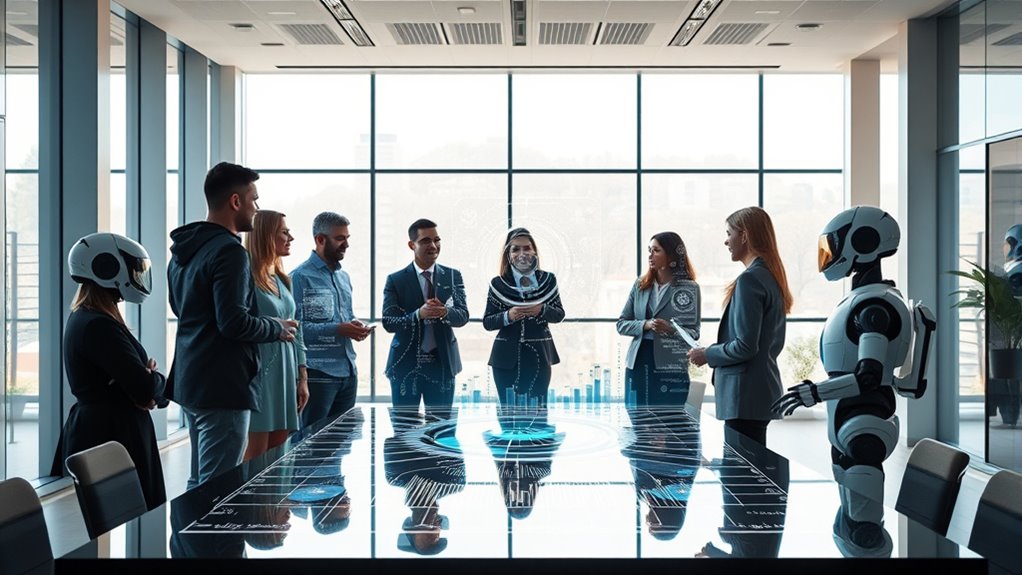
The integration of autonomous agents into workplaces will substantially reshape employment patterns and organizational structures. You’ll see significant job displacement, especially in administrative, customer service, and production roles, with up to 300 million jobs at risk globally. Simultaneously, new roles will emerge, like AI oversight, security, and data stewardship, creating a need for ongoing reskilling. As organizations adapt, they’ll invest more in AI but remain relatively early in maturity—only 1% at full integration. You’ll notice shifts toward greater emphasis on human-centered skills such as resilience, leadership, and social influence. Key impacts include:
- Automation reducing routine cognitive tasks, freeing employees for complex problem-solving
- Organizational restructuring to incorporate new roles and collaborative workflows
- Growing demand for security and technical expertise in response to AI-driven changes
Frequently Asked Questions
How Do Autonomous AI Agents Handle Ethical Decision-Making?
You might wonder how autonomous AI agents make ethical decisions. They rely on explainable AI techniques, which help clarify their reasoning, and follow predefined ethical guidelines or policies. Human oversight remains vital, as it ensures these agents align with societal values and prevent harm. Continuous monitoring, bias mitigation, and legal frameworks also support responsible decision-making, making sure these agents act ethically in complex and sensitive situations.
What Security Risks Are Associated With Deploying AI Agents at Scale?
Think of deploying AI agents at scale like building a sprawling fortress—every new wall or gate adds potential vulnerabilities. You face risks like agents being hijacked or compromised, rogue entities infiltrating your system, and data leaks from misconfigurations. Cloud integrations, compliance gaps, and unpredictable behaviors further amplify threats. To defend your fortress, you need robust security measures, continuous monitoring, and strict governance to prevent attackers from exploiting these openings.
How Do AI Agents Adapt to Rapidly Changing Business Environments?
You can see that AI agents adapt quickly to changing business environments by leveraging real-time data updates and goal-based learning. They autonomously refine their actions through continuous optimization, responding rapidly with model-based reflexes. As a result, you can rely on these agents to make decisions, adjust strategies, and optimize processes on the fly, helping your business stay competitive and agile amidst constant environmental shifts.
What Regulatory Challenges Might Arise From Autonomous AI Use?
You’ll face regulatory challenges with autonomous AI, like steering differing laws across regions, which can slow down deployment and increase costs. Bias and discrimination concerns require ongoing audits and transparency, while safety rules demand regular risk assessments and human oversight. Accountability is vital, so you must establish clear governance and responsibility structures. Staying compliant means continuously monitoring regulations and adapting your AI systems to meet evolving legal standards.
How Will AI Agents Impact Employee Roles and Job Satisfaction?
You’ll find that 67% of executives expect AI agents to drastically change job roles soon. As AI takes over routine tasks like scheduling and document creation, you’ll move toward higher-level responsibilities, boosting job satisfaction. Real-time coaching and personalized training help you learn faster, while lighter administrative burdens reduce stress. This shift empowers you with more autonomy, making work more meaningful and engaging, ultimately enhancing your overall job satisfaction and efficiency.
Conclusion
So, as you enthusiastic ly brace for a future dominated by autonomous agents, remember: your job might not be replaced, just rebranded as “collaborative AI coordinator.” Embrace the chaos, because who needs human judgment when machines can “optimize” everything? Just don’t be surprised if someday your biggest career move is convincing a bot to take your lunch break. Welcome to the brave new world—where humans work for the robots’ amusement.
Fall Picks
fall essentials
As an affiliate, we earn on qualifying purchases.