
AI is transforming art and writing jobs by acting as a creative partner rather than a replacement. You can use AI to generate ideas, drafts, or visuals, which enhances your expression while preserving your unique voice. Ethical concerns like bias and originality are essential to address. As you explore this evolving landscape, you’ll discover how human creativity and AI collaboration can create innovative work. Keeping these dynamics in mind, there’s much more to learn about the future of creative careers.
Key Takeaways
- AI enhances creative workflows by serving as a collaborative tool rather than replacing human artists and writers.
- Ethical considerations, including authorship and bias, are crucial in integrating AI into creative industries.
- Human-AI collaboration unlocks new artistic possibilities, blending emotional insight with machine efficiency.
- AI safety measures help prevent biases and ensure responsible, authentic creative outputs.
- The future of creative jobs involves evolving roles as curators, editors, and collaborators alongside AI technology.

As artificial intelligence continues to advance, it’s transforming the creative landscape in ways that challenge traditional notions of artistry. You might wonder how AI impacts the roles of artists and writers, especially when it comes to notions like originality and human touch. One key area to reflect upon is AI ethics, which involves understanding the moral implications of using AI in creative processes. As AI tools become more sophisticated, questions arise about authorship, originality, and the potential for misuse. You need to think critically about how AI influences creative integrity and ascertain that technology enhances rather than diminishes human expression. It’s not just about what AI can do; it’s about how you use it responsibly to respect intellectual property, avoid bias, and foster transparency.
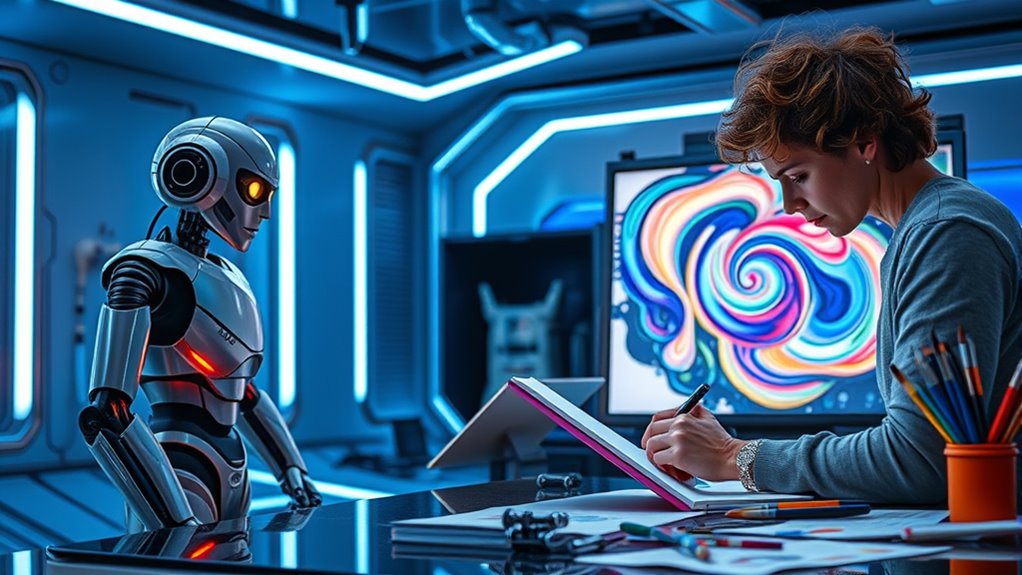
Moreover, the development of AI safety measures highlights the importance of monitoring AI behavior to prevent vulnerabilities and biases from affecting creative outputs AI vulnerabilities. At the same time, AI is reshaping creative collaboration, opening new avenues for artists and writers to work with technology rather than compete against it. Instead of viewing AI as a threat, you can see it as a partner that complements your skills. For example, you might use AI to generate initial drafts, brainstorm ideas, or create visual elements, freeing you up to focus on refining the core message or adding a personal touch. This collaboration allows you to explore new styles, experiment with different mediums, and push creative boundaries that might have been unreachable before. It’s a symbiotic relationship where human intuition and emotional depth combine with AI’s speed and data processing, resulting in innovative work that leverages the strengths of both.
However, embracing AI in your creative process also requires critical awareness. You need to understand the limitations of AI-generated content and verify that your unique voice remains central. It’s easy to get caught up in relying too heavily on algorithms, which can sometimes produce content lacking depth or emotional resonance. That’s why maintaining a focus on AI ethics is essential—so you don’t inadvertently perpetuate biases or produce work that compromises authenticity. Your role becomes that of a curator and editor, guiding AI outputs toward meaningful, genuine art and writing. By doing so, you foster a balanced relationship where AI amplifies your creativity without overshadowing it. In this evolving landscape, your ability to navigate AI ethics and harness creative collaboration will determine whether you thrive as a creator or fall behind.
Frequently Asked Questions
How Will AI Impact Traditional Art Education Programs?
AI will considerably impact your traditional art education programs by transforming your art curriculum and teaching methodologies. You’ll find new tools that enhance creativity and streamline learning processes. However, you might also face challenges in maintaining originality and personal expression. Embracing AI’s potential allows you to expand your skills and adapt to evolving artistic trends, ensuring your education stays relevant and prepares you for future artistic opportunities.
Can AI Truly Replicate Human Emotional Expression in Art?
You wonder if AI can truly replicate human emotional expression in art, and the answer is complicated. While AI can mimic emotional authenticity and capture expressive nuance, it lacks genuine feeling behind its creations. It can imitate emotion convincingly, but the depth of authentic human experience remains elusive. So, as you explore AI-generated art, remember it may evoke feelings, but it can’t fully embody the rich complexity of true human emotion.
What Legal Rights Do Artists Have Over Ai-Generated Work?
You have legal rights over AI-generated work through intellectual property laws. Copyright ownership depends on your level of creative input; if you considerably contribute to the work’s originality, you typically hold the copyright. However, if AI plays a dominant role with minimal human input, ownership rights can be complex. It’s crucial to document your contributions clearly and consult legal experts to protect your rights over AI-created art.
Will AI Create New Job Opportunities for Creatives?
You’ll find AI creates more than just challenges; it sparks an explosion of new opportunities for creatives. While some face AI job displacement, others harness it to elevate their craft through creative skill adaptation. Imagine transforming your talents into tech-enhanced masterpieces, opening doors to fields like digital design, AI storytelling, and virtual art. Embrace this wave, and you’ll ride it into a future where your creative prowess becomes more essential than ever.
How Can Artists Collaborate Effectively With AI Tools?
You can collaborate effectively with AI tools by integrating AI into your creative workflows, viewing it as a partner rather than a replacement. Start by experimenting with AI for brainstorming, generating ideas, or refining your work. Communicate your vision clearly, and be open to iterative adjustments. Embrace AI collaboration as a way to enhance your creativity, streamline processes, and produce innovative art or writing that combines human intuition with machine precision.
Conclusion
As you stand at this crossroads, the future of art and writing hangs in the balance. Will you embrace the relentless rise of AI, or will your unique voice forge a path no machine can follow? The horizon darkens with uncertainty, shadows of innovation casting doubt and hope alike. One thing’s certain—what you create next could redefine the very essence of human imagination. The choice is yours, and the story is only just beginning.