📊 Full opportunity report: Virtual Reality As The Key To Safer, More Skilled Manufacturing Teams on IdeaNavigator AI — validation score, market gap, and execution plan.

Get business pricing on tech for your team
- Business-only prices and quantity discounts
- Tax-exempt purchasing
- Multiple users, one account, clear invoices
TL;DR
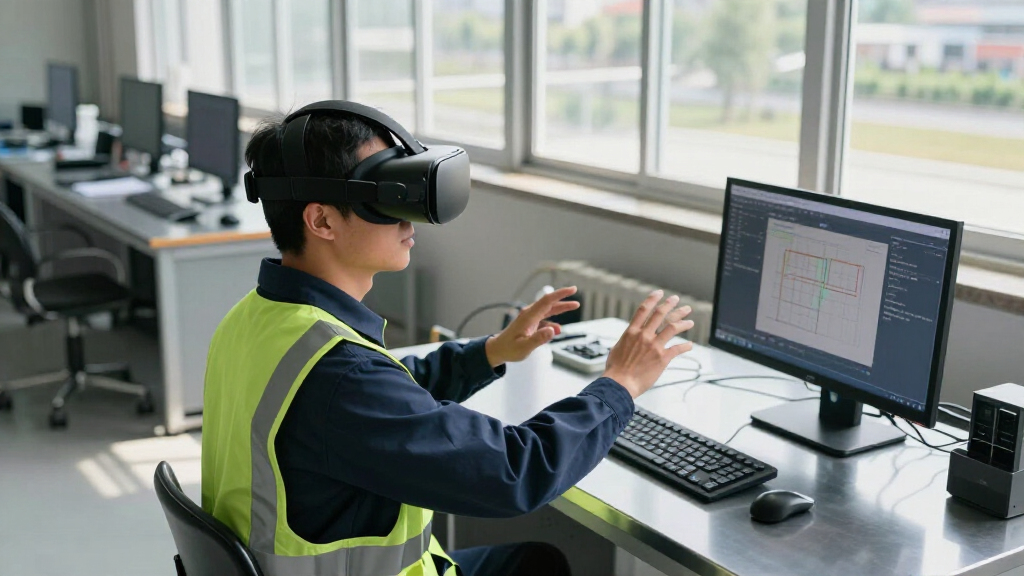
Manufacturers are piloting VR training modules to enhance safety and accelerate onboarding. Early results show promising improvements in hazard recognition and competency. The initiative aims to address labor shortages and safety risks.
Manufacturers are launching pilot programs using virtual reality (VR) training modules to improve safety and speed up onboarding processes for new workers, addressing persistent labor shortages and skills gaps. This development is confirmed by industry sources and early pilot results, which suggest VR can deliver more consistent and effective training for high-risk procedures.
Manufacturers face a critical challenge: a labor shortage estimated at over 400,000 unfilled positions as of August 2025, with projections indicating a need for nearly 3.8 million new workers by 2033. Traditional training methods—classroom instruction and on-the-floor demonstrations—are slow, inconsistent, and pose safety risks when used on live machinery. To combat these issues, companies are testing VR modules that simulate high-risk procedures such as lockout/tagout and forklift safety, delivered via standalone headsets like Meta Quest and Pico.
These VR modules are designed to be deployed at scale, with a cloud dashboard tracking completion, hazard-recognition accuracy, and quiz scores for each worker. Early pilots involve shipping five to ten headsets to a single plant, focusing on a core safety scenario, and measuring outcomes against existing training benchmarks. The goal is to demonstrate faster competency development, better hazard recognition, and higher retention rates, which could reduce incident rates and training costs.
Industry experts say the immersive nature of VR offers a standardized training experience that can be repeated across multiple facilities, reducing variability and improving safety outcomes. The market for immersive enterprise training is rapidly expanding, with estimates reaching USD 14.55 billion in 2025, driven by technological advances and the urgent need for scalable, effective workforce development solutions.
Impact of VR on Manufacturing Safety and Workforce Development
This initiative could significantly improve safety outcomes by enabling workers to experience and recognize hazards in a controlled environment before working on live equipment. Faster onboarding and skill acquisition can help manufacturers fill labor gaps more quickly, reduce incident rates, and lower costs associated with accidents and high employee turnover. As VR training becomes more widespread, it may transform traditional manufacturing training paradigms, leading to safer, more efficient operations.
Products Worth Considering

LG 34GX90SA-W 34-inch Ultragear WQHD OLED Curved Gaming Monitor

LG UltraGear 27-Inch QHD OLED Gaming Monitor, 240Hz, 0.03ms, G-SYNC Compatible, FreeSync Premium Pro, HDMI 2.1

Jackery Solar Generator 1000 V2 with 200W Solar Panel
As an affiliate, we earn on qualifying purchases.
Manufacturing Skills Gap and Training Challenges
The manufacturing sector has been grappling with a severe skills shortage, compounded by an aging workforce and slow onboarding processes. In August 2025, there were approximately 409,000 unfilled manufacturing jobs in the U.S., with projections indicating a need for nearly 3.8 million new workers by 2033. Traditional training methods are often slow, inconsistent, and pose safety risks when used on operational machinery. Recent technological advances, including affordable standalone VR headsets and cloud-based streaming, are enabling new approaches to workforce development, with immersive training gaining traction as a scalable solution.
Early pilot programs are focusing on high-risk, high-value procedures such as lockout/tagout, forklift operation, and machine guarding. These pilots aim to measure the effectiveness of VR training in reducing time-to-competency and improving hazard recognition, with initial results showing promise. The broader market for immersive enterprise training is expanding at an estimated CAGR of around 20%, reflecting industry interest and technological maturity.
Uncertainties in VR Training Effectiveness and Adoption
While initial pilot results are promising, it is not yet clear how scalable and cost-effective VR training will be across diverse manufacturing environments. Long-term data on safety improvements, retention, and cost savings remain unavailable. Additionally, the extent to which VR training can replace or supplement traditional methods at large scale is still under evaluation, and industry-wide adoption may face logistical and technological challenges.
Next Steps for VR Manufacturing Training Pilots
Manufacturers plan to expand pilot programs over the next 6 to 12 months, with the goal of collecting more comprehensive data on training outcomes. Success metrics include reduced onboarding time, improved hazard recognition scores, and positive supervisor assessments. If results remain favorable, broader deployment and integration into standard training protocols are expected, alongside development of additional modules for other procedures and safety scenarios.
Key Questions
How quickly can VR training improve worker safety?
Initial pilot results suggest that VR training can lead to faster competency development and hazard recognition, but definitive timelines for safety improvements are still being studied.
What are the costs involved in implementing VR training?
Costs include standalone VR headsets, content development, and cloud platform subscriptions. Early pilots are testing a per-seat or per-headset SaaS model, with potential for hardware bundling and custom scenario development.
Can VR replace traditional training entirely?
It is too early to say if VR will fully replace traditional methods. Current efforts focus on supplementing existing training with immersive experiences to improve safety and speed up onboarding.
What types of procedures are suitable for VR training?
High-risk, high-value procedures such as lockout/tagout, forklift safety, and machine guarding are prime candidates for initial VR modules due to their safety-critical nature.
Source: IdeaNavigator AI