
TL;DR

Get business pricing on tech for your team
- Business-only prices and quantity discounts
- Tax-exempt purchasing
- Multiple users, one account, clear invoices
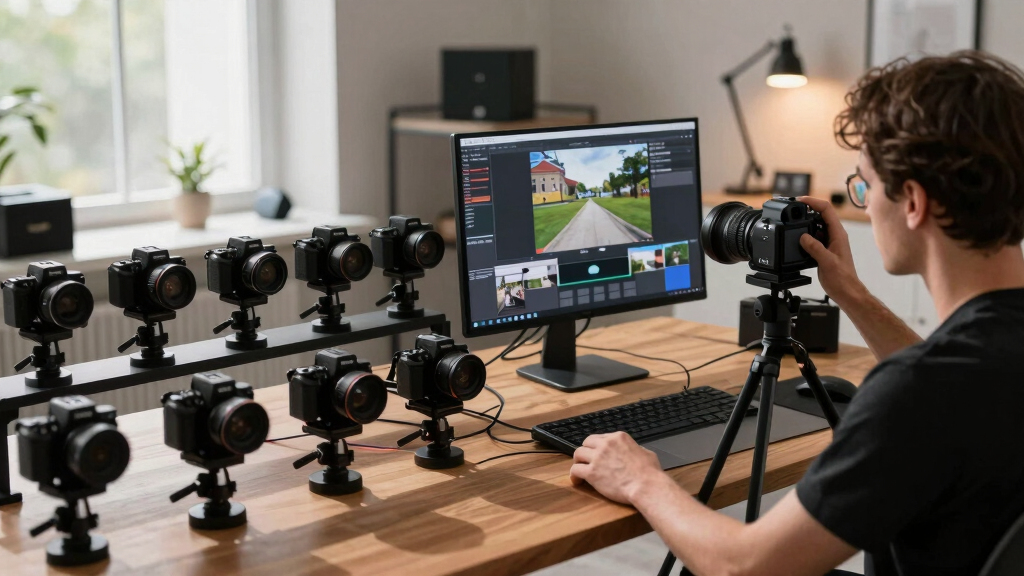
A hobbyist has built a DIY optical motion capture rig with 16 infrared cameras, capable of processing 4 billion pixels per second. This setup aims to achieve Hollywood-level precision for V-tubing and other applications.
A maker has developed a high-performance optical motion capture system that processes 4 billion pixels per second using 16 DIY infrared cameras, marking a significant technical achievement in V-tubing technology.
The project involves 16 custom-built cameras, each equipped with AR0234 MIPI sensors, M12 lenses, and near-infrared filters. These cameras are connected to Raspberry Pi compute modules, with synchronization managed via a pulse-per-second trigger. Each camera is paired with a powerful near-IR LED ring light pulsing at 160 W, enabling high-speed, high-precision tracking of markers for optical motion capture (MoCap).
The system’s processing is optimized with custom software, reportedly 300 times faster than standard OpenCV-based solutions, and is available on GitHub for public access. The entire setup aims to provide Hollywood-level accuracy for tracking, with the project motivated by a desire to explore the limits of DIY optical MoCap technology.
Implications for High-Precision V-Tubing and Motion Capture
This development demonstrates that high-speed, high-precision optical motion capture can be achieved with affordable, DIY components. It could lower the barrier for independent creators and smaller studios seeking professional-level tracking, potentially transforming the V-tubing and animation industries. The project also highlights advancements in custom hardware and software integration, emphasizing the feasibility of sophisticated MoCap systems outside traditional studio environments.
As an affiliate, we earn on qualifying purchases.
Background on DIY Optical MoCap and Its Evolution
Optical motion capture has traditionally been confined to Hollywood and large studios due to its high cost and complexity. Recent years have seen a rise in alternative methods, such as inertial measurement units (IMUs), which trade off some accuracy for affordability. This project builds on prior DIY efforts but pushes the envelope by processing an unprecedented volume of pixel data — 4 billion pixels per second — using custom hardware and software.
The use of IR cameras and synchronization techniques has been standard in professional setups, but this project’s scale and speed are notable. The creator’s approach aims to match or exceed commercial solutions in precision, demonstrating that such systems can be assembled outside of industrial labs with a focus on affordability and customization.
“This DIY optical MoCap system shows promising potential for high-precision tracking at a fraction of the cost of commercial solutions.”
— an anonymous researcher
Raspberry Pi motion capture system
As an affiliate, we earn on qualifying purchases.
As an affiliate, we earn on qualifying purchases.
Unconfirmed Aspects and Technical Challenges Remaining
It is not yet clear how well this system performs in real-world, dynamic scenarios or how scalable it is for different use cases. The actual accuracy, latency, and robustness of the setup under various conditions remain to be tested and validated outside the creator’s initial demonstrations.
As an affiliate, we earn on qualifying purchases.
Future Developments and Potential Applications
The creator plans to publish detailed documentation and open-source the software, enabling others to replicate or improve upon the system. Further testing in live motion capture scenarios is expected to evaluate its practical performance, with potential integration into smaller V-tubing setups or independent animation projects.
As an affiliate, we earn on qualifying purchases.
Key Questions
Can this DIY system match professional Hollywood MoCap accuracy?
While promising, it remains unconfirmed whether the system can consistently achieve Hollywood-level precision in all scenarios. Further testing is needed.
What hardware is used in this DIY MoCap rig?
The system uses 16 custom-built cameras with AR0234 sensors, M12 lenses, IR filters, Raspberry Pi compute modules, and near-IR LED rings.
How accessible is this project for individual creators?
The project is designed to be affordable and open-source, but requires technical expertise in hardware assembly and software configuration.
What are the safety considerations for IR LED use?
High-power IR LEDs are used, so proper eye protection and safety precautions are advised during operation.
Will this technology be available for commercial or hobbyist use soon?
The creator plans to publish detailed guides and software, but widespread commercial availability depends on further development and validation.
Source: Hackaday
Fall Picks
fall essentials
As an affiliate, we earn on qualifying purchases.