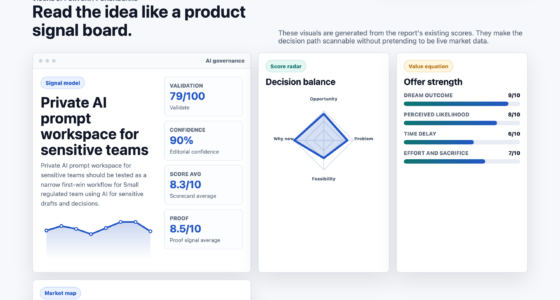

📊 Full opportunity report: How China Achieved Rapid AI Model Deployment With Signal’s Four New Releases on ThorstenMeyerAI.com — validation score, market gap, and execution plan.

Get business pricing on tech for your team
- Business-only prices and quantity discounts
- Tax-exempt purchasing
- Multiple users, one account, clear invoices
TL;DR
In just eight weeks, Chinese AI labs launched four frontier-class open-weight models, significantly accelerating global AI deployment. This shift impacts both technological competitiveness and geopolitical dynamics.
Chinese AI labs completed the release of four frontier-class open-weight models in roughly eight weeks, from late April to mid-June 2026, marking a rapid deployment cadence that impacts global AI competitiveness. These models, including DeepSeek V4, MiniMax M3, Kimi K2.7-Code, and GLM-5.2, are all downloadable, often under permissive licenses, and priced significantly below Western alternatives, signaling a strategic shift in AI development and deployment.
Between late April and mid-June 2026, Chinese research labs launched four major open-weight models: DeepSeek V4 on April 24, MiniMax M3 on June 1, and Kimi K2.7-Code along with GLM-5.2 in mid-June. All models are accessible for download, most under MIT-like licenses, and are priced to undercut Western APIs when hosted locally.
Benchmarks from BenchLM’s July rankings position DeepSeek V4 Pro as the leading Chinese open-weight model, with an overall score of 87, just six points behind the top proprietary models. Other Chinese models like GLM-5.1, Kimi K2.6, and Qwen variants also rank highly, indicating a rapidly expanding and competitive open Chinese AI ecosystem.
This aggressive release cadence reflects a broader strategic push by Chinese labs, including DeepSeek, Z.ai, Moonshot, and Alibaba, each with distinct technological focuses—cost efficiency, long-horizon stability, or broad accessibility—challenging Western dominance in open AI models, which has waned in recent years.
Four Frontier-Class Open Models in Eight Weeks
China’s Release Cadence Is the Story
Same-day-verified market pulse · July 13, 2026
The production line — spring 2026
The board this week — BenchLM overall score, July 2026
Gift & complication — the European read
The gift
Frontier-adjacent capability, permissive licenses, weeks-long refresh cycle. This cadence is what makes serious on-premises AI economically thinkable in 2026.
The complication
Still a dependency — geopolitical, not technical. Hosted Chinese APIs fall under Chinese data law; many Western agencies won’t touch the weights at all. Licensing generosity is a policy, not a law of nature.
The signal: if your infrastructure strategy assumes open models improve slowly, it’s already wrong. If it assumes the current licensing generosity is permanent, it’s unhedged.
Implications for Global AI Leadership and Sovereignty
The rapid deployment of these models signifies a major shift in the global AI landscape, where Chinese labs are now leading in open-weight model capability and release frequency. This accelerates the availability of high-performance, cost-effective models for local and sovereign AI deployments, especially in regions like Europe and Asia. However, it also raises questions about dependency, data sovereignty, and geopolitical restrictions, as many Western enterprises and governments remain hesitant to adopt Chinese-origin models due to legal and security concerns.
For European and other non-Chinese entities, this development offers a strategic opportunity to reduce costs and increase on-premises AI capabilities, but it also underscores ongoing dependencies on Chinese technology and the potential for export restrictions or licensing changes that could alter the landscape.
As an affiliate, we earn on qualifying purchases.
China’s Accelerating AI Model Release Cadence
Over the past two years, Chinese labs have transitioned from a single dominant open-weight model to a diversified ecosystem of four major families—DeepSeek, Z.ai, Moonshot, and Alibaba—each with unique technological focuses. The recent releases of four frontier-class models in just eight weeks mark a significant escalation in their development and deployment cadence, driven partly by hardware scarcity and export control strategies.
This rapid release pattern contrasts sharply with the slower, more cautious approach seen in Western labs, where flagship open efforts like Meta’s stalled and open-source models trail Chinese capabilities in raw performance. The Chinese strategy appears to be a deliberate effort to establish a dominant, default AI substrate globally, with permissive licensing and high scalability.
While these models are accessible and affordable, their adoption in regulated environments remains limited by legal restrictions and data sovereignty concerns, especially in Western countries, which continue to ban or restrict Chinese-origin AI applications on government devices and in sensitive sectors.
“The Chinese AI release cadence over the past eight weeks has effectively created a production line of frontier models, challenging Western dominance and reshaping the global AI ecosystem.”
— Thorsten Meyer
As an affiliate, we earn on qualifying purchases.
Uncertainties Around Long-Term Adoption and Restrictions
It remains unclear how Western governments and enterprises will respond to this rapid Chinese release cycle. Many remain hesitant to adopt Chinese-origin models due to legal, security, and geopolitical concerns, especially regarding data sovereignty and export controls. The durability of this cadence and whether it will be sustained amid potential export restrictions or licensing changes is also uncertain.
Additionally, the impact of these models on the global AI power balance and the possibility of future restrictions or bans on Chinese models in key markets are still developing issues.
As an affiliate, we earn on qualifying purchases.
Next Steps in Monitoring Chinese AI Release Strategies
Further releases and benchmark updates are expected over the coming months, with Chinese labs likely to continue their rapid cadence. Stakeholders should monitor licensing policies, export controls, and geopolitical developments that could influence model accessibility and adoption. Additionally, Western and other non-Chinese entities may accelerate their own open AI efforts to stay competitive, potentially leading to a new phase of AI model development and deployment.
Researchers and policymakers will need to evaluate the evolving landscape for implications on sovereignty, security, and technological leadership.
As an affiliate, we earn on qualifying purchases.
Key Questions
Why are Chinese labs releasing models so quickly?
Chinese labs are releasing models rapidly due to strategic hardware efficiencies, export control responses, and a desire to establish dominance in the global AI ecosystem by creating a production line of frontier models.
Can Western companies or governments safely use these Chinese models?
Many Western enterprises and governments face legal and security restrictions on Chinese-origin models, especially regarding data sovereignty and export controls, limiting their adoption in sensitive environments.
How does this affect the global AI power balance?
The rapid Chinese model releases are shifting the balance toward China as a leader in open-weight AI capabilities, challenging Western dominance and potentially reshaping international AI development strategies.
Will this cadence continue beyond 2026?
It is uncertain. Future releases depend on geopolitical developments, licensing policies, hardware availability, and strategic choices by Chinese labs and international regulators.
Source: ThorstenMeyerAI.com
Fall Picks
fall essentials
As an affiliate, we earn on qualifying purchases.