
TL;DR
Mistral is betting on sovereignty, open weights, and enterprise control to stand out in AI. While this appeals for regulated markets, skepticism exists about its technical edge. The real question: can sovereignty be a lasting competitive advantage?
Imagine a world where controlling your AI isn’t just a feature—it’s the whole game. That’s what Mistral is betting on. They’re not just trying to build the biggest or smartest models—they want to own the entire stack, from hardware to software, for clients who need full control.
At their recent summit in Paris, the message was loud and clear: sovereignty, openness, and customization are the new battleground. But beneath that confident stance lies a thorny question: are they truly competing at the frontier, or are they already playing a different game—one where control trumps size?
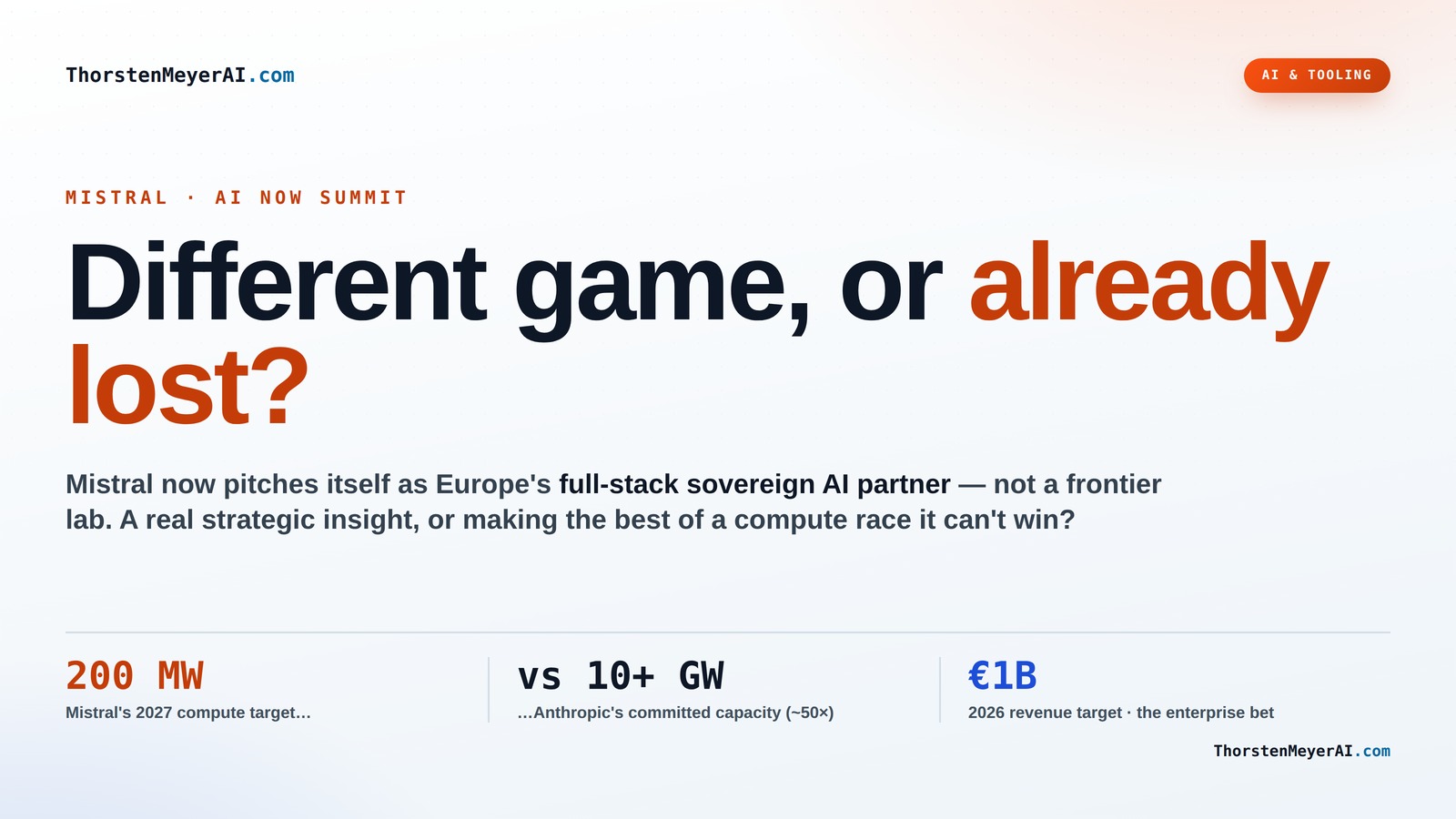
Different game, or already lost?
Mistral now pitches itself as Europe’s full-stack AI provider — compute, models, platform, consultancy — not a frontier-model lab. Is that a real strategic insight, or making the best of a race it can’t win? Both readings fit the same facts.
From model lab to full-stack provider
The clearest signal from the summit wasn’t a model — it was a posture. Heavy on enterprise logos and partnerships (ASML, BNP Paribas, Alexa+), light on new-model announcements. That absence is exactly what skeptics seized on.
Compute
40MW Paris DC + Sweden build · 200MW target by 2027
Models
Open & custom · efficient · you own and run them
Platform
Forge for custom models · Vibe for Work agent
Consultancy
Sales teams, integrators, EU provenance & support
Small & focused, or large & general?
Mistral bets on specialized small models. The claim isn’t that they win a reasoning leaderboard — they don’t. It’s that on the metrics that matter in production agent systems, a purpose-built small model wins. Flip the metric to see the case reverse.
Small specialized vs large general — by what you measure
In token-heavy agentic apps making hundreds of calls, speed/energy/cost compound. Toggle the metric.
Narrow models doing real work
Each is one model doing one thing efficiently — the tangible version of the strategy. Strong on their own terms; the open question is whether the bundle beats a free Chinese open-weight download.
On-prem KYC compliance
Mistral models run inside the bank’s walls for know-your-customer checks. Sensitive financial data never leaves. (BNP was Mistral’s first customer, 2023.)
Voxtral multilingual voice
A focused voice model powering Alexa+ across Europe — speed and efficiency over raw size.
Robostral industrial robotics
Plus a “physics AI” push (via the Emmi acquisition) into aerospace, automotive & semiconductor design and simulation.
Document AI / OCR at scale
Large-scale text extraction — the unglamorous, high-volume enterprise work small models excel at.
The strategy is downstream of the compute gap
Once you see the raw numbers, “why is Mistral behind?” answers itself — and the specialized-small-model strategy starts looking partly like a smart adaptation to a binding constraint, not a pure philosophical choice.
Compute & capital · Mistral vs a frontier leader, this same week
Not a knock — it’s the constraint that forces the efficiency-first, sovereignty-wedge strategy. Adapting intelligently to your position is what good strategy is.
“I want them to win, but I’m worried”
That ambivalence is the most accurate read of where Mistral sits. The enterprise pivot gets read two opposite ways — and both deserve airing.
On-prem, real sales teams, the Koyeb deployment acquisition, EU provenance — exactly what regulated enterprises want, and stickier than consumer mindshare. Targeting €1B revenue in 2026 with 1,000 staff, up from 15 people and one customer in 2023. US closed-API labs structurally can’t match the sovereignty axis.
“Software consultancy with a data center,” not a foundation-model moat. Enterprise B2B is where European startups go when they can’t win consumer or world-scale SaaS. Why pay Mistral on-prem when you could run Qwen free? One paying Le Chat Pro user said the quality gap with frontier labs is now hard to ignore.
Key Takeaways
- Mistral’s sovereignty and open weights attract regulated and European clients prioritizing control over size.
- Their focus on small, efficient models aims for operational superiority, not leaderboard wins.
- Technical parity remains a concern; skepticism exists about their medium-sized reasoning capabilities.
- European political and regulatory trends bolster Mistral’s strategic positioning.
- Long-term success depends on whether sovereignty can be a durable moat in the AI landscape.
As an affiliate, we earn on qualifying purchases.
How Mistral’s Full Stack Approach Changes the AI Game
Mistral isn’t just making models anymore. They’re positioning as a full-stack provider—think data centers, custom models, and enterprise support. This move shifts the focus from just performance to control and sovereignty. For example, owning a 40MW data center near Paris and planning a €1.2 billion build in Sweden means they’re serious about European compute independence.
This approach appeals to regulated sectors like banking and defense—where data residency and control matter more than having the absolute fastest model. It’s a bold play to compete on a different layer, one where owning infrastructure and software stack is the true prize.
By owning the entire infrastructure, Mistral can offer a more secure, compliant environment tailored to specific regulatory needs. However, this strategy also involves tradeoffs: it requires significant capital investment and may limit agility compared to cloud-based models. This focus on control can slow down innovation cycles but provides a crucial advantage in markets where trust and compliance outweigh raw performance.

full-stack AI development platform
As an affiliate, we earn on qualifying purchases.
As an affiliate, we earn on qualifying purchases.
What Does Sovereignty Really Mean for Mistral?
Sovereignty is not just a buzzword. For Mistral, it means enabling customers—especially in Europe—to run models on-prem, keep data inside their own walls, and avoid reliance on US-based cloud giants. For instance, BNP Paribas runs Mistral models locally for compliance, keeping sensitive financial data in Belgium.
This control-focused approach makes sense for sectors with strict regulation or political concerns. Yet, skeptics wonder—if you can run open weights for free, why pay Mistral? The answer lies in their support, customization, and European provenance, which many clients value highly.
More profoundly, sovereignty affects the entire data ecosystem. It implies a shift from centralized, cloud-based AI to distributed, localized systems. This transition can enhance security and compliance but also raises questions about scalability, maintenance, and the ability to keep pace with rapid AI advancements. Clients must weigh the security and control benefits against potential limitations in model updates and innovation speed.

As an affiliate, we earn on qualifying purchases.
Can Small, Specialized Models Win in Production?
Mistral champions small, purpose-built models over giant general-purpose ones. They argue that in real-world applications—like OCR, voice, or industrial robotics—speed, energy efficiency, and cost matter more than raw reasoning power. For example, their Voxtral model powers Alexa+ in Europe, handling multilingual voice efficiently.
This sparks a debate: should a lab build massive models or focus on small, optimized ones? Both sides have points—big models excel at reasoning, but small models dominate in cost, speed, and local deployment. Mistral’s focus on niche models aims to win in operational metrics, not leaderboard rankings.
Choosing smaller models involves a strategic tradeoff: while they may lack the broad reasoning capabilities of larger models, they enable faster inference, lower latency, and easier deployment within regulated or resource-constrained environments. This focus aligns with their overall strategy of control and specialization, providing a competitive edge in specific use cases where performance at scale is less critical than reliability and compliance.

AI infrastructure for regulated markets
As an affiliate, we earn on qualifying purchases.
As an affiliate, we earn on qualifying purchases.
Are Mistral’s Claims About Technical Parity Still Valid?
Here’s the core tension: critics say Mistral has fallen behind in reasoning performance—especially at medium context sizes. Community chatter suggests their models aren’t keeping pace with the latest from Gemma, Qwen, or even Chinese open weights.
However, this debate misses the bigger picture. Mistral’s emphasis on sovereignty and control shifts the success metric away from raw reasoning scores to deployment flexibility, security, and compliance. For their target markets, these qualities can outweigh incremental gains in reasoning performance. The implication is that in certain regulated sectors, the ability to deploy models securely within local infrastructure may be more valuable than the latest benchmark scores. Yet, if the gap in reasoning performance widens further, it could threaten their credibility as AI models evolve and competitors close the gap, forcing Mistral to balance their strategic priorities between technical parity and control advantages.

Europe’s Push for AI Independence and What That Means
Europe is increasingly emphasizing digital sovereignty—aiming for AI independence from US and Chinese giants. Mistral fits perfectly here, offering open weights and on-prem solutions that align with these policies. Their models are designed to be self-hosted, inspected, and controlled.
For example, public sector clients and banks see this as a way to reduce geopolitical risk and meet compliance. This political backing can be a real advantage, even if Mistral’s models aren’t the biggest or fastest.
This trend signifies a broader shift: Europe aims to develop a resilient, localized AI ecosystem that can operate independently of global tech giants. For Mistral, this means a strategic opportunity to position as a trusted, domestically-controlled provider. However, it also requires balancing political expectations with technological innovation—if they fall behind in performance, their political advantage could erode, making their long-term viability dependent on maintaining a delicate balance between regulation, innovation, and market trust.

The Real Market for Sovereign AI: Who Needs It?
Not every company cares about sovereignty. Many still chase the biggest, fastest models—think OpenAI or Google. But for regulated industries, governments, and politically sensitive organizations, sovereignty isn’t optional. They want control, compliance, and transparency in AI.rency.
Take a bank that must keep customer data on-site or a defense contractor with strict data laws. For them, Mistral’s open weights and on-prem options are more than features—they’re essentials. The importance of sovereignty here isn’t just about data privacy; it’s about strategic independence, operational resilience, and avoiding geopolitical vulnerabilities. These organizations are willing to trade off some performance for the peace of mind that comes with local control, even if it means working with less cutting-edge models. This creates a niche market where Mistral’s offerings are uniquely suited to meet complex regulatory and strategic needs.

Is Mistral’s Strategy a Long-Term Winner or Just a Niche Play?
The question is whether sovereignty can sustain a business. Critics say Mistral’s smaller models and focus on control may limit their ability to keep up technically. But supporters argue that in Europe and similar markets, control and compliance will always matter more than raw size.
This is a strategic gamble: can they build a durable moat around sovereignty, or will they fall behind as frontier models become faster and more capable? The answer hinges on whether their niche expands or shrinks. If the global AI landscape continues to prioritize open, controllable, and compliant solutions, Mistral’s approach could become a long-term advantage. Conversely, if the industry shifts toward raw performance at scale, their niche might diminish, forcing a reevaluation of their strategy.

What’s Next for Mistral? Opportunities and Challenges
Mistral’s next steps are critical. They could double down on European partnerships, develop even smaller models optimized for local deployment, or push harder on enterprise support. But they also face challenges—rising competition, technical parity issues, and whether their sovereignty story resonates enough to grow.
Imagine a future where Mistral’s models power critical European institutions—control, transparency, and sovereignty as the new standards. Will they get there, or will bigger giants push through? Success will depend on their ability to innovate within their niche, expand their ecosystem, and convince clients that sovereignty isn’t just a political ideal but a practical necessity that outweighs raw performance gains.
Frequently Asked Questions
What exactly does 'sovereign AI' mean?
Sovereign AI refers to models and systems that organizations can run on their own infrastructure, keeping control over data, deployment, and updates—especially important for regulated sectors or politically sensitive regions.Why is Mistral associated with European AI independence?
Mistral emphasizes control, open weights, and on-prem deployment, aligning with Europe’s push for digital sovereignty and reducing reliance on US cloud giants, making them a natural fit for European institutions.Are Mistral’s models technically competitive?
Community feedback suggests Mistral’s models lag behind in reasoning at medium context sizes, raising questions about their performance ceiling—though they excel in control and deployment flexibility.Who truly needs sovereign AI rather than cloud-based models?
Regulated industries like banking, defense, and government agencies—where data security, compliance, and independence are non-negotiable—are the main customers for sovereign AI solutions.Can Mistral’s focus on sovereignty sustain it long-term?
It depends. If control and compliance remain paramount, they could carve out a stable niche. However, if technical parity becomes a must-have, they’ll need to innovate faster or risk being left behind.Conclusion
Mistral isn’t just competing on models anymore—they’re crafting a space where control, sovereignty, and customization reign. For certain industries and regions, that’s a winning strategy. But if technical parity becomes the only measure, they might be playing a game they can’t win in the long run.
Whether sovereignty is a fortress or a fragile bubble, one thing’s clear: in AI, control isn’t just a feature—it’s the new frontier. Your move is to decide if you want to bet on the game changing or staying the same.