Berlin’s AI Agenda positions the city as Europe’s leader in digital transformation by focusing on innovation, ethics, and talent development. The city invests heavily in startups, fosters public-private partnerships, and attracts global researchers and entrepreneurs. Major events and collaborations further advance responsible AI deployment. If you keep exploring, you’ll discover how Berlin aims to shape Europe’s future with its ambitious, human-centric AI strategies and cutting-edge initiatives.
Key Takeaways
- Berlin’s strategic focus on AI leadership aims to position Europe as a global innovation hub, driving its most ambitious digital transformation.
- Strong public-private partnerships and research institutions accelerate AI development, infrastructure, and practical deployment across sectors.
- City policies emphasize transparency, ethics, and social impact, fostering responsible AI adoption aligned with Europe’s digital goals.
- Hosting major AI events and fostering cross-border collaboration enhances Berlin’s role in shaping Europe’s digital future.
- Investment in talent, skills development, and innovation infrastructure ensures Berlin remains at the forefront of Europe’s digital transformation efforts.
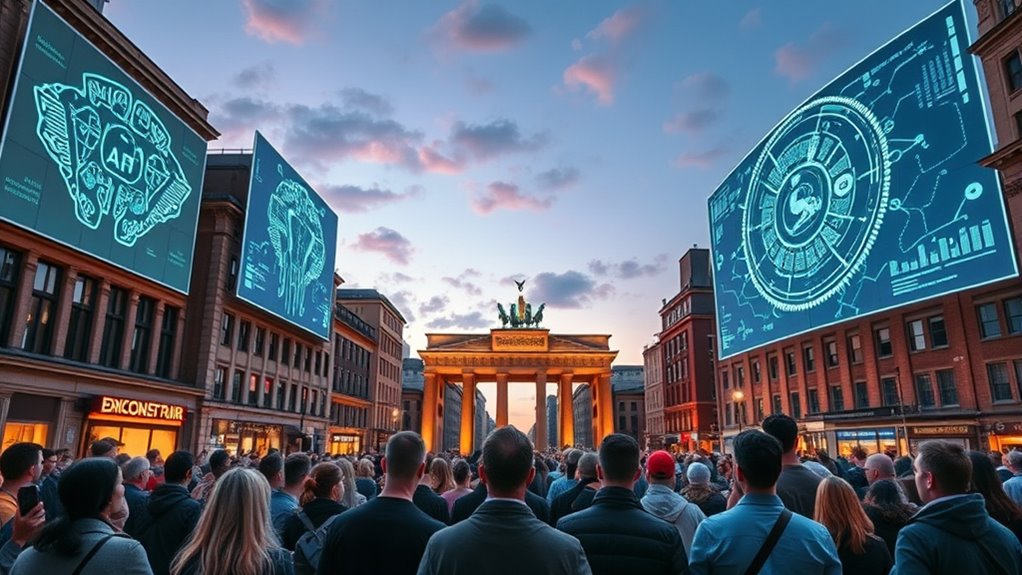
Berlin is rapidly establishing itself as a leading hub for artificial intelligence in Europe, driven by a strategic focus on transparency, human-centric principles, and innovation. As you explore Berlin’s AI landscape, you’ll notice that the city’s policies prioritize building trust in AI through clear standards on data privacy, ethics, and social impacts. Germany’s High-Tech Agenda 2025 underpins this approach, making AI a national priority and channeling significant investments into research and deployment. By 2030, Germany’s AI market is expected to surpass €40 billion, reflecting bold ambitions for growth and global competitiveness.
Berlin leads Europe’s AI revolution with a focus on transparency, ethics, and innovation, backed by Germany’s ambitious High-Tech Agenda 2025.
In Berlin, this investment fuels a vibrant startup scene and attracts major multinational tech firms, all keen to tap into the city’s talent and funding opportunities. The government’s support, combined with strong public-private partnerships, helps scale innovative AI solutions from labs to real-world applications. The city’s ecosystem is reinforced by a high concentration of research institutions like Technische Universität Berlin and the Fraunhofer Institute, which drive cutting-edge advancements in machine learning and AI technologies. Furthermore, the emphasis on fostering specialized skills ensures the workforce remains adaptable to rapidly evolving AI trends.
Your access to talent is also a key strength. Berlin draws an international pool of researchers, entrepreneurs, and students, thanks to flexible visa policies and collaborative programs between academia and industry. Continuous upskilling initiatives ensure that the workforce keeps pace with evolving AI demands, fostering a culture of knowledge-sharing and open-source collaboration that accelerates progress.
Berlin’s role as a hub for industry collaboration is evident in its hosting of major AI events like the Rise of AI Conference and Generative AI Summit. These gatherings bring together industry leaders, policymakers, and researchers to discuss infrastructure, deployment challenges, and responsible AI practices. Such events create essential networking opportunities, helping startups, investors, and corporations forge partnerships and share insights. As you follow Berlin’s AI trajectory, you’ll see a city committed to responsible innovation, practical applications, and cross-border cooperation—paving the way for Europe’s most ambitious digital transformation.
Top picks for "berlin agenda signal"
Open Amazon search results for this keyword.
As an affiliate, we earn on qualifying purchases.
Frequently Asked Questions
How Will Berlin’s AI Agenda Impact Local Employment?
Berlin’s AI agenda will notably impact your local employment by creating new job opportunities in AI-related fields, like trainers and ethics officers. You’ll see traditional industries, such as manufacturing and healthcare, transforming and demanding new skills. While some jobs may be displaced, your best move is to upskill and embrace AI literacy. By adapting quickly, you’ll stay relevant and benefit from emerging roles in this evolving digital landscape.
What Ethical Guidelines Are Included in Berlin’s AI Strategy?
Think of Berlin’s AI strategy as a guiding compass steering through ethical waters. You’re expected to uphold human dignity, prevent discrimination, and guarantee AI decisions are transparent and explainable. Privacy is your anchor, safeguarding personal data at every step. You’ll also balance risks and benefits carefully, making sure innovation doesn’t come at society’s expense. These principles create a trustworthy foundation, helping AI serve humanity’s best interests with integrity and fairness.
How Will Berlin Fund Its AI Initiatives Long-Term?
You’ll see Berlin’s long-term AI funding mainly through substantial federal commitments, totaling around €5 billion through 2025, with dedicated programs like “AI Made in Germany” and sector-specific initiatives. The city benefits from growing venture capital, with over €2 billion invested in 2025 alone, plus strong support for research institutions and public-private partnerships. These combined efforts make certain of sustained investment, enabling Berlin to stay at the forefront of AI innovation and application.
What Partnerships Are Central to Berlin’s AI Development?
You should know that Berlin’s key partnerships drive its AI development. You’ll find collaboration between top research institutions like DFKI and local universities, industry giants such as Deutsche Telekom and NVIDIA, and government agencies focused on innovation. International coalitions like the Coalition for Sustainable AI also play a crucial role. These partnerships enable rapid research, funding, and global visibility, making Berlin a leading hub for ethical, cutting-edge AI advancements.
How Does Berlin’s AI Plan Compare to Other European Cities?
Think of Berlin as a vibrant mosaic, each piece representing sectors like healthcare, government, and industry working together seamlessly. Compared to other European cities, your city’s AI plan is more integrated, with ongoing summits, cross-sector collaborations, and a strong focus on ethics and public sector transformation. This dynamic approach fosters continuous innovation and community engagement, making Berlin’s AI development more all-encompassing and ambitious than many of its European counterparts.
Conclusion
As you follow Berlin’s AI agenda, it’s clear that the city is truly betting the farm on digital transformation. With bold initiatives and forward-thinking policies, Berlin aims to set the pace for Europe’s tech future. While challenges are inevitable, this move shows that the city isn’t afraid to put all its eggs in one basket. Keep a keen eye on Berlin—it’s really going all in on shaping a smarter, more innovative tomorrow.