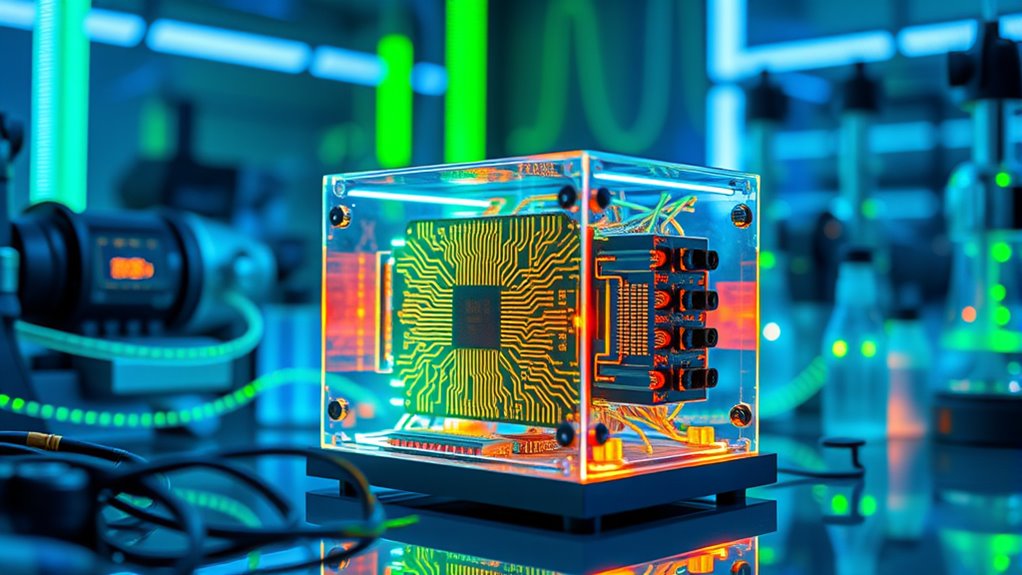

Scientists have created a groundbreaking light-based processor that makes AI processing much faster and greener. By harnessing light in integrated photonic chips, they achieve computations in less than half a nanosecond while using up to 100 times less power than electronic chips. This technology enables ultra-fast, energy-efficient AI tasks like real-time learning and complex data analysis. Keep exploring how these innovations could transform AI for a more sustainable and high-speed future.

Get business pricing on tech for your team
- Business-only prices and quantity discounts
- Tax-exempt purchasing
- Multiple users, one account, clear invoices
Key Takeaways
- Light-based processors perform neural computations in less than 0.5 nanoseconds, vastly increasing AI processing speed.
- These optical chips consume up to 100 times less power than traditional electronic hardware, reducing energy use.
- Incorporating LEDs and wavelength encoding enhances efficiency and enables parallel data processing for AI tasks.
- Optical components like programmable beamsplitters and photodiodes improve accuracy while maintaining high performance.
- The technology significantly lowers cooling costs and carbon footprint, supporting more sustainable AI development.

Light-based processors are revolutionizing AI by harnessing the power of photonics to perform computations at unprecedented speeds and energy efficiencies. Instead of relying on electrical signals, these chips use light to encode parameters of deep neural networks, enabling faster data processing with less heat generation. An array of programmable beamsplitters performs matrix multiplication directly in the optical domain, considerably reducing the need for electrical conversions that slow down traditional hardware. Nonlinear activation functions are achieved by siphoning light to photodiodes, which eliminates the need for external amplifiers, keeping energy consumption exceptionally low. Fully integrated photonic chips can perform all neural network computations in less than 0.5 nanoseconds, demonstrating their remarkable speed. The speed of these photonic processors is remarkable—they can perform complete AI computations in under 0.5 nanoseconds. This ultra-low latency makes real-time AI learning and inference feasible for applications like autonomous vehicles or instant data analysis. Accuracy rates surpass 96% during training and stay above 92% for inference, comparable to what traditional electronic hardware offers. This shows photonic processors aren’t just fast; they’re also precise enough for demanding AI tasks. Energy efficiency is one of their biggest advantages. These light-based chips consume a fraction of the power used by electronic counterparts—some designs improve AI task power efficiency by 100 times. Using LEDs instead of lasers further reduces power needs, helping cut down heat dissipation and cooling costs in data centers. This green approach supports sustainable AI development by lowering the carbon footprint associated with training large models. Microsoft’s analog optical computer estimates about a 100-fold improvement in energy efficiency over conventional digital hardware. Parallelism and speed are also key benefits. Photonic chips process multiple data streams simultaneously by encoding information across different wavelengths of light, or colors. A single chip can handle dozens of these parallel streams, vastly exceeding electronic chip capabilities. This enables lightning-fast matrix-vector multiplication, essential for many AI workloads, and functions like scanning an entire airport crowd at once rather than one passenger at a time. The result is real-time AI learning and inference, even with complex data. Innovations like frequency comb lasers generate multiple optical frequencies, increasing data transmission and processing capacity. These advancements are paving the way for faster, greener, and more efficient AI hardware that could transform data centers and large-scale AI training, contributing to a sustainable technological future.
photonic neural network processor
As an affiliate, we earn on qualifying purchases.
As an affiliate, we earn on qualifying purchases.
Frequently Asked Questions
How Does the Light-Based Processor Compare in Cost to Traditional Chips?
You’ll find that light-based processors currently cost more per unit than traditional chips due to their novel technology and limited production scale. While they offer up to 50 times better speed and significant energy savings, the high manufacturing and material costs keep prices higher initially. However, as production ramps up and technology matures, expect costs to decrease, making photonic chips more competitive with established silicon-based options in the future.
What Are the Potential Challenges in Commercializing This Technology?
You may face some hurdles in bringing this technology to market. Material complexities, like integrating exotic substances onto silicon, pose manufacturing challenges. Ensuring consistent quality at scale remains tricky, and aligning optical with electronic components adds layers of complexity. Additionally, establishing a robust ecosystem, managing higher costs, and overcoming regulatory concerns require strategic efforts. While promising, these factors emphasize the need for careful development to realize widespread adoption and commercial success.
Can This Light-Based Processor Be Integrated With Existing AI Systems Easily?
Yes, this light-based processor can be integrated with existing AI systems easily. You’ll find it compatible through hybrid designs that combine photonic and electronic components, making use of standard frameworks like PyTorch and TensorFlow. With advanced packaging and interface technologies, you can seamlessly incorporate photonic accelerators into your current infrastructure, enhancing performance and energy efficiency without overhauling your entire setup. This smooth integration helps you adopt cutting-edge AI hardware quickly and effectively.
What Is the Energy Consumption Difference Between This and Conventional Processors?
You’ll be amazed—these light-based chips use up to 99.9% less energy than traditional processors. Imagine slashing power consumption by a factor of 10 to 100 times, with some models like Tsinghua’s Taichi reducing it by up to 1,000 times! This means your AI tasks run with a fraction of the electricity, drastically cutting costs and environmental impact while boosting performance. It’s like turning a power-hungry beast into a tiny, efficient marvel.
How Scalable Is This Technology for Large-Scale AI Applications?
You can scale this photonic technology for large-scale AI applications quite well. It’s demonstrated on commercial foundry processes, allowing mass production. With integration of over 16,000 components and wavelength division multiplexing, you get higher density without increasing size or power. Plus, hybrid designs support existing infrastructure, making deployment easier. While challenges remain in manufacturing consistency and data movement, ongoing innovations are paving the way for extensive, efficient AI system scaling.
As an affiliate, we earn on qualifying purchases.
Conclusion
This breakthrough means you could see AI that’s not only faster but also more energy-efficient. Imagine reducing power consumption by up to 70% while boosting processing speeds—it’s a game-changer for sustainability and performance. As light-based processors become more common, expect smarter, greener technology to transform your daily life. This innovation paves the way for a future where AI advances don’t come at the planet’s expense, making your digital world both smarter and more sustainable.
integrated photonic chips for AI
As an affiliate, we earn on qualifying purchases.
As an affiliate, we earn on qualifying purchases.
As an affiliate, we earn on qualifying purchases.
Fall Picks
fall essentials
As an affiliate, we earn on qualifying purchases.