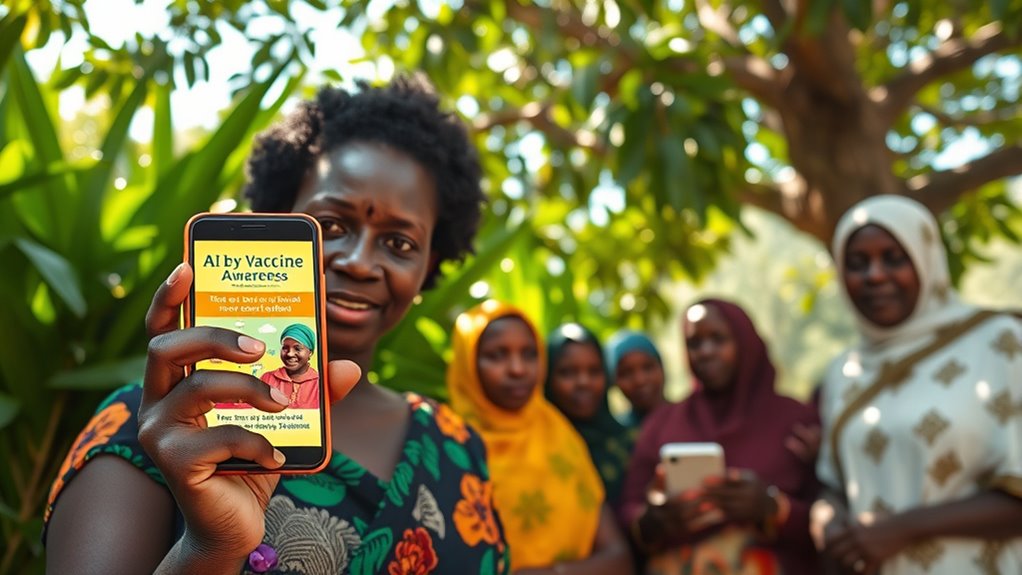

AI is transforming vaccine awareness for mothers in Kenya and Nigeria by delivering culturally relevant messages through mobile apps and chatbots, making health information more accessible and personalized. It helps identify communities with low immunization rates, allowing targeted support where it’s needed most. AI tools also improve engagement with antenatal care and create tailored communications that respect local customs. Keep exploring how these innovations are creating meaningful change in maternal and child health outcomes.
Key Takeaways
- AI-driven mobile apps send personalized vaccine reminders and educational messages to mothers via SMS and calls.
- Data analysis tools identify high-risk communities, enabling targeted vaccination campaigns and support.
- Culturally sensitive AI-generated messaging ensures vaccine information resonates and addresses local beliefs.
- AI tools improve maternal health engagement, indirectly boosting immunization rates among children.
- Ethical AI frameworks promote equitable access to vaccine information, reducing disparities in Kenya and Nigeria.

Artificial intelligence is transforming how mothers in Kenya and Nigeria access vaccine information and services. In Nigeria, AI-driven mobile apps like HelpMum are making a significant impact by sending calls and text messages to notify mothers about their children’s vaccination schedules. This approach helps bridge gaps caused by limited healthcare infrastructure and literacy, as primary healthcare workers now use smart tablets to register mothers in rural areas, overcoming digital barriers. Despite these efforts, disparities remain; children from wealthier families are much more likely to be fully immunized—children from the richest 20% are 16 times more likely to be vaccinated than those from the poorest 20%. Transport costs to health centers hinder access for poorer families, emphasizing that notifications alone can’t solve all barriers. Currently, HelpMum’s focus is on Oyo State, but its features are available across Nigeria, broadening its reach. Nigeria’s vaccination rates are below targets, which underscores the urgent need for innovative solutions like AI to improve immunization coverage.
AI frameworks like ADVISER are further enhancing vaccination outcomes by analyzing data from over 13,000 Nigerian families. They identify communities needing extra support, enabling targeted interventions in regions with high infant mortality. These systems work alongside local governments and health workers to guarantee ethical and equitable access, supported by funding from organizations such as the Patrick J. McGovern Foundation. The data-driven nature of AI health interventions is crucial for addressing disparities and ensuring resources are directed where they are most needed, fostering more equitable health outcomes. The goal is to inspire more AI-health collaborations across Nigeria and Africa, improving immunization rates systematically.
AI systems like ADVISER analyze data from Nigerian families to identify support needs and improve immunization efforts ethically and equitably.
In Kenya, AI tools like Obstetric Point-of-Care Ultrasound (OPOCUS) and the PROMPTS SMS system are improving maternal health during pregnancy, which indirectly supports immunization efforts. Kenya’s high maternal and neonatal mortality rates highlight the urgency of adopting such innovations. These AI tools help increase antenatal and postnatal care, guiding clinical decisions and encouraging mothers to seek care. Researchers are evaluating their usability and impact across ten counties, using diverse data sources, including health records and community feedback. This data-driven approach aims to address barriers and improve health outcomes.
Both countries are exploring AI’s potential to craft culturally responsive vaccine messages. Studies show that AI-generated messages often include local metaphors but sometimes lack contextual depth, risking cultural misalignment. Traditional messages rely heavily on biomedical authority but neglect local community knowledge. AI platforms like SARAH.AI produce medically accurate content but can be overly templated, while ChatGPT offers more dynamic narratives that sometimes miss cultural nuances. These insights stress the importance of participatory AI design that respects local cultures, ensuring health messages resonate effectively and avoid epistemic injustice. Overall, AI is reshaping vaccine awareness by making information more accessible, personalized, and culturally sensitive for mothers in Kenya and Nigeria.
vaccine reminder mobile app for mothers
As an affiliate, we earn on qualifying purchases.
As an affiliate, we earn on qualifying purchases.
Frequently Asked Questions
How Do AI Tools Ensure Data Privacy for Mothers’ Health Information?
AI tools protect your health information by encrypting data during transmission and storage, making it unreadable to unauthorized people. They use strong security measures like firewalls and regular audits, and they separate personal identifiers from clinical data to reduce re-identification risks. You also have control through easy-to-use apps, with clear options to access, manage, or opt out of data sharing, ensuring your privacy is always maintained and respected.
What Challenges Exist in Implementing Ai-Driven Vaccine Programs in Rural Areas?
Imagine trying to tune into a clear radio signal across rugged hills and dense forests—that’s what implementing AI-driven vaccine programs feels like in rural areas. You face uneven internet, frequent power outages, and patchy health records that muddy data quality. Limited resources, language barriers, and cultural distrust further complicate outreach efforts. Without reliable infrastructure and local buy-in, deploying AI tools becomes an uphill climb, hampering efforts to improve vaccine awareness effectively.
How Accessible Are Ai-Based Vaccination Resources for Illiterate Mothers?
AI-based vaccination resources are often hard for you to access if you’re illiterate or live in rural areas with poor infrastructure. Limited smartphones, internet, or digital devices make it tough to benefit from AI tools. Even if available, many messages rely on text, which you might not understand. To improve access, AI systems need to incorporate audio, visuals, and culturally relevant communication methods tailored to your needs.
What Role Do Local Languages Play in AI Vaccine Awareness Tools?
Local languages are the heartbeat of effective AI vaccine awareness tools. They let you communicate in ways that resonate deeply, building trust and understanding among mothers. When AI uses dialects like Hausa, Yoruba, or Kiswahili, it dismantles cultural barriers and makes health messages feel personal and relatable. This linguistic inclusivity boosts vaccine acceptance, fights misinformation, and ensures no community is left behind in the fight against preventable diseases.
How Is AI Evaluated for Effectiveness in Improving Vaccination Rates?
You can see how AI’s effectiveness is evaluated by comparing its predictions with actual vaccination rates over time. AI models use metrics like correlation coefficients to measure accuracy and validate their forecasts. You should also look at how well AI-driven interventions increase vaccination uptake, and whether public sentiment analysis helps address hesitancy. Continuous validation guarantees AI tools reliably support improving vaccination efforts.
AI-powered maternal health ultrasound device
As an affiliate, we earn on qualifying purchases.
As an affiliate, we earn on qualifying purchases.
Conclusion
As AI continues to weave itself into the fabric of healthcare, it acts like a lighthouse guiding mothers in Kenya and Nigeria through the fog of vaccine misinformation. By delivering tailored, timely information, AI empowers you to make confident health decisions for your children. Just as a steady hand steadies a boat in rough waters, AI’s influence helps you navigate the storm of uncertainty, illuminating a brighter, healthier future for your family.
SMS vaccine education tool
As an affiliate, we earn on qualifying purchases.
As an affiliate, we earn on qualifying purchases.

Clearblue Early Digital Pregnancy Test, Early Detection at Home Pregnancy Test, 2 Ct
EARLY DIGITAL PREGNANCY TEST: Includes two (2) Clearblue Early Digital Home Pregnancy Test(s); over 99% accurate[1]
As an affiliate, we earn on qualifying purchases.
As an affiliate, we earn on qualifying purchases.