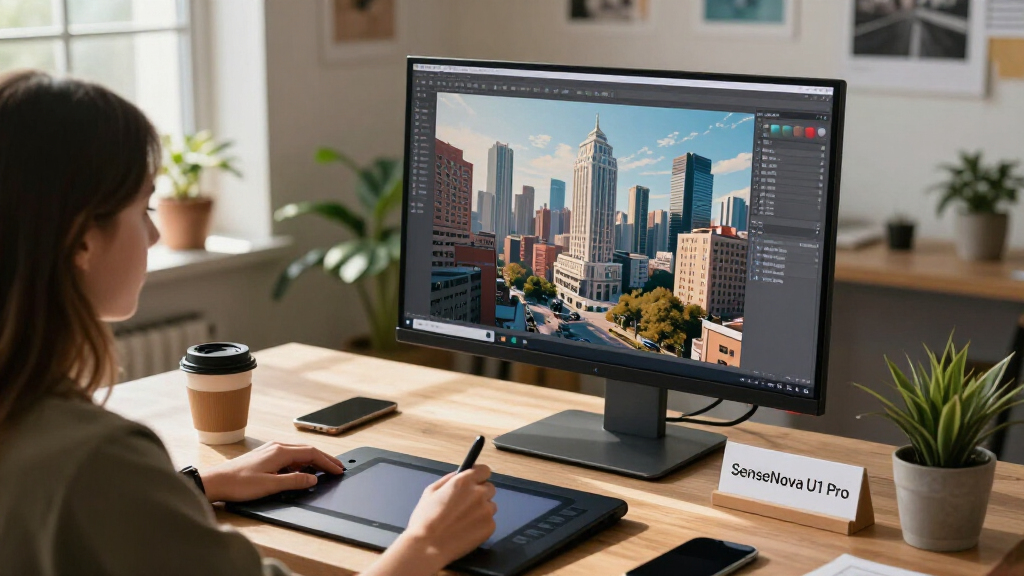

🔍 Read the full analysis: SenseTime Releases SenseNova U1 Pro Image Model With Up To 8K Output – TechNode on ThorstenMeyerAI.com

Get business pricing on tech for your team
- Business-only prices and quantity discounts
- Tax-exempt purchasing
- Multiple users, one account, clear invoices
TL;DR
SenseTime has released SenseNova U1 Pro, an image generation model that the company says produces images at resolutions up to 8K, according to TechNode. Technical specifications, pricing, and independent quality verification were not included in the initial announcement.
SenseTime has released SenseNova U1 Pro, a new image generation model that the company says supports output resolutions of up to 8K, according to a TechNode report. The release marks an upgrade to the Chinese AI firm’s SenseNova foundation model family and its push into an increasingly crowded market for AI image generation tools, where mainstream services commonly top out at 1K or 2K resolutions in standard tiers.
The announcement centers on a single headline capability: the model’s ability to generate images at resolutions reaching 8K output. That figure is higher than the output limits commonly offered by mainstream image generation services, many of which cap standard-tier output at 1K or 2K resolutions. High-resolution output targets use cases where fine detail matters, such as print design, advertising, architecture visualization, and large-format displays, where lower-resolution generated images would otherwise require upscaling or would appear degraded when enlarged.
SenseNova is SenseTime’s umbrella brand for its foundation model offerings, spanning language, vision, and multimodal capabilities. U1 Pro sits within the image generation portion of that portfolio, alongside models such as SenseNova’s 8B multimodal model. The company has positioned SenseNova as a commercial platform, offering models to enterprise customers through cloud interfaces rather than exclusively as a consumer app.
Detailed technical specifications — the model’s architecture, parameter count, training data, pricing, and benchmark comparisons against rivals — were not included in the initial announcement coverage. Independent testing results were also not available at the time of writing, so claims about image quality rest on SenseTime’s own description of the product.
Why 8K Output Matters for Professional Users
Resolution has become a visible differentiator in the image generation market. While services such as Midjourney, OpenAI’s image tools, and Chinese competitors including Alibaba’s Tongyi Wanxiang and ByteDance’s offerings compete largely on prompt adherence and aesthetics, output resolution determines whether generated images are usable in professional production workflows. For advertising agencies, publishers, and industrial designers, an 8K-native image could skip the upscaling step that often introduces artifacts or softens detail.
For SenseTime specifically, the release signals continued investment in generative AI as a growth business. The company, best known historically for computer vision systems, has faced pressure on its traditional surveillance-related revenue lines and has reoriented toward foundation models and AI infrastructure. A headline capability like 8K output is a way to stand out in a market where Chinese AI vendors are releasing image and video models at a rapid pace.
The release also reflects broader dynamics in China’s AI sector, where vendors are racing to match or exceed capabilities introduced by international competitors while serving a domestic market with strong demand for content-generation tools.
SenseTime’s SenseNova Product Line
SenseNova is the model family SenseTime has built out since 2023, when large language models and multimodal systems became the center of the AI industry’s competition. The platform includes language models, multimodal understanding models, and image and video generation tools, offered to developers and enterprises through SenseTime’s cloud services.
SenseTime is one of China’s most prominent AI companies, listed in Hong Kong, and has historically derived revenue from computer vision technology deployed in smart city, security, and business applications. In recent years it has invested heavily in generative AI, repositioning SenseNova as a core commercial offering amid regulatory and market shifts affecting its legacy businesses.
The image generation segment where SenseNova U1 Pro sits is among the most competitive in AI. Chinese platforms and international players alike have shipped rapid model upgrades, with resolution, text rendering, and multi-image consistency as common areas of claimed improvement.
“SenseTime releases SenseNova U1 Pro image model with up to 8K output.”
— TechNode
Details the Announcement Leaves Out
Several key details are not yet public. It is unclear when exactly the model became available, which customers can access it, and what it costs. The announcement coverage did not specify whether 8K output is available in all usage tiers or restricted to certain plans.
There is also no independent verification of image quality at 8K resolution. Claims about the model’s performance come from SenseTime’s own marketing, and no third-party benchmarks or peer evaluations were available at the time of writing.
Whether “up to 8K” means native generation at that resolution or AI-assisted upscaling from a lower-resolution base was not stated — a distinction that materially affects image quality in practice. Availability outside China, API access terms, and any content policy restrictions are likewise unstated.
Watch for Benchmarks and Pricing
Expect SenseTime to publish or present more detail on U1 Pro in the near term, typically through model documentation, developer documentation, or a launch event. Independent testers and AI evaluation sites will likely run comparisons against competing models once access widens, which will show whether the 8K claim translates into usable quality advantages.
Competitively, watch whether rival Chinese vendors respond with their own high-resolution offerings in the coming weeks, as capability one-upmanship in this market has been fast. Enterprise adoption announcements — customers building U1 Pro into design or advertising pipelines — would be the clearest signal of commercial traction.
Key Questions
What is SenseNova U1 Pro?
SenseNova U1 Pro is a new image generation model from SenseTime, part of the company’s SenseNova foundation model family. The company says it supports output resolutions of up to 8K.
Is the 8K output claim independently verified?
No. Claims about the model’s performance come from SenseTime’s own description of the product. No third-party benchmarks or independent testing results were available at the time of writing.
How much does SenseNova U1 Pro cost?
Pricing has not been disclosed in the initial announcement coverage. It is also unclear which usage tiers include 8K output or which customers can currently access the model.
Who is SenseTime?
SenseTime is one of China’s most prominent AI companies, listed in Hong Kong, historically known for computer vision systems. It has reoriented toward foundation models and generative AI under the SenseNova brand.
Why does 8K resolution matter for image generation?
Higher resolution determines whether generated images are usable in professional workflows such as print design, advertising, and large-format displays, where lower-resolution images would require upscaling that can introduce artifacts or soften detail.
Primary source: SenseTime · via ThorstenMeyerAI.com
Fall Picks
fall essentials
As an affiliate, we earn on qualifying purchases.