TL;DR

Get business pricing on tech for your team
- Business-only prices and quantity discounts
- Tax-exempt purchasing
- Multiple users, one account, clear invoices
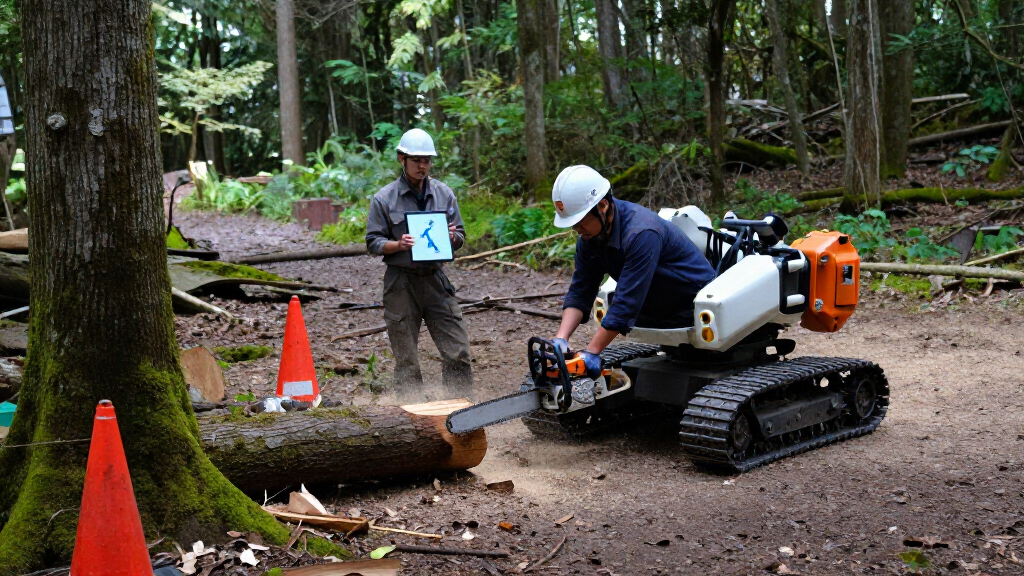
Japan’s JR East used a rail truck-mounted heavy machinery robot to cut and handle tree branches obstructing tracks. Despite descriptions of autonomous, AI-enabled robotics, the chainsaw and grabber arms in the footage were remotely controlled by a human.
Japan’s railway company JR East used a rail truck-mounted robot with a chainsaw and grabber arm to clear tree branches that had begun to impede tracks, according to footage shown by ANN News. The equipment was remotely controlled by a human during the work, so the demonstration does not establish that the chainsaw operation was autonomous, despite broader company efforts to bring AI and robotics into railway maintenance.
The machine is described as an unnamed heavy machinery robot mounted on a rail truck. It uses a chainsaw to cut branches and a grabber arm to handle them. The reported task was to remove vegetation that had started to obstruct rail tracks, a maintenance job with potential safety implications for railway operations.
In the footage covered by Tom’s Hardware, a human remotely operated both arms. The available account does not say that an AI system selected branches, controlled the cutting tool or performed the work without operator input. Calling the machine autonomous would go beyond the confirmed details of this particular operation.
JR East is broadly integrating AI and robotic technologies across its operations, with the stated aims of improving safety, efficiency and round-the-clock maintenance. The report, however, provides no technical description of this robot’s software or evidence that AI was used in the branch-clearing task itself.
Rail maintenance · Japan · Reported operation
Japan Experiments With Autonomous AI Chainsaw-wielding Robots
JR East used a rail truck-mounted machine to cut and handle branches obstructing tracks. In the reported work, a human remotely controlled its arms—the footage does not establish autonomous or AI-directed cutting.
01 / The development
A mechanical platform for difficult trackside work
The rail truck carried heavy machinery equipped to cut branches and handle the debris. The reported task was removing vegetation that had begun to impede railway tracks.
Rail truck-mounted
The unnamed machine was mounted on a rail truck for work beside railway lines.
Chainsaw arm
A chainsaw-equipped arm was used to cut back branches near the tracks.
Grabber arm
A second arm gripped and handled branches after they were cut.
02 / The key distinction
Remote operation is not autonomy
A person controlled both arms remotely.
The available report does not say that AI selected branches, operated the chainsaw, assessed hazards, or made cutting decisions. Describing this specific task as autonomous goes beyond the confirmed details.
Position
Machine mounted on a rail truck.
Operator controls
A human remotely directs the arms.
Cut branches
Chainsaw arm removes obstructing growth.
Handle debris
Grabber arm moves the cut branches.
03 / Evidence check
What is known—and what remains open
Reported in the account
- JR East used the machine to clear branches that had begun to obstruct tracks.
- The equipment had chainsaw and grabber arms.
- A human remotely controlled the arms during the work.
- ANN News footage was covered by Tom’s Hardware.
Not established
- Whether AI played any role in this specific operation.
- Where and when the branch-clearing work took place.
- Whether use is a trial or routine maintenance.
- Maker, specifications, safety procedures, performance, or rollout plans.
04 / Wider context
Part of a broader robotics push
JR East is integrating AI and robotics across its operations with stated goals of improving safety, efficiency, and round-the-clock maintenance. The report does not connect a specific AI capability to the machine shown clearing branches.
“The company is integrating AI and robotic technologies across its operations to enhance safety, efficiency and round-the-clock maintenance.”JR East, as described in the report
05 / Reader questions
The essential answers
Was the chainsaw robot operating autonomously?
No. A human remotely controlled the chainsaw and grabber arms in the reported operation.
What was it used for?
Clearing tree branches that had begun to impede railway tracks.
Did AI control the machine?
That has not been established. The reported account describes remote human control.
Where and when was it deployed?
The available reporting does not give a specific location or date.
Remote Tools for Rail Maintenance
Railway maintenance can involve work close to tracks and heavy equipment. A rail-mounted machine that lets an operator control cutting and gripping tools from a remote position could change how some hazardous or physically demanding tasks are carried out. In this reported case, the human remained in control; the robot’s role was to provide a mechanical platform and tools for removing branches.
The distinction matters because remote operation is not the same as autonomy. The footage indicates a robot-assisted maintenance task, not proof that an AI system independently assessed hazards or made decisions about cutting. That careful distinction helps readers judge what has actually been demonstrated as JR East expands its use of automation and robotics.
If similar equipment is used more widely, its practical value would depend on factors not specified in the report, including how it performs in different track conditions, how operators supervise it and whether it reduces exposure to risk or maintenance time. Those outcomes have not been quantified in the information available.
Products Worth Considering

Jackery HomePower 1000 Plus v2 Portable Power Station

DJI Osmo Pocket 3 Filter Bundle – Vlogging Camera with 1 CMOS Sensor and 4K/120fps

DJI Osmo Pocket 4 Gimbal Camera Pro Kit, 18-Piece Bundle
As an affiliate, we earn on qualifying purchases.
JR East’s Broader Robotics Push
The branch-clearing job sits within JR East’s broader effort to introduce AI and robotics across railway operations. The company is pursuing those technologies for safety, efficiency and maintenance coverage, including work that may need to continue around the clock. The report does not link a specific AI capability to the robot shown cutting branches.
ANN News showed the rail truck-mounted machine in operation, and Tom’s Hardware reported on the footage. The named task was clearing branches that had begun to impede tracks. No deployment date, location, operating specifications or details about how often the machine is used were provided, so the footage should be understood as a reported use rather than evidence of a network-wide rollout.
“The company is integrating AI and robotic technologies across its operations to enhance safety, efficiency and round-the-clock maintenance.”
— JR East, as described in the report
Autonomy and Deployment Details
Several details remain unreported, including where and when the work took place, how frequently JR East uses this machine and whether it is a trial or part of routine maintenance. The robot’s maker, technical specifications and safety procedures are also not identified in the available account.
It is also unclear whether AI was involved in any part of the operation beyond JR East’s wider technology program. The reported arms were remotely controlled by a person, and there is no disclosed evidence that the machine operated autonomously, detected branches on its own or made cutting decisions. No performance data or comparisons with conventional methods were supplied.
More Evidence on Routine Use
The next useful information would be whether JR East intends to expand or formalize use of the rail-mounted machine, and how it assesses safety and effectiveness. Further company details or reporting could clarify the equipment’s operating limits, the human supervision required and whether AI features are planned or already used in other maintenance systems.
Until those details are available, the confirmed development is narrow: a human remotely operated a robot’s cutting and gripping arms to remove branches obstructing railway tracks. JR East’s wider interest in AI and robotics is relevant context, but it does not change the nature of the operation shown.
Source: Tom’s Hardware
Key Questions
Was the chainsaw robot operating autonomously?
No. In the reported operation, a human remotely controlled the chainsaw and grabber arms. The available details do not show autonomous cutting.
What was the robot used for?
JR East used the rail truck-mounted machine to clear tree branches that had begun to impede tracks, according to the report.
Did AI control the machine?
That has not been established. JR East is broadly adopting AI and robotics, but the reported account says the machine’s arms were remotely controlled by a person.
Where and when was the robot deployed?
The available report does not provide a specific location or date for the branch-clearing work.
Source: Tom’s Hardware