TL;DR
Thorsten Meyer says he now uses AI coding agents to build and connect tools for analytics, project tracking, PDFs and video, rather than paying other software vendors. He reports 5,648 commits and 2,128 test files across seven of his repositories as of Nov. 24, 2026; those figures describe his own projects, not independently verified results or a general measure of AI productivity.
Thorsten Meyer says he has stopped paying other vendors for the software he uses to run his work, building tools for analytics, project tracking, PDFs and video with AI coding agents instead. In an article published Nov. 25, 2026, he describes using Claude and Codex subscriptions to develop and connect the tools, while taking on responsibility for their maintenance, security and review.

Get business pricing on tech for your team
- Business-only prices and quantity discounts
- Tax-exempt purchasing
- Multiple users, one account, clear invoices
Meyer says the tools are built with AI coding agents, which work inside a software project: they read and write code, run tests and report results. He names Anthropic’s Claude Code and OpenAI’s Codex as the agents he uses. His role, as he describes it, is to set goals and check the work. He also pays separately for AI models that generate voices, images and video clips.
He describes a workflow in which a job passes through seven tools, starting in a project tracker and ending in publishing and analytics. The tools have written guides and interfaces that let agents use them without a person clicking through each step. Meyer says people still define the goal and review the result.
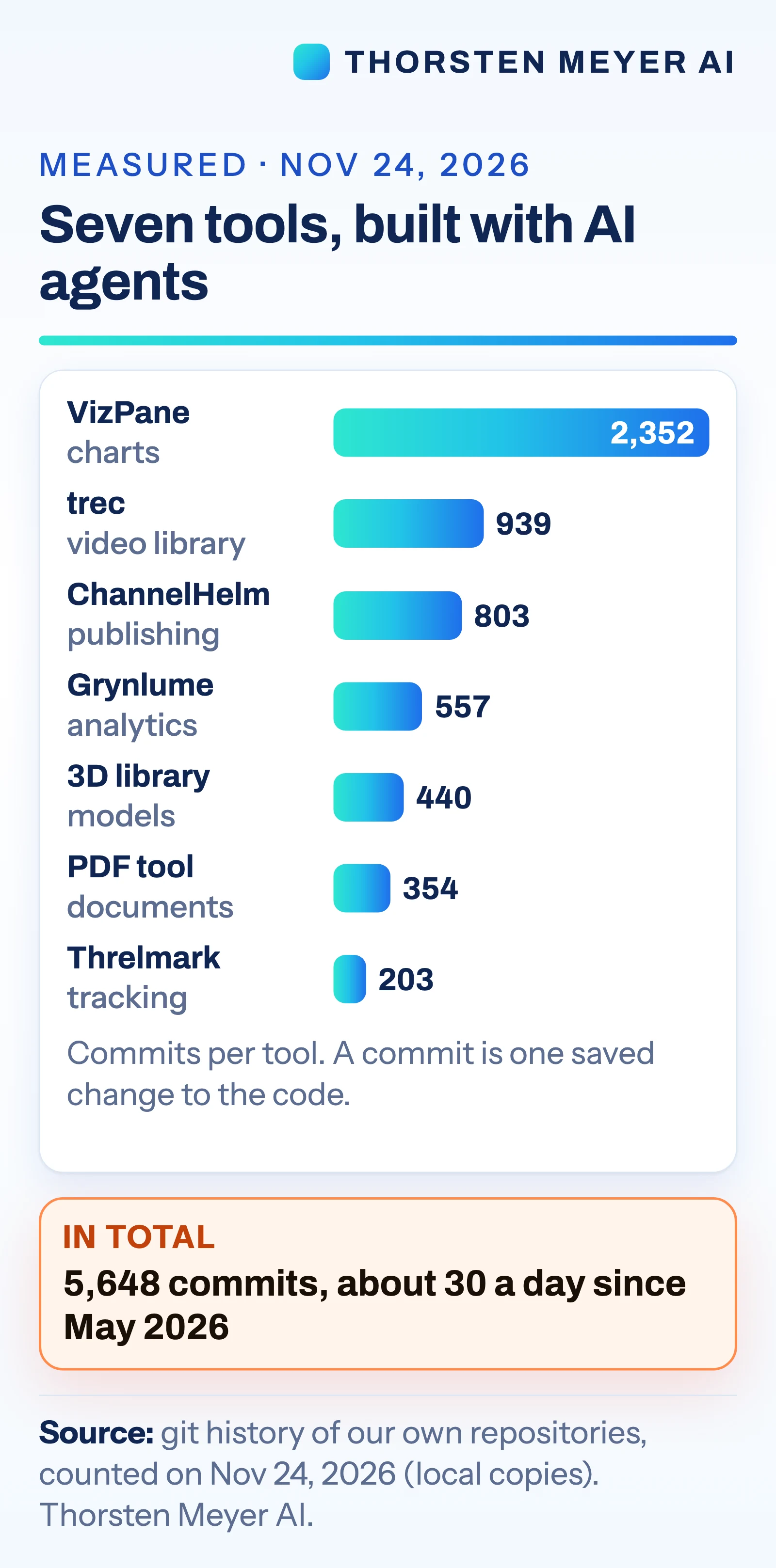
Across the seven tools discussed, Meyer reports 5,648 commits and 2,128 test files in his own repositories, counted on Nov. 24. These are figures he supplies about his projects; the article does not provide an independent audit or a comparison with commercial software. He also says that his software bill is limited to Claude and Codex subscriptions, while model-generated media is charged per use.
What Small Firms Can Build
Meyer’s account illustrates how coding agents may let a sole worker or small business build software tailored to its own workflow. That can reduce reliance on separate subscriptions for narrow tasks, but it shifts work and responsibility to the person building the tools. Users must decide what they need, review whether the tools do it correctly, and handle upkeep and security.
For software providers, Meyer argues that some customers may create simpler versions of products themselves. He suggests that providers will need to compete on reliability, support and security, as well as making their products usable by agents. That is his assessment, not evidence that customers broadly are leaving subscription software.
The approach also concentrates dependence: Meyer says he relies heavily on Anthropic and OpenAI for coding-agent subscriptions. The account describes one practitioner’s choices and does not establish how the costs or risks compare across businesses.
Products Worth Considering

Bose QuietComfort Ultra Earbuds (2nd Gen), Wireless Noise-Cancelling Earbuds, Black

Samsung Galaxy Tab A11+ 11-Inch Wi-Fi Tablet, 128GB, 6GB RAM, Silver

Amazon Kindle Paperwhite (2024) – 16GB, 7 Glare-Free Display, Waterproof
As an affiliate, we earn on qualifying purchases.
From Software Rental to Custom Tools
Many online business applications follow the software-as-a-service model: customers pay to use applications running on a provider’s cloud infrastructure. Meyer cites the U.S. National Institute of Standards and Technology’s definition in NIST Special Publication 800-145, which says users do not manage the underlying servers or storage and have limited control over application capabilities.
That arrangement offers ready-to-use services, but businesses may end up with separate subscriptions, logins and rules for different tasks. Meyer’s alternative is to build tools for his own work. He describes an AI coding agent as a model that can inspect a project, make changes and run tests, while noting that it needs written project instructions and a human reviewer.
He uses “agentic” to describe software designed to be used by other software as well as by people. In his workflow, each tool provides a guide and a way for agents to interact with it. The article presents this as Meyer’s implementation and explanation; it does not establish a universal standard for agent-compatible software.
““I no longer pay other vendors for the software I run my work on.””
— Thorsten Meyer
Costs and Reliability Remain Unmeasured
The account does not provide a full cost comparison between Meyer’s subscriptions, usage-based media charges and the software services he replaced. It also does not quantify the time he spends building, reviewing and maintaining the tools, or report an independent assessment of their security and reliability.
The commit and test-file counts are self-reported repository totals. The article does not say how many tests pass, how much code they cover, or whether the tools perform as well as the commercial services they replaced. It is also unclear how the workflow would hold up for a larger team or for businesses with different technical and regulatory needs.
Meyer’s Workflow in Practice
Meyer’s article is a written companion to a video about his tool fleet. It describes one job moving through seven tools, from a project tracker to publishing and read-only analytics. The article does not announce a product launch or give a schedule for additional releases.
For now, the next test of the approach is ongoing use: whether the tools remain dependable as Meyer maintains them and relies on them for work. The account provides no independent results or broader adoption figures, so the costs and outcomes for other businesses remain open questions.
Key Questions
What software does Thorsten Meyer say he replaced?
He says he now uses tools he built for web analytics, project tracking, PDFs and video recording, rather than paying other vendors for those services.
Which AI coding agents does he use?
Meyer names Claude Code from Anthropic and Codex from OpenAI. He says they read and write project code, run tests and report back, with him setting goals and reviewing results.
What do the commit and test figures measure?
Meyer reports 5,648 commits and 2,128 test files across seven of his own tools, measured on Nov. 24, 2026. They are self-reported project totals, not independent measures of quality or productivity.
Does Meyer say businesses should stop renting software?
No. He says renting remains a reasonable choice for people who do not enjoy building tools. His approach is presented as a fit for people willing to define requirements, review results and take responsibility for maintenance and security.
Source: Thorsten Meyer AI