
🔍 Read the full analysis: How Small Businesses Can Compare AI Automation Tools In 2027 on ThorstenMeyerAI.com

Get business pricing on tech for your team
- Business-only prices and quantity discounts
- Tax-exempt purchasing
- Multiple users, one account, clear invoices
TL;DR
The source material compares 15 books that teach small-business AI automation, not software platforms that perform it. It favors a broad practical guide overall, while identifying no-code and ChatGPT-focused titles as possible starting points for narrower learning needs. Specific contents, integrations and results cannot be verified from the supplied title-level information.
A roundup of 15 AI automation books for small businesses ranks learning resources by their stated scope and audience, not by software performance. Its overall pick is AI Automation for Small Businesses: A Practical Guide to Automating Marketing, Sales, Customer Service, Operations, and Everyday Work, while titles emphasizing no-code workflows or ChatGPT offer more focused paths. The source says buyers still need to select and configure the software that carries out any workflow.
The comparison presents the books as different ways to learn about automation across marketing, sales, customer service and operations. It gives the broad practical guide the top overall position based on the range of functions named in its title. That assessment reflects the source’s selection criteria; it is not a finding from testing the book against competing tools or implementations.
For readers seeking a more directed introduction, the source identifies AI Automation Made Simple for Small Business as focused on no-code workflows and ChatGPT for Business: The 10X Playbook as emphasizing adaptable workflow ideas. Other titles are described through cues in their names, including beginner framing, a set-up-yourself approach, a 30-day plan, entrepreneurship, or everyday work. The source does not provide enough detail to confirm how thoroughly any book delivers those approaches.
The roundup says it compared 15 titles using their stated audiences, promised formats and named topics. It prioritized practical workflow coverage, accessible starting points for nontechnical owners and relevance to common business functions. It explicitly treats the books as educational material rather than working automation products.
The 15 picks
- 1
 Smart AI for Small Business: 50 Simple Hacks to Grow Revenue, Cut Costs, and…View on Amazon →
- 2
 The Small Business Owner’s AI Handbook: How to Use Artificial Intelligence to…View on Amazon →
- 3
 AI Tools for Small Business: A Practical Guide to Automation, Saving Time, an…View on Amazon →
- 4
 AI-Powered Automation and Workflows for Small Business OwnersView on Amazon →
- 5
 ChatGPT for Business: The 10X Playbook — 100 AI Workflows to Save Time, Grow…View on Amazon →
- 6
 AI Automation for Small Businesses: Build Smarter Workflows, Save Time, Reduc…View on Amazon →
- 7
 Claude AI Made Practical: A Beginner’s Guide to Everyday Work, Small-Business…View on Amazon →
- 8
 AI Automation for Small Businesses: A Practical Guide to Save Time, Work Smar…View on Amazon →
- 9
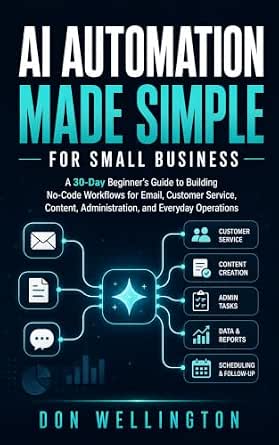 AI Automation Made Simple for Small Business: A 30-Day Beginner’s Guide to No…View on Amazon →
- 10
 AI Automation for Small Business: Simple AI Workflows for Everyday TasksView on Amazon →
- 11
 AI Automation for Small Business: A Practical Guide to Automating Marketing,…View on Amazon →
- 12
 AI for Small Business, Volume I: Getting Started — Set It Up Yourself, No Tec…View on Amazon →
- 13
 AI for Small Business: From Marketing and Sales to HR and OperationsView on Amazon →
- 14
 AI Automation for Small Businesses: Build Semi-Passive Income Systems Without…View on Amazon →
- 15
 AI for Entrepreneurs and Small Business Owners: How to Compete with Larger Bu…View on Amazon →
Choosing a Guide Before a Platform
For a small business, the distinction between learning material and an operating tool affects both spending and expectations. A book may help an owner identify a process worth automating, but it does not by itself connect email, customer records, calendars or payment systems. Buyers must still check which software supports a proposed workflow and whether it fits their existing setup.
The comparison also highlights a practical choice: broad coverage versus a guided starting point. A wide-ranging guide may suit an owner surveying several departments; a no-code or assistant-specific resource may be easier to match to a defined first project. The source does not establish that one learning style produces better business results.
That matters because automation involves more than removing steps. Owners need to account for setup, review and error handling, especially when AI-generated material reaches customers or affects business records. The source advises setting approval rules and judging a workflow by the time needed to check its output as well as the work it saves.
Products Worth Considering

DJI Mini 4K Drone with 4K UHD Camera

DJI Mini 3 Drone with DJI RC and 3-Axis Gimbal

Apple AirPods Pro (2nd Generation) Wireless Earbuds with USB-C MagSafe Charging Case
As an affiliate, we earn on qualifying purchases.
How the 15 Titles Were Compared
The source’s method is a title-and-description-based comparison, not a review of implemented workflows or measured outcomes. It says it relied on stated audience, promised format and named subject areas because the available information did not establish the books’ full contents. That limits how confidently readers can judge instruction quality, technical depth or software compatibility.
Its selection logic favors books that appear to balance practical application with broad business relevance. More specialized titles may still fit a particular tool or learning preference, but the roundup places wider-ranging resources higher. It also treats labels such as “beginner,” “no-code” and “30-day plan” as signals of a possible learning path, not proof that a book includes detailed setup instructions.
“These are learning resources, not automation platforms.”
— ThorstenMeyerAI.com roundup
What the Book Listings Cannot Confirm
The supplied material names only three of the 15 titles and does not include full descriptions or a complete ranked list. It therefore cannot support a title-by-title account of all 15 books, their authors, publication dates, prices or exact placement. The comparison’s broader claims should be read as a summary of the source’s stated approach, not as independently verified evaluations.
It is also unclear whether the books contain current instructions for particular AI models, software integrations, privacy practices or regulatory requirements. No measured evidence is provided about saved time, costs, revenue or accuracy. A title’s promise of simple, practical or growth-oriented advice does not establish that readers will achieve those results.
Verify Fit Before Buying
Owners can begin by naming one repetitive, well-defined task that consumes staff time, then document its current steps and intended outcome. The next step is to compare a guide’s sample pages or publisher description with the business’s technical confidence and existing software. If integration details are missing, the roundup advises checking with the relevant software provider rather than assuming a workflow will connect automatically.
Before using AI on customer-facing messages or sensitive records, businesses should decide which outputs require human approval and how errors will be handled. The source offers no announced follow-up research, testing or publication date for this comparison, so readers should verify book details and tool guidance directly before making a purchase or implementation decision.
Key Questions
Are the 15 items AI automation software tools?
No. The source describes them as books and learning resources. Businesses still need to choose and configure the software that performs a workflow.
Which title does the roundup favor overall?
It names AI Automation for Small Businesses: A Practical Guide to Automating Marketing, Sales, Customer Service, Operations, and Everyday Work as its overall pick, based on the broad functional scope indicated by its title.
What does the source suggest for a beginner?
It points to AI Automation Made Simple for Small Business for its no-code framing. The supplied information does not confirm the book’s step-by-step detail, so readers should check a sample or full description.
Does the roundup prove these books save time or money?
No. It provides no measured results for time saved, costs, revenue or accuracy. Its comparison is based on stated audiences, formats and topics, rather than tested business outcomes.
What should a business check before automating a workflow?
Identify the task and its current steps, check whether the required software connects to the business’s existing systems, and set human review rules for customer-facing or sensitive outputs.
Source: ThorstenMeyerAI.com