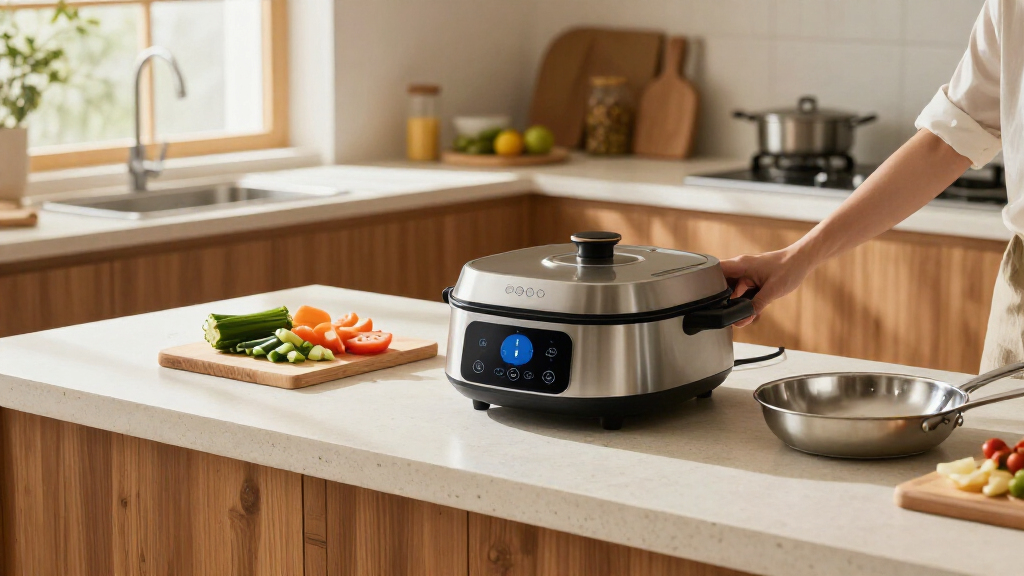

Choosing an AI-powered kitchen device is less about buying the most futuristic appliance and more about deciding which part of cooking you want to make easier. An AI-enabled smart oven applies sensors, presets, and app controls to a familiar oven workflow; an AI-guided countertop cooker uses a smaller, task-focused appliance to automate or coach specific jobs. That distinction affects what you can cook, how much counter or installation space you need, and whether the device can help with everyday meals or only selected tasks.

Get business pricing on tech for your team
- Business-only prices and quantity discounts
- Tax-exempt purchasing
- Multiple users, one account, clear invoices

TOKIT AI Cooking Robot Omni Cook C2 21-in-1 Food Processor
- ✔ Bowl capacity: 2.2 liters
- ✔ Cooking functions: 21 listed
- ✔ Recipe guidance: 7-inch touchscreen; more than 3,000 recipes

All-in-One Smart Kitchen Machine with LCD Display, Guided Recipes and Adjustable Temperature (37–160°C)
- ✔ Bowl capacity: 3 liters
- ✔ Power: 1500 W
- ✔ Temperature range: 37–160 °C

KAIKAFEI Smart Cooking Robot with Built-In Scale, 3L Bowl, and WiFi Recipe Connectivity
- ✔ Bowl capacity: 3 liters
- ✔ Motor power: 1500 W
- ✔ Temperature range: 37–160 °C
Smart ovens tend to suit households already replacing an oven and cooks who want better control over roasting, baking, and reheating. Countertop cookers appeal to renters, smaller kitchens, and people who want help with a limited set of repeatable meals without renovating. Neither category makes cooking fully hands-free: model features vary, recipes and connectivity matter, and users still need to load food and check results. The best choice depends on whether you want to automate a central kitchen appliance or add a compact specialist.
At a Glance
| Criteria | AI-enabled smart ovens | AI-guided countertop cookers | Winner |
|---|---|---|---|
| Cooking range | Broad oven tasks such as baking, roasting, and reheating | Focused on the tasks supported by that cooker, such as guided or programmed cooking | A |
| Automation and guidance | Sensors and presets can adjust or monitor cooking; features vary by model | May automate steps or guide recipes within a narrower appliance workflow | Depends |
| Setup and space | Requires an oven-sized opening and often a more involved installation | Sits on a counter and usually needs no permanent installation | B |
| Everyday convenience | Can improve a cooking tool used across many meals | Quick to add for repeat meals, but competes for counter and storage space | Depends |
| Flexibility and control | Familiar controls plus model-specific smart functions | Convenient for supported routines, less useful outside its task range | A |
| Cost and value | More compelling when replacing an oven that is already due for replacement | Lower commitment than an oven replacement, though specialist devices still add cost | Depends |
| Connectivity and privacy | May depend on an app, Wi-Fi, accounts, and software support | Connected features can require an app and account; check offline functions and data terms | Tie |
TOKIT AI Cooking Robot Omni Cook C2 21-in-1 Food Processor
The TOKIT Omni Cook C2 is the strongest all-round match for buyers who want one guided appliance to cover a wide range of kitchen jobs. Its stated 21 functions include sous-vide, emulsifying, blending, kneading, grinding, steaming and chopping. That breadth gives it a clearer case for consolidating equipment than either KAIKAFEI listing, whose descriptions name several tasks but do not give a comparable function count.Its 7-inch touchscreen, built-in scale and access to more than 3,000 recipes bring guidance and measurement into the same workflow. The scale is particularly useful for buyers who want fewer separate prep steps; compared with the adjustable-temperature KAIKAFEI, TOKIT pairs that convenience with a more specific recipe-library claim. Its 2.2-liter bowl, however, is smaller than the 3-liter bowls in both KAIKAFEI models, making those alternatives more appealing when batch size takes priority.Self-cleaning mode may ease the burden after a multi-step meal, but the compact-appliance pitch has a limit: its listed dimensions are 14 inches deep and wide, and the unit still needs a permanent place on the counter. Full recipe access depends on Wi-Fi, according to the supplied description, so buyers who prefer appliances that work independently of online services should weigh that reliance. The two-year warranty is a useful stated ownership detail, although the listing does not describe what it covers.
Pros:
- Lists 21 cooking functions, including steaming, kneading and sous-vide.
- 7-inch touchscreen and access to more than 3,000 guided recipes.
- Built-in scale and self-cleaning mode simplify preparation and cleanup.
- Supplied specifications include a two-year warranty.
Cons:
- Its 2.2-liter bowl is smaller than the 3-liter bowls in the KAIKAFEI options.
- Recipe access depends on Wi-Fi, and software updates may affect functionality.
- Still requires dedicated counter space.
Best for: Cooks who want a broad set of guided functions, an integrated scale and a large recipe library in one appliance.
Not ideal for: Households that regularly cook large batches, have very limited counter space or want recipe guidance that does not rely on Wi-Fi.
Bottom line: We rank the TOKIT first for its clearly stated function breadth and integrated recipe workflow, provided its smaller bowl suits our cooking and we are comfortable with connected features.
“We rank the TOKIT first for its clearly stated function breadth and integrated recipe workflow, provided its smaller bowl suits our cooking and we are comfortable with connected features.”
All-in-One Smart Kitchen Machine with LCD Display, Guided Recipes and Adjustable Temperature (37–160°C)
For buyers who put bowl volume and heat settings ahead of a detailed function count, this KAIKAFEI smart kitchen machine makes a different case from TOKIT. Its 3-liter bowl holds more than the Omni Cook C2’s 2.2-liter bowl, while the stated 37–160°C adjustment gives shoppers a concrete range to assess for recipes that need controlled heating. The description positions it for blending, boiling, kneading, steaming and whisking, but does not claim TOKIT’s 21-function tally.A 7-inch TFT display and Wi-Fi recipe guidance make the machine approachable for cooks who want instructions on screen. Compared with the other KAIKAFEI listing in this roundup, this one foregrounds temperature control rather than a built-in scale. That distinction matters when our recipes benefit more from setting heat than from weighing ingredients inside the appliance. The supplied details say nothing about an integrated scale, so we should not assume it has one.The main compromise is size: listed at 22.44 inches deep, 16.54 inches wide and 15.35 inches high, it may be difficult to leave out in a small kitchen. Its ABS body is specified, but the listing gives less detail on the blade and included components than the scale-equipped KAIKAFEI. We would choose it for the stated larger capacity and adjustable heat, while buyers seeking a more fully described guided workflow may prefer TOKIT or the other KAIKAFEI option.
Pros:
- 3-liter bowl offers more capacity than the TOKIT model.
- Specifies adjustable temperature from 37–160°C.
- 7-inch TFT touchscreen and Wi-Fi guided recipes.
- 1500 W power is explicitly listed.
Cons:
- Large listed dimensions may be difficult to accommodate on smaller counters.
- No built-in scale is specified in the supplied description.
- The listing gives fewer details about included components and blade material.
Best for: Households that want a 3-liter bowl and explicit temperature adjustment for varied guided cooking.
Not ideal for: Small kitchens, buyers who specifically want an integrated scale, or shoppers who need a clearly stated function count.
Bottom line: We recommend this KAIKAFEI when larger bowl capacity and a stated temperature range matter more than integrated weighing or a clearly enumerated function set.
“We recommend this KAIKAFEI when larger bowl capacity and a stated temperature range matter more than integrated weighing or a clearly enumerated function set.”
KAIKAFEI Smart Cooking Robot with Built-In Scale, 3L Bowl, and WiFi Recipe Connectivity
This KAIKAFEI makes its best argument at the preparation stage: it combines a built-in scale with a 3-liter bowl, online guided recipes and a self-cleaning function. For cooks who want to weigh ingredients as they move through a recipe, that combination may reduce interruptions and separate measuring equipment. The adjustable-temperature KAIKAFEI shares the same stated 3-liter capacity and temperature range, but its supplied description does not mention weighing.Like the TOKIT, this model brings measurement into the appliance. TOKIT, however, provides a more specific breadth claim with 21 functions and more than 3,000 recipes; KAIKAFEI’s listing instead names blending, boiling, cooking, kneading, steaming and whisking. That makes the scale-equipped KAIKAFEI a focused convenience pick rather than the clearest choice for buyers trying to replace the greatest number of tools. It also lists a chopping blade among the included components, giving us one concrete clue about what arrives in the box.Its 7-inch TFT touchscreen and Wi-Fi recipe connection support guided cooking, while self-cleaning may simplify the end of a session. The tradeoff is the same substantial footprint as the other KAIKAFEI machine: 22.44 inches deep and 16.54 inches wide. The description also ties full recipe functionality to Wi-Fi, and the listed materials are ABS with a stainless-steel blade. We would consider it when integrated weighing and larger capacity are central to our routine, while confirming the exact model details because the two KAIKAFEI listings share many specifications.
Pros:
- Built-in scale reduces separate ingredient-measuring steps.
- 3-liter bowl and 37–160°C temperature range are listed.
- 7-inch touchscreen, Wi-Fi recipes and self-cleaning feature.
- Chopping blade is listed among included components.
Cons:
- Large dimensions can take up substantial counter space.
- Recipe connectivity relies on Wi-Fi for full functionality.
- Its listed functions are less comprehensively enumerated than TOKIT’s.
Best for: Cooks who want to weigh ingredients in the appliance while using guided recipes and a larger bowl.
Not ideal for: Buyers who need a compact machine, want a detailed function count or do not want recipe features tied to Wi-Fi.
Bottom line: We choose this KAIKAFEI for integrated weighing and a larger bowl, while TOKIT remains the better fit when stated function breadth is the priority.
“We choose this KAIKAFEI for integrated weighing and a larger bowl, while TOKIT remains the better fit when stated function breadth is the priority.”
As an Amazon Associate we earn from qualifying purchases.
Key Differences
The biggest difference is breadth versus focus. A smart oven brings connected controls and, on some models, cooking sensors to a high-use appliance. It can serve a wide range of oven-based meals, so improvements may matter repeatedly. Yet the actual assistance differs from model to model: a preset that suggests a time is not the same as a sensor that monitors doneness, and neither removes the need to prepare food or supervise safely.
A countertop cooker is easier to add and can make a supported routine more repeatable. That can be a meaningful benefit for someone who often cooks the same kinds of meals or wants guided steps. Its limits are equally practical: it handles only the jobs its design supports, takes counter space, and may not replace an oven. The strongest purchase is the device that fits a recurring bottleneck, not the one with the most prominent AI label.
Cost should be judged against the alternative. If an oven replacement is already planned, smart features may be a useful increment over a conventional model. Replacing a working oven solely for AI functions is a much harder value case. A countertop cooker has a smaller installation commitment, but its value depends on regular use; if it duplicates appliances already in the kitchen or supports only occasional recipes, the convenience may not repay its price or space.
Detailed Comparison
Cooking range (AI-enabled smart ovens wins — major)
Smart ovens win for breadth, a major difference. They handle familiar oven jobs across meals, from baking to roasting, though advanced features depend on the model. A countertop cooker can excel at its supported tasks but does not provide the same general-purpose oven capacity. Choose the oven category if you want one device to support varied oven cooking; choose a specialist when its narrower job is exactly the one you repeat.
Automation and guidance (moderate difference)
Neither category wins across the board; the gap is moderate and model-dependent. Smart ovens may use sensors or presets to adjust or monitor a cooking cycle. Countertop cookers may offer more step-by-step guidance or automate a particular workflow. In practice, check the feature list for the exact task you care about: recipe suggestions alone do not guarantee automatic temperature adjustment, and a guided recipe does not necessarily mean the appliance operates unattended.
Setup and space (AI-guided countertop cookers wins — major)
Countertop cookers win, a major practical difference for renters and small kitchens. They can usually be placed on a suitable counter and put away when not in use, while a smart oven requires a dedicated opening and may involve electrical or installation work. The countertop option still occupies space and needs room for safe use. If you are already replacing an oven, the installation burden is less of a new cost.
Everyday convenience (moderate difference)
The winner depends on what you cook, with a moderate difference. A smart oven can improve a central appliance used for many meals. A countertop cooker can be more convenient when its recipe flow matches a frequent routine and reduces repeated decisions or steps. Consider your actual weekly cooking: a broad tool used often may beat a very convenient specialist, while a specialist can win if it solves a persistent, specific hassle.
Flexibility and control (AI-enabled smart ovens wins — moderate)
Smart ovens usually win, a moderate gap. Their familiar oven functions provide a broad baseline even when connected features are not useful. A task-focused cooker offers a simpler path within its supported workflow, but can be limiting when you want to improvise or cook something outside its design. Check whether manual controls remain usable if the app or internet connection is unavailable.
Cost and value (major difference)
There is no universal winner; the gap depends on the purchase being replaced. A countertop appliance avoids the cost and commitment of an oven installation, but buying a specialist for occasional use can be poor value. A smart oven makes more financial sense when it replaces an aging appliance and its cooking range will be used regularly. Paying extra just for an AI feature is hard to justify if a standard model already meets your needs.
Connectivity and privacy (minor difference)
This is a tie at category level, a minor difference. Either type may rely on Wi-Fi, an app, an account, or cloud services for some features. The practical differences come from each model’s policies and offline behavior, not the appliance category. Before buying, check what works without an account, whether app support is maintained, and what data the company collects.
AI-enabled smart ovens: Pros and Cons
Pros:
- Supports a broad range of oven-based cooking
- Can add sensor-based monitoring or connected controls to a central appliance
- A sensible upgrade when an oven replacement is already needed
Cons:
- Requires dedicated space and may require installation work
- AI features and usefulness vary substantially by model
- A poor value upgrade if a working oven is replaced only for smart functions
AI-guided countertop cookers: Pros and Cons
Pros:
- Usually easier to add without renovation
- Can make a supported repeat task more guided or consistent
- Lets renters and smaller households try automation without replacing an oven
Cons:
- Handles a narrower range of cooking jobs
- Uses counter or storage space and may duplicate existing appliances
- Convenience depends on regular use and continued support for connected features
Who Should Choose What
Choose AI-enabled smart ovens if:
- You are already replacing an oven and want connected features across varied oven cooking.
- You bake or roast often and value sensor monitoring or easier control in a central appliance.
- You have the space and installation setup for a built-in or full-size oven.
Choose AI-guided countertop cookers if:
- You rent or want to avoid an oven installation.
- You have a frequent, specific cooking task that the model supports well.
- You want guided cooking in a compact appliance and have counter space for it.
Skip both if: Skip both if your current appliances already handle your cooking well, you rarely use the tasks these devices automate, or the AI features require subscriptions or connectivity you do not want.
Value for Money
Paying more for an AI-enabled oven is most defensible when the oven is already due for replacement. Then the extra cost buys connected features on a broad-use appliance, and the value can accumulate across many meals. If your current oven works well, replacing it solely to gain app controls or automated presets is difficult to justify; a conventional oven may deliver the same core cooking at lower cost.
A countertop cooker costs less to install because it generally needs no built-in replacement, but that does not make it a bargain by default. Its value comes from frequent use of the exact tasks it supports. Pay more for one only if its guidance or automation addresses a recurring frustration. If it will sit unused or duplicate a capable appliance, keeping the money and counter space is the better choice.
Final Verdict
For most households choosing an appliance upgrade, an AI-enabled smart oven is the stronger all-round choice when an oven replacement is already planned: it combines familiar, broad cooking capacity with model-specific smart assistance. Choose a countertop cooker if you want a lower-commitment addition, rent, or have one repeated task that its workflow handles especially well. The deciding factor is not which device sounds more intelligent; it is whether you need breadth across meals or convenience for a focused routine. Do not pay a premium for AI features unless you can name how often you will use them and what effort they will save.
Frequently Asked Questions
Can an AI-powered kitchen device cook a meal without supervision?
Do not assume so. Some devices can monitor or automate parts of a cooking cycle, but users still need to prepare ingredients, follow safety guidance, and check the result. Confirm the exact model’s capabilities and instructions before leaving it unattended.
Are smart ovens better than countertop cookers for beginners?
It depends on the cooking task. A smart oven offers broad familiar functions, while a countertop cooker may provide clearer guidance for a narrower set of recipes. Compare the actual instructions and supported meals rather than relying on the AI label.
Is an AI oven worth replacing a working oven for?
Usually not on the strength of smart features alone. The value is easier to justify when the existing oven needs replacement and the new model’s controls or sensors match cooking you already do.
Do these appliances work without Wi-Fi?
Offline functions vary by model. Check whether manual controls, saved recipes, timers, and core cooking modes remain available without internet, and review whether an app account is required for setup.