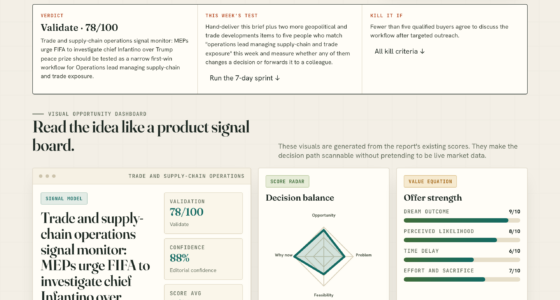

📊 Full opportunity report: Kill-Switch-Proof: How to Build So Washington Can’t Take Your AI Stack Down on ThorstenMeyerAI.com — validation score, market gap, and execution plan.
TL;DR
In June 2026, the US government shut down major AI models, exposing vulnerabilities in reliance on external providers. Experts recommend building kill-switch-proof AI stacks through dependency mapping, abstraction layers, and self-hosted open-weight models.
In June 2026, the US government ordered the shutdown of the most advanced AI models, including Anthropic’s Fable 5 and limited access to OpenAI’s GPT-5.6, revealing a new threat to AI deployment: government-ordered model outages that are unpredictable and unappealable. Experts warn that reliance on external providers can leave organizations vulnerable to shutdowns beyond their control, emphasizing the importance of architectural resilience.
The shutdowns in June were triggered by government directives, with Fable 5 going dark globally within about 90 minutes and GPT-5.6 remaining restricted to select vetted partners. These events demonstrated that model access is no longer solely an operational risk but a political and legal one, especially given export controls that can trigger worldwide outages for foreign or offshore teams.
Industry leaders and security experts advise organizations to adopt a defensive architecture that minimizes dependency on external models. This includes inventorying all dependencies, deploying abstraction layers (gateways) that allow quick model swaps, and maintaining open-weight, self-hosted models that are immune to government restrictions. Such strategies aim to create a resilient AI stack that can withstand political disruptions without catastrophic downtime.
Kill-switch-proof: build so Washington can’t take your AI stack down
In June, the US government switched off the market’s most capable model — twice, in three weeks. You can’t stop the gate. You can decide whether it takes you down. The difference is entirely architectural — and buildable.
You can’t control the gate — Washington will keep deciding which frontier models ship, and both labs are pushing to make review permanent. What you control is your exposure to it. Kill-switch-proofing isn’t predicting the next directive — it’s making the next one a config change instead of an outage, a routing rule that fails over to a model no one can pull while your users notice nothing. The question stops being “will they take my model away?” and becomes the boring one you can answer: “which one do I route to next?”
Implications of Model Outages for AI Deployment Security
This development underscores the increasing geopolitical risks associated with reliance on external AI providers. Organizations that depend on proprietary or cloud-based models risk being shut down without notice, which can disrupt operations, compromise security, and expose sensitive data. Building kill-switch-proof AI architectures offers a way to maintain control and continuity, especially for critical applications in regulated industries or national security contexts.
From Weights to Wisdom: The Complete Guide to Running and Adapting Opensource AI Models
As an affiliate, we earn on qualifying purchases.
As an affiliate, we earn on qualifying purchases.
Recent Events Highlight the Vulnerability of External AI Dependencies
The June 2026 outages marked a turning point, illustrating that government directives can effectively cut off access to vital AI models globally, regardless of where a team is located. Prior to this, provider risk was mainly operational, involving temporary API downtimes. The new threat is a political decision with no SLA or appeal, affecting both US and international teams.
This situation is compounded by export controls, which treat model serving to foreign nationals as a deemed export, leading to shutdowns even for domestic teams with international members. Hardware constraints, such as memory shortages, further emphasize the need for organizations to own and control their infrastructure, reducing reliance on external vendors.
“The recent shutdowns reveal that reliance on external models is a strategic vulnerability, and organizations must architect their AI stacks to be resilient against political disruptions.”
— Thorsten Meyer, AI security expert

AI Prompts for Project Planning and Scheduling: Practical AI Prompts: 252 Prompts to Build Timelines, Manage Dependencies, and Deliver on Time (AI Toolkit for Project Managers Book 8)
As an affiliate, we earn on qualifying purchases.
As an affiliate, we earn on qualifying purchases.
Unclear Aspects of Future Government Interventions
It remains uncertain how widespread or frequent government directives will become, and whether new legal or regulatory frameworks will formalize such shutdown powers. The effectiveness of proposed architectural measures against future outages also needs further validation, and the pace at which organizations adopt these strategies varies widely.
AI model abstraction layer software
As an affiliate, we earn on qualifying purchases.
As an affiliate, we earn on qualifying purchases.
Next Steps for Building Resilient AI Architectures
Organizations are expected to inventory dependencies, implement abstraction gateways, and develop self-hosted open-weight models as standard practices. Industry groups and security agencies may issue guidelines or standards for kill-switch-proof architectures. Monitoring developments in export controls and legal frameworks will be crucial for adapting strategies.

Build & Publish Your Own Web App: A Beginner's Blueprint: From First Idea to a Secure, AI-Powered App Live on Your Own Domain
As an affiliate, we earn on qualifying purchases.
As an affiliate, we earn on qualifying purchases.
Key Questions
What is a kill-switch-proof AI stack?
A kill-switch-proof AI stack is an architecture designed to withstand government or provider shutdowns by minimizing dependencies on external models, using abstraction layers, and maintaining self-hosted, open-weight models.
How can organizations prepare for government-led model shutdowns?
They should inventory all AI dependencies, deploy flexible gateways for quick model swaps, and develop or acquire open-weight models that can be hosted internally, reducing reliance on external providers.
Are open-weight models capable of replacing proprietary models?
While open-weight models have closed much of the performance gap, they are generally considered a resilient fallback rather than daily drivers for complex reasoning tasks. They offer sovereignty and control advantages, especially under restrictive legal environments.
Will future regulations make such shutdowns more common?
It is uncertain, but recent events suggest that governments may increasingly use legal tools to control or restrict AI model access, making architectural resilience an important consideration.
Source: ThorstenMeyerAI.com