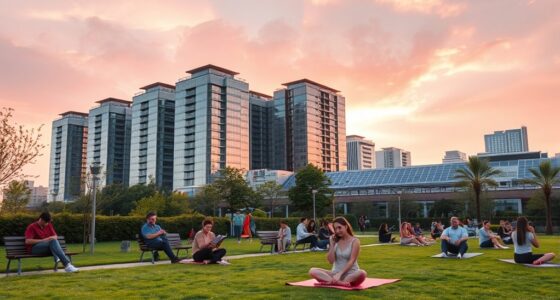

In a post-labor society, you’ll rely on continuous learning to stay adaptable and fulfilled, since traditional careers become less central. You’ll need to develop flexible skills, embrace lifelong education, and view learning as an ongoing journey. Formal schooling isn’t enough anymore; personalized, on-demand learning will be essential. Cultivating curiosity and resilience helps you navigate constant change and stay relevant. If you continue exploring, you’ll discover ways to thrive in this evolving landscape.
Key Takeaways
- Lifelong learning becomes essential as traditional careers fade, enabling individuals to stay relevant and adaptable in a fluid job market.
- Education shifts from a one-time event to continuous, personalized growth pathways supported by digital platforms and on-demand resources.
- Skill adaptability and soft skills like emotional intelligence are crucial for navigating diverse roles and societal changes.
- Formal degrees may hold less significance; ongoing education and self-directed learning are key to personal and professional development.
- Embracing a growth mindset and resilience prepares individuals for economic shifts and new societal roles beyond traditional careers.

As automation and artificial intelligence reshape the workforce, traditional concepts of labor are becoming obsolete, prompting us to rethink how education prepares individuals for the future. In this new landscape, the idea that a single job or career will define your entire life is fading. Instead, you’ll find that lifelong learning becomes essential, and your ability to adapt your skills will determine your success and fulfillment. Education is no longer just about acquiring a set of skills early on; it’s an ongoing process that equips you to navigate constant change. You’ll need to develop a mindset that embraces continuous growth, seeking out new knowledge and competencies throughout your life. This shift means that your learning journey doesn’t end with formal schooling but extends into every stage of your existence.
Skill adaptability is the cornerstone of thriving in a post-labor society. You might think your current skills are sufficient, but the reality is that technology’s rapid evolution can render them obsolete faster than you expect. To stay relevant, you must cultivate a flexible skill set—one that can be easily modified or expanded as new demands emerge. This could mean learning new digital tools, developing soft skills like emotional intelligence, or mastering entirely different disciplines. The key is to stay curious and proactive in updating your skills. Education systems will need to evolve, offering more flexible, personalized learning pathways that encourage experimentation and resilience. You’ll benefit from platforms that allow you to learn on demand, blending online courses, workshops, and real-world experiences.
In this context, your approach to education should be rooted in adaptability. Traditional degrees may no longer guarantee lifelong employment or career stability, so you must see learning as an ongoing investment. Think of it as constantly recharging your mental toolkit, ensuring you’re prepared for whatever the future holds. This approach also means that failure or setbacks won’t be as discouraging because you view them as opportunities to learn and grow. Lifelong learning becomes a way of life, helping you stay competitive, innovative, and fulfilled in a world where work itself may become optional or less central. You’ll find that this mindset not only prepares you for economic shifts but also enriches your personal development, allowing you to pursue passions and interests outside conventional career paths. Recognizing the importance of skill adaptability will be crucial for navigating the evolving job landscape effectively.

HowExpert Guide to Education: The Ultimate Handbook for Lifelong Learning, Effective Teaching, and Educational Success
As an affiliate, we earn on qualifying purchases.
As an affiliate, we earn on qualifying purchases.
Frequently Asked Questions
How Will Income Inequality Impact Access to Education?
Income inequality worsens access to education because wealth disparity creates significant access barriers for many. When wealth is concentrated among the few, fewer resources are available for those with less, making it harder for you to afford quality education or opportunities. This deepens social divides, limiting your chances for upward mobility and perpetuating cycles of inequality. Addressing these barriers requires systemic change to guarantee equitable access regardless of economic background.
What Role Will Technology Play in Future Learning Environments?
Imagine a future where technology is your guiding star. It’ll personalize curricula to fit your unique learning style and needs, making education more relevant and engaging. Virtual classrooms will break down barriers, allowing you to learn anytime, anywhere. You’ll interact with AI tutors and immersive simulations, transforming education from static to dynamic. Technology becomes your personal mentor, empowering you to explore knowledge without limits.
How Can Lifelong Learning Be Effectively Incentivized?
You can stay motivated by implementing effective motivation strategies like personalized goal-setting and regular feedback. Reward systems, such as recognition or tangible incentives, encourage continuous learning. To make lifelong learning appealing, integrate these strategies into daily routines and align them with your personal interests. By actively engaging with meaningful goals and receiving rewards, you’ll find it easier to stay committed and make learning a consistent part of your life.
What Changes Are Needed in Educational Institutions?
You need to push for curriculum reform that emphasizes critical thinking, creativity, and adaptability. Educational institutions must embrace pedagogical innovation, integrating technology and flexible learning formats. You should advocate for personalized learning paths that cater to diverse interests and lifelong learning goals. By fostering an environment that values curiosity and skill development over traditional job training, institutions can better prepare learners for a society where careers are optional and continuous growth is essential.
How Will Cultural Values Influence Post-Labor Education Systems?
Your cultural values will shape post-labor education systems by emphasizing cultural identity and social cohesion. You’ll find that curricula incorporate local traditions and histories, fostering pride and belonging. Education will focus less on job skills and more on community values, encouraging collaboration and understanding. By aligning learning with your cultural identity, you help create a society where social cohesion thrives, making education a tool for unity rather than just economic productivity.

Digital Tools and Platforms for Effective and Personalized Learning
As an affiliate, we earn on qualifying purchases.
As an affiliate, we earn on qualifying purchases.
Conclusion
In a post-labor society, education becomes your foundation, your tool, your path forward. It empowers you to adapt, to innovate, to grow beyond mere survival. It challenges you to learn constantly, to explore endlessly, to reinvent yourself continually. Education is no longer just a means to a job; it’s your gateway to purpose, your source of fulfillment, your key to a future where you create, contribute, and thrive. Embrace learning—because your potential is limitless.

The Hard Truth About Soft Skills: Workplace Lessons Smart People Wish They'd Learned Sooner
As an affiliate, we earn on qualifying purchases.
As an affiliate, we earn on qualifying purchases.

Workbook for BetterCulture's On-Demand MindSet Leadership Program
As an affiliate, we earn on qualifying purchases.
As an affiliate, we earn on qualifying purchases.