
TL;DR

Get business pricing on tech for your team
- Business-only prices and quantity discounts
- Tax-exempt purchasing
- Multiple users, one account, clear invoices
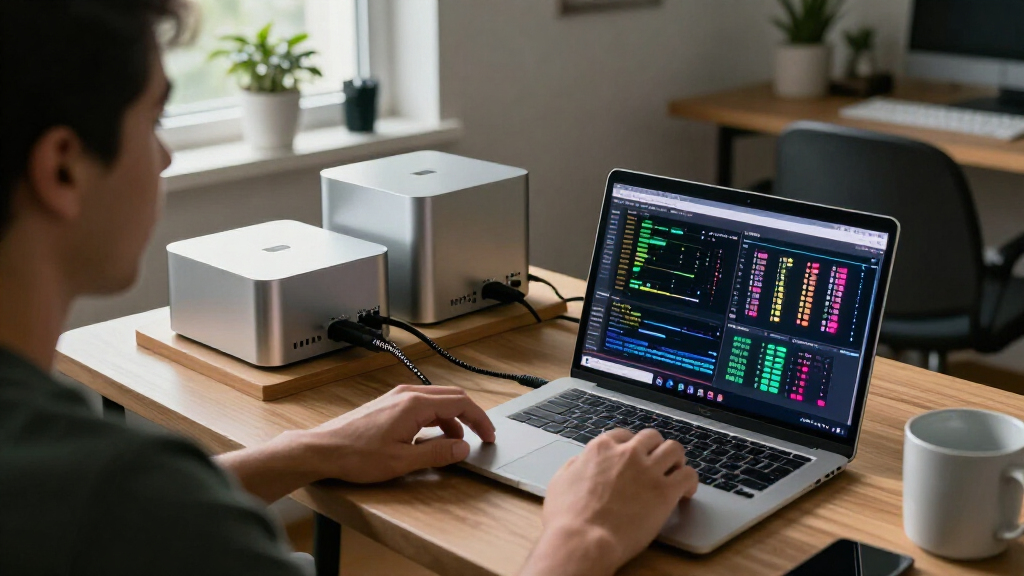
Apple Machine Learning Research has presented Minions, a system for coordinating idle GPUs across Apple silicon Macs to run machine-learning inference tasks. The report says the approach could make existing hardware useful when centralized GPU resources are constrained, but it does not provide public performance benchmarks, deployment scale or cost comparisons.
Apple Machine Learning Research has described Minions, a system that pools idle GPUs in Apple silicon Macs to run machine-learning inference across multiple macOS devices. The report presents the approach as a way for teams to use hardware they already own when centralized GPU resources are costly, constrained or slow to access; it does not establish how broadly Minions is deployed or quantify its performance.
Minions is designed to distribute inference tasks across a changing pool of Mac devices rather than rely on a single centralized GPU cluster. The report says the system supports flexible task execution, fault tolerance and more efficient use of available resources. Its stated use case is large-scale inference, not a general replacement for dedicated data-center infrastructure.
The authors describe a problem familiar to machine-learning teams: demand for GPU-accelerated inference can exceed available centralized capacity, while the cost of buying additional hardware and delays caused by resource constraints can limit access. In parallel, the report says Apple silicon Macs have capable GPUs that are often idle during ordinary use. Minions is intended to connect those two conditions by coordinating spare capacity across devices.
The paper’s summary says the team’s experience indicates that idle macOS devices can form a practical distributed inference platform in environments where centralized GPU resources are constrained. That is the authors’ reported finding. The supplied material gives no numerical results, workload comparisons, utilization figures or direct evidence of cost savings, so readers cannot use it to compare Minions quantitatively with a conventional GPU cluster.
Turning Spare Macs Into Inference Capacity
If the system works reliably at useful scale, Minions could let organizations make more use of Mac hardware already on hand before purchasing additional GPUs or waiting for shared infrastructure. That is relevant to research groups and teams testing inference workloads, particularly where access to centralized computing is limited. The report frames this as a way to improve resource use, not as proof that distributed Macs are cheaper or faster for every task.
Pooling devices also changes the operational question. A central cluster offers a managed pool of compute, while a distributed collection of Macs may vary in availability and capacity as individual machines are used for other work or go offline. Minions’ stated support for fault tolerance addresses part of that challenge, but practical value will depend on how the system schedules work, handles interruptions and performs across different devices and network conditions.
The work is also relevant to organizations with Apple silicon fleets that want to test whether existing machines can support inference workloads. The report does not say that every Mac can participate at all times, that devices are dedicated to Minions, or that the system is available as a public cloud service. Its significance is therefore the described infrastructure model and reported experience, rather than a confirmed commercial offering.
Apple Silicon GPU inference hardware
As an affiliate, we earn on qualifying purchases.
As an affiliate, we earn on qualifying purchases.
Why Apple Silicon Is Involved
The report situates Minions against two developments: demand for inference computing and the presence of Apple silicon Macs in developer and research environments. Apple’s research material also points to MLX, a framework that lets users run and experiment with machine-learning models on Apple silicon. That provides relevant local-computing context, but the supplied information does not specify whether Minions depends on MLX or how it integrates with particular model software.
Unlike a conventional cloud service built from centrally managed accelerators, Minions is described as aggregating GPUs from separate macOS devices. The distinction matters because distributed systems must coordinate machines that may not have identical performance or continuous availability. The authors say Minions addresses execution flexibility and faults, but the available summary does not explain its architecture in enough detail to assess those mechanisms or establish how it compares with other distributed inference systems.
“The system provides flexible GPU inference task execution, fault tolerance, and efficient resource utilization.”
— The Minions report by Jianhua Li, Yun Xing, Girisha De Silva, Ryan Flint, Kai Yuan and Sean Suchter
Mac mini with GPU for machine learning
As an affiliate, we earn on qualifying purchases.
As an affiliate, we earn on qualifying purchases.
Performance And Deployment Details
The supplied report summary does not identify how many devices were tested, what models or workloads were run, or what throughput and latency Minions achieved. It also gives no benchmark against centralized GPUs, no cost analysis and no details about network requirements, security controls, device eligibility or the software’s availability. The publication date is not provided in the material supplied for this article.
It is also unclear how the system handles machines that become busy or disconnect, how much coordination overhead distributed execution adds, and whether tasks can be divided effectively across devices for different models. The authors describe fault tolerance as a system capability, but the summary does not spell out the implementation or the conditions under which it was tested. Those details are needed to judge whether the reported approach is suitable for production use or primarily for constrained research environments.
As an affiliate, we earn on qualifying purchases.
Evidence Needed For Wider Use
The next step for evaluating Minions is access to fuller technical and experimental details: device counts and configurations, workload descriptions, reliability results, and measured latency and throughput. Comparisons with centralized GPU systems would help establish where pooling idle Macs is useful and where it is not. Cost and energy data would also be needed to assess the report’s resource-efficiency rationale.
The supplied material does not announce a product release, public service, rollout schedule or follow-up milestone. Until those details are available, Minions should be understood as a system described in an Apple Machine Learning Research report, with the authors reporting practical experience in settings where centralized GPU resources are constrained.
Apple Silicon Mac for AI inference
As an affiliate, we earn on qualifying purchases.
As an affiliate, we earn on qualifying purchases.
Key Questions
What is Minions?
Minions is a system described by Apple Machine Learning Research that coordinates idle GPUs across Apple silicon Macs to run machine-learning inference workloads.
Does the report show that Minions is faster or cheaper than a GPU cloud?
No such comparison appears in the supplied material. The report discusses cost and capacity constraints as motivations, but provides no numerical benchmark or cost analysis here.
Is Minions available as a public service?
The material does not announce public access, a commercial product or a release schedule. It describes the system and the authors’ experience with it.
What remains unknown about how it works?
The supplied summary does not detail the system’s architecture, device requirements, security controls, network needs, tested scale or handling of interrupted devices. Those details would help determine its fit for production workloads.
Source: hn
Halloween Picks
halloween
As an affiliate, we earn on qualifying purchases.