AI social media management tools can help with planning, content creation, repurposing, and workflow automation, but these nine picks are books and practical guides rather than software platforms. My best overall pick is The AI Social Media Manager for its broad, one-person approach to planning and growth; AI Prompts for Social Media Management stands out for its ready-to-use prompt library, while Effective Use of AI Tools for Social Media Managers is aimed more directly at professional practice. The main tradeoff is between a broad end-to-end system and focused help with prompts, beginner learning, or agency workflows. The guides also vary in how much they center specific platforms and audiences. Read on for the full breakdown and help matching a guide to the way you manage social media.

Get business pricing on tech for your team
- Business-only prices and quantity discounts
- Tax-exempt purchasing
- Multiple users, one account, clear invoices
Key Takeaways
- The AI Social Media Manager earns the lead for covering planning, creation, repurposing, and growth in one guide, making it the broadest fit for a solo operator.
- AI Prompts for Social Media Management is the most direct choice for readers who want a large library of starting points rather than a general introduction to AI.
- Effective Use of AI Tools for Social Media Managers has a narrower professional audience than the beginner-oriented titles, which may suit working managers better.
- Several books focus on content creators, but their platform and workflow emphasis differs; readers should match the guide to their actual channels before choosing.
- The agency-focused title and the social-media-agent guide address specialized needs, while broader marketing guides may be a better first step for readers new to AI.




| AI social media management tool | Format |
|---|---|
| The AI Social Media Manager: O | Guide |
| Best AI Tools for Content Crea | Guide |
| AI-Powered Digital and Social | Beginner’s guide |
| AI Tools for Content Creators: | Practical blueprint |
| AI Prompts for Social Media Ma | Guide |
| Effective Use of AI Tools for | — |
| Social Media AI Agents for Beg | Book |
| How to Automate Content With A | — |
| AI-Powered Social Media Market | — |
More Details on Our Top Picks
The AI Social Media Manager: One-Person System for Planning, Creating, Repurposing, and Growing Your Social Media with AI
The AI Social Media Manager stands out for treating social media as a repeatable solo workflow, from calendar planning and post creation to repurposing and growth. That scope makes it a better fit for someone managing several tasks alone than AI Prompts for Social Media Management, which is described as a prompt collection rather than a full planning system. The emphasis on using AI to save content-production time may help readers who need a process, not just more post ideas. Its tradeoff is that the guide may assume readers already know their way around AI platforms; complete beginners may find AI-Powered Digital and Social Media Marketing more approachable based on its stated beginner audience. The available details do not identify specific platforms or tools, so buyers seeking platform-by-platform instructions should check the book’s contents before choosing.
Pros:- Step-by-step framework for managing social media alone
- Connects planning, creation, repurposing, and growth in one workflow
- Uses AI to reduce the effort involved in content creation
Cons:- May assume basic familiarity with AI platforms
- Provided information does not name supported platforms or specific tools
Best for: Solo creators or small-business owners who handle planning, writing, repurposing, and growth without a dedicated social media team
Not ideal for: AI newcomers who need foundational platform instruction, or marketers seeking confirmed guidance for a specific social network
- Format:Guide
- Primary topic:AI-assisted social media management
- Intended audience:Individuals managing their own social media
- Planning coverage:Content calendars
- Creation coverage:AI-assisted post creation
- Repurposing coverage:Repurposing existing material
- Growth coverage:Social media growth
Our verdict“Choose this guide if you want an end-to-end AI-assisted social workflow built around one-person management.”
Best AI Tools for Content Creators (2026 Edition): Grow Faster on YouTube, Instagram, and Social Media Using ChatGPT and AI Tools
Best AI Tools for Content Creators (2026 Edition) is the clearest match here for creators choosing AI with YouTube and Instagram in mind, while also covering social media more broadly. Its creator-growth framing differs from The AI Social Media Manager, which describes a fuller solo-management workflow spanning calendars, repurposing, and growth. The title names ChatGPT and other AI tools, but the available information does not say which tools, workflows, or platform tactics the guide explains. That makes it harder to judge how actionable or current its advice will be, even with a 2026 edition label. I’d treat it as a potentially useful platform-oriented starting point rather than a confirmed step-by-step management system; buyers who want clearly stated beginner instruction may prefer AI-Powered Digital and Social Media Marketing.
Pros:- Explicitly focuses on AI tools for content creators
- Names YouTube and Instagram alongside broader social media
- Identifies ChatGPT as part of its subject matter
Cons:- Available details do not describe the book’s contents or format
- Specific tools, workflows, and platform instructions are not confirmed
Best for: Creators building audiences across YouTube and Instagram who want a guide focused on ChatGPT and other AI tools
Not ideal for: Buyers who need a verified workflow, detailed chapter coverage, or clear evidence of beginner-level instruction before choosing
- Format:Guide
- Edition:2026 Edition
- Primary audience:Content creators
- Named AI tool:ChatGPT
- Other tools:Other AI tools; not specified
- Named platform:YouTube
- Named platform:Instagram
- Stated goal:Grow faster on social media
Our verdict“Consider this guide for its YouTube-and-Instagram creator focus, but verify its contents if you need a defined workflow.”
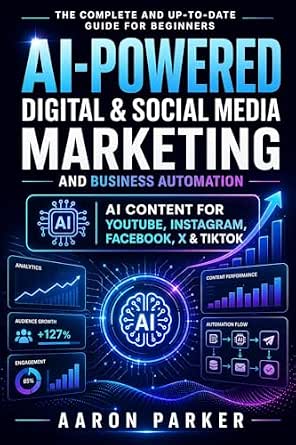
AI-Powered Digital and Social Media Marketing earns its beginner-focused role by pairing content creation with business automation and naming five platforms: YouTube, Instagram, Facebook, X, and TikTok. That breadth gives new marketers a wider starting point than AI Prompts for Social Media Management, whose listed scope is prompts rather than platform coverage. It also differs from The AI Social Media Manager, which centers on a one-person end-to-end routine. Here, the stated angle reaches beyond social posting into digital marketing and automation, which may suit readers connecting content with broader business tasks. The tradeoff is limited detail about the actual methods and no supplied examples or chapter information. Beginners can see who the guide targets and which networks it names, but cannot confirm how much depth it gives each one.
Pros:- Explicitly aimed at beginners
- Names YouTube, Instagram, Facebook, X, and TikTok
- Covers content creation alongside business automation
Cons:- Available information does not describe specific methods or examples
- The scope spans digital marketing and automation, so depth on social management is unclear
Best for: New marketers or small-business owners who want an introductory AI guide spanning content creation, automation, and several major social platforms
Not ideal for: Experienced social media managers seeking documented advanced tactics or detailed platform-specific workflows
- Format:Beginner’s guide
- Topic:AI-powered digital and social media marketing
- Audience:Beginners
- Content coverage:Content creation
- Automation coverage:Business automation
- Platform:YouTube
- Platform:Instagram
- Platform:Facebook, X, and TikTok
Our verdict“Pick this as a broad entry point if you are new to AI marketing and want several platforms covered in one guide.”
AI Tools for Content Creators: A Practical Blueprint to Automate Your Workflow and Scale Your Digital Brand
AI Tools for Content Creators is positioned around a specific outcome: using AI to automate content workflows and scale a digital brand. That makes it a distinct option beside The AI Social Media Manager, which lays out a broader social-management path from planning through growth, and Best AI Tools for Content Creators (2026 Edition), which names YouTube and Instagram but gives no confirmed workflow detail. The word “practical” and the blueprint framing suggest an applied approach, yet the available product information does not specify tools, platforms, or the steps included. Buyers should not assume it covers scheduling or analytics just because it addresses workflow automation. Its appeal is the focused creator-and-brand angle; its limitation is how little detail is available to verify the promised practicality.
Pros:- Focuses on practical AI workflows for content creators
- Addresses workflow automation directly
- Connects content operations with digital brand growth
Cons:- Available details do not identify tools or supported platforms
- The specific workflows and degree of hands-on instruction are not described
Best for: Content creators with an existing digital brand who want AI workflow automation as a path to scaling production
Not ideal for: Beginners who need confirmed platform guidance, or social media managers seeking clearly specified scheduling and analytics coverage
- Format:Practical blueprint
- Primary audience:Content creators
- Subject:AI tools for content creation
- Workflow focus:Workflow automation
- Stated goal:Scale a digital brand
- Named platforms:Not specified
- Named tools:Not specified
Our verdict“Choose this if workflow automation and brand growth are your priorities, provided the limited product details meet your needs.”
AI Prompts for Social Media Management: 500 Ready-to-Use Prompts
AI Prompts for Social Media Management offers a focused resource: 500 ready-to-use prompts for social media tasks. That makes it a different kind of purchase from The AI Social Media Manager, which describes an end-to-end system for planning, creating, repurposing, and growing a presence. A prompt collection may help a manager get from a blank page to a starting draft, but the available information does not explain how prompts are organized, which platforms they address, or whether they cover strategy and scheduling as well as writing. That uncertainty matters if you expect a complete management method. Compared with AI Tools for Content Creators, this title is more explicitly social-management focused, but it offers less stated guidance on workflow automation or brand growth.
Pros:- Includes 500 ready-to-use prompts
- Focuses specifically on social media management
- Can serve as a prompt resource alongside an existing workflow
Cons:- Available information does not describe prompt categories or examples
- The guide’s format and platform coverage are not specified
- A prompt collection alone may not provide a full planning or management system
Best for: Social media managers and creators who already use AI tools and want a large set of prompts to support recurring content tasks
Not ideal for: Readers seeking a complete management framework, platform-specific instructions, or confirmed guidance on automation and scheduling
- Format:Guide
- Primary topic:Social media management prompts
- Prompt count:500
- Prompt status:Ready to use
- Intended use:AI-assisted social media management
- Platform coverage:Not specified
- Prompt categories:Not specified
Our verdict“Choose this for a prompt-focused supplement to an existing social workflow, not as a substitute for a complete management guide.”
Effective Use of AI Tools for Social Media Managers
Effective Use of AI Tools for Social Media Managers is the most workflow-oriented choice in this group: its stated focus spans content creation, engagement, and strategy automation rather than a single platform or business goal. That breadth may help social media managers map where AI could reduce repetitive work, while Social Media AI Agents for Beginners is more narrowly aimed at newcomers generating posts and growing an audience. The tradeoff is that the available product information gives no format, chapter outline, or specific tools, so I can’t judge how actionable or current its guidance is. It may suit readers seeking a broad management framework, but buyers who want named platform workflows should compare it with AI-Powered Social Media Marketing, which explicitly covers Instagram, TikTok, and Facebook.
Pros:- Addresses content creation as a way to streamline social media work
- Includes engagement as part of its stated focus
- Covers strategy automation, giving the topic broader scope than a post-generation-only guide
Cons:- The available data does not specify format or publication details
- No named tools, platforms, or concrete workflows are provided in the product information
- The breadth of its stated scope makes its depth difficult to judge
Best for: Social media managers seeking broad guidance on applying AI to content creation, engagement, and strategy workflows.
Not ideal for: Readers who need confirmed format details, named software recommendations, or platform-specific step-by-step instructions.
- ASIN:B0FCCZLHSS
- Title:Effective Use of AI Tools for Social Media Managers
- Stated subject:Using AI tools for social media management
- Content focus:Streamlining social media content creation
- Engagement focus:Improving social media engagement
- Automation focus:Automating social media strategies
Our verdict“Choose this guide for broad AI workflow coverage, but favor a platform-specific book if you need defined instructions for particular channels.”
Social Media AI Agents for Beginners: Automate AI Agents to Generate Engaging Content and Grow Your Audience
Social Media AI Agents for Beginners has the clearest entry-level focus among these picks: it introduces AI agents through two practical aims, generating social posts and growing an audience. That makes it a more approachable starting point than How to Automate Content With AI, Attract High-Paying Clients, Deliver Viral Social Media Campaigns, which is tailored to agency owners and client acquisition. The tradeoff is a narrower promise: the supplied details do not identify specific platforms, tools, or agent-building steps, so readers cannot tell how much hands-on instruction the book contains. Its listed Book format is useful when choosing a learning resource, but experienced managers who already have a content system may get more relevant business workflows from the agency-focused title.
Pros:- Explicitly targets beginners rather than assuming prior AI-agent experience
- Connects AI-agent use to social media content creation
- Includes audience growth as a stated goal
- Identifies the product format as a book
Cons:- The available description does not name platforms or AI-agent tools
- Specific instructions and workflow depth are not established by the supplied details
- Its beginner focus may not meet the needs of experienced practitioners
Best for: New creators or small-business social media operators who want an introductory guide to AI agents for post creation and audience growth.
Not ideal for: Experienced social media managers seeking advanced automation instructions, named platforms, or agency client-acquisition systems.
- ASIN:B0F94D16PH
- Format:Book
- Audience:Beginners
- Primary topic:AI agents for social media
- Content focus:Generating engaging social media content
- Growth focus:Growing an audience
Our verdict“Pick this book if you are new to AI agents and want a social-content starting point, not an advanced or agency-specific playbook.”
How to Automate Content With AI, Attract High-Paying Clients, Deliver Viral Social Media Campaigns (Agency Business Series Book 1)
How to Automate Content With AI is the most commercially focused option here. Its stated combination of AI-assisted production, client acquisition, and campaign delivery is aimed at agency owners who need social media workflows to support both service delivery and business growth. The description also promises step-by-step implementation and case studies, giving it a more applied agency angle than Effective Use of AI Tools for Social Media Managers, whose supplied details describe broader management themes without specifying examples. That specialization is also the main limitation: the book may not fit a solo creator or beginner who needs foundational instruction before selling services. Its claims around viral campaigns and high-paying clients describe its focus, not a guaranteed outcome; the available data does not identify platforms or the tools covered.
Pros:- Frames AI content production around agency workflows
- Addresses attracting clients as well as delivering campaigns
- The description promises step-by-step implementation guidance
- Includes case studies of social media campaigns, according to the supplied product information
Cons:- Its agency-business emphasis may be too specialized for beginners
- The supplied information does not name specific platforms or AI tools
- Campaign virality and client outcomes are goals, not assured results
Best for: Agency owners and social media consultants who want to connect AI content workflows with client acquisition and campaign delivery.
Not ideal for: New creators without agency experience, or readers seeking a platform-by-platform tutorial with named tools.
- ASIN:B0GXL4VQ1Y
- Series:Agency Business Series
- Series position:Book 1
- Primary audience:Agency owners
- Content focus:AI-assisted content production
- Business focus:Client acquisition and agency growth
- Campaign focus:Social media campaign delivery
- Described learning elements:Step-by-step guidance and campaign case studies
Our verdict“Choose this agency-focused guide if you want AI content workflows tied to client growth; skip it for a general beginner introduction.”
AI-Powered Social Media Marketing: Step-by-Step Prompts and Workflows to Grow on Instagram, TikTok, and Facebook Without Burning Out
AI-Powered Social Media Marketing is the clearest fit for creators managing several major channels: its stated scope names Instagram, TikTok, and Facebook, and it pairs prompts with workflows rather than focusing only on AI concepts. That gives it a more concrete platform remit than Social Media AI Agents for Beginners, whose supplied description emphasizes content generation and audience growth without naming channels. The burnout-reduction angle also speaks to creators who need repeatable systems, though the available information does not explain how the workflows differ across platforms or what tools they require. Readers looking for agency sales guidance may be better served by How to Automate Content With AI; this title is oriented toward sustainable social publishing and audience growth instead.
Pros:- Names Instagram, TikTok, and Facebook as covered platforms
- Combines step-by-step prompts with workflows
- Pairs audience growth with a focus on reducing burnout
- Targets practical social media marketing rather than AI theory alone
Cons:- The supplied details do not identify the AI tools required
- The depth of guidance for each platform is not specified
- It is less tailored to agency client acquisition than the agency-focused title
Best for: Creators and small teams publishing on Instagram, TikTok, and Facebook who want prompt-led workflows to support audience growth and reduce repetitive work.
Not ideal for: Agency owners prioritizing client acquisition, or readers who need confirmed tool lists and detailed platform-specific workflow examples before choosing.
- ASIN:B0FQWG3DF5
- Primary topic:AI-powered social media marketing
- Platforms covered:Instagram, TikTok, and Facebook
- Instruction style:Step-by-step prompts and workflows
- Growth focus:Growing a social media audience
- Workflow goal:Reducing burnout
Our verdict“Choose this guide for prompt-and-workflow coverage across three named platforms, especially if reducing repetitive publishing work is a priority.”

How We Picked
I compared these nine titles as learning resources for AI-assisted social media management, not as software products. The ranking reflects how clearly each book aligns with the search intent, the breadth or usefulness of its stated workflow, the specificity of its audience, and how directly its subject can help a reader act. I gave more weight to guides that connect multiple parts of social media work than to titles centered on one narrow technique, while recognizing that a focused prompt collection can be a stronger fit for a reader with a specific need.
I also considered approachability, platform focus, and specialization. Beginner guides can lower the learning barrier, but may not meet the needs of experienced managers; agency and AI-agent titles can offer a distinct angle but have a smaller audience. Since the supplied titles do not establish details such as exact platform integrations, publication updates, or the depth of each workflow, I avoid treating them as verified software capabilities. The order favors the closest overall match first, then directs readers toward more specific goals and experience levels.
| AI social media management tool | Format |
|---|---|
| The AI Social Media Manager: O | Guide |
| Best AI Tools for Content Crea | Guide |
| AI-Powered Digital and Social | Beginner’s guide |
| AI Tools for Content Creators: | Practical blueprint |
| AI Prompts for Social Media Ma | Guide |
| Effective Use of AI Tools for | — |
| Social Media AI Agents for Beg | Book |
| How to Automate Content With A | — |
| AI-Powered Social Media Market | — |
Factors to Consider When Choosing AI Social Media Management Tools
Because this roundup covers books and guides rather than subscription software, choose based on the kind of help you need to apply. A useful guide should fit your role, current workflow, and preferred level of instruction—not just promise faster content.
Match the guide to your role
A solo creator often needs help connecting ideas, publishing plans, and repurposing, while an agency may care more about campaign delivery and client workflows. A social media manager may already know the basics and want sharper ways to use AI in an existing process. Avoid choosing a title only because it mentions growth or automation; those terms can cover very different jobs. Write down the tasks that take the most time, then favor a guide whose stated focus maps to those tasks. This prevents paying attention to a broad overview when you really need a practical resource for one recurring bottleneck.
Choose the right level of instruction
Beginner titles can explain concepts and reduce setup confusion, but they may spend less time on the refinements an experienced marketer wants. Prompt collections can be quick to use, yet a list of prompts is less helpful if you do not know how to judge or adapt the output. Before choosing, ask whether you need a foundation, reusable examples, or a more advanced workflow perspective. A common mistake is to pick the most tactical-sounding guide without checking whether it explains how to evaluate results. The best fit is the one that meets your current skill level while leaving room to build better judgment.
Check platform fit before committing
Platform-specific advice can be useful when most of your work happens on a small set of channels, but it may age or transfer poorly as your mix changes. A guide naming Instagram, TikTok, Facebook, or YouTube is not automatically equally useful for every platform; content formats and audience expectations differ. Decide whether you want channel-specific examples or principles that can travel across networks. If your business relies on a less-covered platform, check the material’s stated scope before treating it as a complete playbook. This tradeoff matters especially for creators who publish the same idea in several formats.
Separate prompts from a repeatable workflow
Prompts can speed up drafting, but a dependable process also needs inputs, review, editing, and a decision about what gets published. A large prompt bank is most useful when you already know your brand voice and can spot generic or inaccurate output. If you need help joining research, drafting, repurposing, and planning, favor a guide framed around a broader system. Do not assume that more automation means less oversight; published content still reflects on your brand. Treat AI as a production aid, then keep human review for accuracy, tone, and audience fit.
Decide how specialized your use case is
An agency operator, a beginner exploring AI agents, and an individual creator may all want automation but need different safeguards and workflows. Specialized guides can be more relevant when their audience matches yours, though their advice may not transfer to a general social media role. A broad guide offers flexibility but may give less detail on a specific business model. Compare the title’s promised audience with your actual responsibilities, including whether you manage client approvals or publish only for yourself. Choose specialization when it solves a real constraint, not simply because the niche sounds more advanced.
Look for durable judgment, not just current tactics
AI tools and platform features change quickly, so a guide built around sound editorial habits can remain useful longer than one tied to a single workflow. Look for guidance that helps you set goals, review generated content, and learn from performance rather than only produce more posts. The title alone cannot confirm how recently a book was updated or how deeply it handles changing tools, so check publication details and sample pages where available. A common buying error is treating a dated prompt or tool reference as a complete operating method. Favor principles you can adapt when a platform or AI product changes.
Frequently Asked Questions
Are these AI social media management tools software platforms?
No. The nine items in this roundup are books and guides about AI-assisted social media work, not scheduling or publishing applications. They can help you learn approaches to planning, prompts, content, or automation, but they do not replace a platform that connects to your social accounts. If you need direct publishing, analytics, or team approval features, evaluate software separately. Choose a guide here for learning and workflow ideas, not for account integrations.
Which title makes the most sense if I manage all my own social media?
The AI Social Media Manager is the clearest starting point for a solo operator because its stated scope spans planning, creation, repurposing, and growth. That wider focus may be more useful than a prompt-only resource if you are still building a repeatable routine. If you already have a system and mainly need drafting prompts, the prompt collection may better address that specific gap. Consider which stage consumes your time before choosing between a broad system and a narrow aid. Neither title should be treated as a substitute for checking the quality of AI-generated posts.
Should I choose a prompt book or a broader AI workflow guide?
Choose a prompt book when you know the task you want help with and can adapt generated output to your brand. A broader workflow guide is a better fit when you need to connect ideation, drafting, repurposing, and planning rather than solve one isolated task. Prompt collections can save setup time, but they do not automatically explain how to check accuracy or measure whether a post worked. A workflow guide may take longer to apply but can help shape a repeatable process. Your current bottleneck—not the number of prompts—is the better basis for the decision.
Which guide is more appropriate for an agency or client-facing social media manager?
How to Automate Content With AI, Attract High-Paying Clients, Deliver Viral Social Media Campaigns is the most explicitly agency-oriented title in this group. Effective Use of AI Tools for Social Media Managers may fit a working manager looking for a role-centered perspective without choosing a guide framed around agency growth. Client work adds approval, voice, and accuracy requirements, so check whether the material addresses those needs before relying on it. Do not equate automation advice with a complete client-service process. Pick based on whether your priority is agency business development or day-to-day social media management.
How can I tell whether a book about AI social media advice is still useful?
Check its publication or edition details and see whether its advice is tied to specific tools or focused on broader methods. Tool interfaces and platform features can change, while practices such as defining a brand voice, reviewing claims, and adapting content by channel tend to travel better. Look at available sample pages to judge whether the material explains decisions or only supplies steps and prompts. If your workflow depends on a newly released feature, verify that the guide discusses it before buying. Treat any tool-specific instruction as something to confirm against the current product.
Conclusion
Best overall: I recommend The AI Social Media Manager for solo operators who want one guide spanning planning, creation, repurposing, and growth. Best value for a focused need: choose AI Prompts for Social Media Management if you already understand your workflow and want prompt ideas to adapt. Best for beginners: start with AI-Powered Digital and Social Media Marketing or Social Media AI Agents for Beginners, depending on whether you want a broad introduction or an agent-centered topic. Best for working managers: consider Effective Use of AI Tools for Social Media Managers; best for agency-specific needs: choose the Agency Business Series title. I would treat the creator-focused books as narrower alternatives when their workflow or channel emphasis matches your work, rather than assuming one guide serves every social media role.
Halloween Picks

Pumpkin Halloween Fog Machine with 12-Color LED Lights, Bluetooth Speaker, and Remote

Kalolary 11 ft Halloween Inflatable Archway Ghost House Tunnel

Govee Outdoor Halloween Projector Light with 3D Effects
As an affiliate, we earn on qualifying purchases.